
-
Your next favorite book
is waiting.
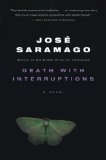
 Book Reviewed by:
"The following day, no one died," begins Death with Interruptions, and
the rest of the novel scrambles to catch up to this extraordinary new reality.
Before the first deathless day is out, the cardinal calls the prime minister to
upbraid him for celebrating the body's new immortality. The end of death means,
after all, the end of the Church, "since this was clearly the only agricultural
implement god possessed with which to plough the roads that would lead to his
kingdom." What will the state do if death does not return, asks the
cardinal. What will the Church do, asks the prime minister in kind. The cardinal
answers smoothly, "The church has never been asked to explain anything, our
specialty, along with ballistics, has always been the neutralization of the
overly curious mind through faith." Death's disappearance reveals the
struts propping up the everyday world.
Saramago's unnamed nation becomes a self-contained wonderland in which the new
rules must be discovered by testing them. The citizens learn that death is only
suspended for humans, and so undertakers revive their comatose businesses with
elaborate pet funerals. The citizens further discover that death operates
normally outside of the nation's boundaries, and so the mafia handsomely profits
by secretly transporting elderly relatives across the political border just long
enough for them to cross the spiritual border, an unsanctioned kind of
euthanasia for families with means. The evaporation of death is, for this droll
novel, a fall into pure narrative. Death with Interruptions charges into
the story but remains hovering over the nation in a birds-eye view, delivering a
fast-paced plot with virtually no individualized characters or sense of place.
It is a fable, and in the absence of humanistic characters, we are left with the
persona of the storyteller to entertain us. The narrator is a disembodied
presence who simply cannot refrain from breaking into the story with formal
circumlocutions that do nothing so much as announce his or her existence.
Consider this passage:
"It may be that a very genteel upbringing, of the kind that is becoming increasingly rare, along, perhaps, with the almost superstitious respect that the written word can instill into certain timid souls, has prevented readers, although they are more than justified in showing signs of ill-contained impatience, from interrupting this long digression and demanding to be told what death has been up to since the fateful night when she announced her return."
Death's return, I will not dally in telling you, occurs in the form of a letter whose style the narrator describes in terms that are clearly, wryly meant to be self-referential:
"…the chaotic syntax, the absence of full stops, the complete lack of very necessary parentheses, the obsessive elimination of paragraphs, the random use of commas and, most unforgivable sin of all, the intentional and almost diabolical abolition of the capital letter, which, can you imagine, is even omitted from the actual signature of the letter and replaced by a lower-case d."
If you can tolerate sentences that go on for pages, the effect is charming.
It reads as a precise blend of Gabriel Garcia Márquez and David Foster Wallace.
If the narrator is ambiguous, death, when she finally arrives in the novel, is
fully realized right down to the toe bones that clack on the floor as she walks.
When she decides to restart mortality, she adds a new provision: now, everyone
will get seven days' notice of their own death, time enough to settle their
affairs and say their final goodbyes. It is here that the panoramic vision of
the novel starts to seem odd, as if the single most fascinating thing about
Saramago's surreal time and place were its administrative details. The narrator
too enthusiastically describes death's filing system and the way it
automatically updates itself with each detail of each mortal life. "And it
shouldn't astonish us in the least if, at the very moment we were reading our
own personal file, we saw instantaneously recorded there the sudden pang of
anxiety that froze us." The panorama has turned into a panopticon*.
And so the novel sags in the middle when the narrator can do nothing but narrate
death alone in her magical office. This section embarrassingly culminates in a
conversation between death and her scythe. But when one of death's notices comes
back to her unopened and the man for whom it was intended does not die on the
date marked in his file, the plot restarts, this time with two characters in the
throes of life. Death sheathes herself in a body and visits the undead man, and
the conversations between the two of them are utterly riveting. Again and again,
death surprises herself with what she is willing to do for this man who has a
power of which he cannot conceive. By the time the narrator has finished with
her, death has brought the novel around to yet another fabulous terrain. The
ending casts the first sentence in an entirely different light, and I closed the
book in triumph and delight.
 This review was originally published in November 2008, and has been updated for the
September 2009 paperback release.
Click here to go to this issue.
This review was originally published in November 2008, and has been updated for the
September 2009 paperback release.
Click here to go to this issue.
Saramago's characterization of death departs from convention in several ways—not least in her
insistence in remaining lower case: "I am not Death, but death. Death is
something of which you could never even conceive, and please note, mister
grammarian, that I did not conclude that phrase with a preposition, you human
beings only know the small everyday death that is me, the death which, even in
the very worst disasters, is incapable of preventing life from continuing, one
day you will find out about Death with a capital D, and at that moment, you will
understand the real difference between the relative and the absolute, between
full and empty, between still alive and no longer alive…."
Much Western painting depicts death as a female angel, but contemporary film and
literature typically characterize death as the Grim Reaper, a male figure of
wordless dread. Until now, the personification of death has been largely
confined to genre fiction, such as Piers Anthony's Incarnations of
Immortality series and
Terry
Pratchett's Discworld novels
(though one could argue that the Judge in Cormac McCarthy's Blood Meridian
strides the earth as Thanatos incarnate). Saramago's portrait is the second of
two recent highbrow representations of death. The first was Markus Zusak's 2006
young-adult novel,
The Book Thief, the story of a young girl
growing up in Germany during WWII which is quite sympathetically narrated by
Death.
And then there is W. Somerset Maugham's story, also narrated by Death, which
appears as an epigraph to John O'Hara's 1934 novel, Appointment in Samarra:
"Death speaks: ‘There was a merchant in Baghdad who sent his servant to market to buy provisions and in a little while the servant came back, white and trembling, and said, Master, just now when I was in the market-place I was jostled by a woman in the crowd and when I turned I saw it was Death that jostled me. She looked at me and made a threatening gesture; now, lend me your horse, and I will ride away from this city and avoid my fate. I will go to Samarra and there Death will not find me. The merchant lent him his horse, and the servant mounted it, and he dug his spurs in its flanks and as fast as the horse could gallop he went. Then the merchant went down to the market-place and he saw me standing in the crowd and he came to me and said, Why did you make a threatening gesture to my servant when you saw him this morning? That was not a threatening gesture, I said, it was only a start of surprise. I was astonished to see him in Baghdad, for I had an appointment with him tonight in Samarra.'"
This review was originally published in November 2008, and has been updated for the
September 2009 paperback release.
Click here to go to this issue.
Your guide toexceptional books
BookBrowse seeks out and recommends the best in contemporary fiction and nonfiction—books that not only engage and entertain but also deepen our understanding of ourselves and the world around us.
