
-
Your next favorite book
is waiting.
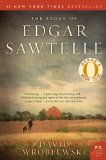
A Novel
by David Wroblewski Book Reviewed by:
The Story of Edgar Sawtelle is a long, eventful, and
whisper-quiet book. The story envelopes you so completely and so gently that you
can almost hear the brush of Edgar's sleeves as he signs to his parents.
David Wroblewski hit on a brilliant narrative device when he decided to rob his
main character of his voice. Edgar can hear and understand but not speak—just
like his dogs. Bringing Edgar down to the level of his dogs shows just how
elevated they are as a species. The book gathers speed by building scene upon
scene of subtly amazing communication between boy and dog. In one instance,
Edgar and Almondine conspire to be secretive. Edgar painstakingly discerns where
to step on each floorboard of the creaky staircase in the old farmhouse so that
he can descend without making a sound, and he teaches her the path, picking up
and placing her paws on each quiet spot. In another instance, Edgar and
Almondine conspire to shout. Edgar, desperate to prevent his uncle Claude from
shooting a stray dog in the woods, signs for Almondine to come to him, then stay
and speak. She begins to bay, the stray dog bolts at the sound, and Claude loses
his aim.
These moments are possible because the dogs that Edgar and his parents breed are
extraordinarily responsive and keen, the product of generations of cultivation.
But not one of the Sawtelle dogs is purebred; the Sawtelles breed for
intelligence only. Edgar's father keeps meticulous breeding records in order to
discern "the story of the dog—what a dog meant." Sawtelle
dogs are distinguishable by a certain knowingness in their eyes, a certain
heightened ability to perceive and understand their humans. Edgar's parents have
a near-religious faith in the possibilities of animal training. "From the moment
they opened their eyes the dogs were taught to watch and listen and trust. To
think and choose. This was the lesson behind every minute of training. They were
taught something beyond simple obedience: that through the training all things
could be spoken." In other words, the Sawtelles teach their dogs a
language. With each new litter, Edgar combs through the dictionary to name the
pups, coming up with lovely nouns like Finch, Umbra, and Tinder. But their
communication does not, ultimately travel through words. They connect by
gesture, by look, by pure animal intuition. Training serves to "draw up the ties
between them…as though shaping the world from scratch." Ultimately, Edgar
seeks to transcend the need to command his dogs, wanting only to ask them for
their graceful actions and have them fully consent rather then obey.
As a shaggy dog tale, it doesn't get much better. The dogs practically luminesce
in the gorgeous, precise prose with which Wroblewski conjures them. He is
equally good at describing the dogs' physical characteristics ("He was moving in
a strangely light-footed way for such a solidly constructed dog, lifting and
dropping his paws as if suspended by invisible strings and merely paddling along
for steering.") and their inner lives ("For she was not without her own
selfish desires: to hold things motionless, to measure herself against them and
find herself present, to know that she was alive precisely because he needn't
acknowledge her in casual passing; that utter constancy might prevail if she
attended the world so carefully.").
But as the book jacket hints, The Story of Edgar Sawtelle is really two
stories superimposed upon one another. The slow-moving chronicle of Edgar's
boyhood among the dogs and his education in dog training gives way to a
fast-paced, deeply melodramatic, magical realist, murder mystery when his father
dies unexpectedly and his uncle woos his mother. This is a strange pairing
indeed: Lassie meets Hamlet, complete with the dead father's
return as a ghost. I'm not sure what made Wrobewksi think that he could retell
one of the English language's most canonical pieces of literature as a dog
story, but it works. It works because Wroblewski believes so unfailingly in his
own story and plunges into it with the unquestioning eagerness of one of his own
canine characters.
But as a shaggy dog tale, it could have used a quick grooming. Edgar almost
never feels like a child, just as the setting never really feels like the 1950s.
Wroblewski trades specificity for suggestiveness so often that his story blurs
at the edges, like the soft-focus painting on the book cover. There are several
plot points—Edgar's fascination with the unexplained Starchild Colony in Canada,
a voluble ghost in a taciturn man's shed—that never go anywhere. But these burrs
are easily overlooked, because there is nothing as pleasurable as starting out
the summer with a big, fat book, and The Story of Edgar Sawtelle
justifies its own length and heft.
Dog lovers will take to this book like, well, like a retriever to water (beware,
though, that you may come away feeling badly about treating your own dog like a
pet rather than a glowingly, steadfastly sentient being). Yet the book also
transcends its subject matter, and anyone who loves a good yarn, one that
confidently soars well past the borders of believability, will take to it as
well—and might even find themselves with the urge to head down to their local
animal shelter.
 This review was originally published in June 2008, and has been updated for the
October 2009 paperback release.
Click here to go to this issue.
This review was originally published in June 2008, and has been updated for the
October 2009 paperback release.
Click here to go to this issue.
Edgar Sawtelle would not have much to say—or sign—to the Dog Whisperer. Cesar Millan, the star of "The Dog Whisperer" on the National Geographic Channel, is known for his "pack-oriented" philosophy, which traces canine behavior back to their survival instinct for living in highly organized packs led by a single, strong leader. As Millan's website states, "[I]n order to properly fulfill both our dogs and ourselves, we each need to become our canine's calm-assertive pack leader." And so Millan teaches dog owners to exert dominance over their dogs—a practice found in many dog behavior books. His work has drawn criticism from other trainers who believe that countering canine aggression with human aggression is a dangerous tactic.
By contrast, the Sawtelles view their dogs as equals. In one achingly beautiful
scene, Edgar's mother Trudy teaches Edgar how to train his dog Finch. She asks
Edgar to command Finch to jump a short barrier. Edgar stands on the other side
of the barrier and signals a recall. When Finch walks around the barrier to
Edgar, Trudy scolds her son, not the dog. Edgar did not properly communicate to
Finch what he wanted. Trudy points out that in this exchange, Finch was the
teacher, because he taught Edgar what his own words meant. Training in the
Sawtelle barn happens via positive reinforcement for successful obedience, leash
corrections for slight mistakes, and an enormous amount of patience and mutual
respect.
 In
the novel, Edgar's father corresponds with a researcher at Fortunate Fields, a
kennel in Sweden, about the feasibility of crossing dogs of unknown provenance
in order to capture their genes for intelligence. Fortunate Fields was an actual
place, the brainchild of USA-born
Dorothy Leib Harrison Wood Eustis. Eustis bred German shepherds for
intelligence and loyalty and put them to work with the Swiss Army. In 1927,
Eustis learned of a German school that trained dogs as guides for blind
veterans. She wrote an article about the school for the Saturday Evening Post,
and the article prompted an inquiry from an American blind man named
Morris Frank. He traveled to Fortunate Fields and came home with a German
Shepherd named Buddy. The pair received so much publicity in the United States
that in 1929, Eustis returned to Tennessee to open the nation's first training
school for guide dogs. The organization, called
The Seeing Eye, still
exists today, breeding and training shepherds, labs, and retrievers to work with
people with disabilities.
In
the novel, Edgar's father corresponds with a researcher at Fortunate Fields, a
kennel in Sweden, about the feasibility of crossing dogs of unknown provenance
in order to capture their genes for intelligence. Fortunate Fields was an actual
place, the brainchild of USA-born
Dorothy Leib Harrison Wood Eustis. Eustis bred German shepherds for
intelligence and loyalty and put them to work with the Swiss Army. In 1927,
Eustis learned of a German school that trained dogs as guides for blind
veterans. She wrote an article about the school for the Saturday Evening Post,
and the article prompted an inquiry from an American blind man named
Morris Frank. He traveled to Fortunate Fields and came home with a German
Shepherd named Buddy. The pair received so much publicity in the United States
that in 1929, Eustis returned to Tennessee to open the nation's first training
school for guide dogs. The organization, called
The Seeing Eye, still
exists today, breeding and training shepherds, labs, and retrievers to work with
people with disabilities.
 In
the Saturday Evening Post, Eustis describes how a Seeing Eye dog guides
and responds to his owner, what might be seen as the most perfect instance of
human-canine interaction:
In
the Saturday Evening Post, Eustis describes how a Seeing Eye dog guides
and responds to his owner, what might be seen as the most perfect instance of
human-canine interaction:
"He must go at a fast walk so that the slackening in his gait for an obstacle is
instantly felt through the rigid handle of his harness. For curbs he pulls back
and stands still so that his master can find the edge with his cane; for steps,
approaching traffic and all obstacles barring progress, he sits down; and for
trees, letter boxes, scaffoldings, pedestrians, he leans away from his man, who
follows the pull and so is led safely around. He learns the direction commands
of right, left and forward, and to pick up anything his master drops. He is
taught to protect his master from violence and this instinct develops in bounds
after he finally wins through to his own blind master. He must be ever watchful
and protective, but never aggressive, and it is that quality of perfect balance
in instruction that is the success at Potsdam."
Incidentally, Hill's Pet Nutrition also has its roots in Buddy and Morris Frank's story: Back in 1939 Morris Frank asked Dr. Mark Morris, Sr., a strong believer in using carefully formulated nutrition to manage diseases in pets, whether he could do anything to save Buddy, then about 12 years old and suffering from kidney failure. In his kitchen, Dr. Morris devised the first Hill's Prescription Diet product, founding the company shortly thereafter. As for Buddy, apparently he survived and thrived.
Photos: Dorothy Leib Harrison Wood Eustis & Morris Frank with Buddy.
This review was originally published in June 2008, and has been updated for the
October 2009 paperback release.
Click here to go to this issue.
Your guide toexceptional books
BookBrowse seeks out and recommends the best in contemporary fiction and nonfiction—books that not only engage and entertain but also deepen our understanding of ourselves and the world around us.
