
-
Your next favorite book
is waiting.
Summary | Excerpt | Reviews | Beyond the Book | Readalikes | Genres & Themes | Author Bio
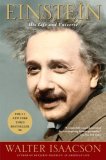
His Life and Universe
by Walter Isaacson Book Reviewed by:
At a time when there is a new emphasis, in the face of global competition, on science and math education, we should also note the other part of Einstein's answer. "Critical comments by students should be taken in a friendly spirit," he said. "Accumulation of material should not stifle the student's independence." A society's competitive advantage will come not from how well its schools teach the multiplication and periodic tables, but from how well they stimulate imagination and creativity.
Therein lies the key, I think, to Einstein's brilliance and the lessons of his life. As a young student he never did well with rote learning. And later, as a theorist, his success came not from the brute strength of his mental processing power but from his imagination and creativity. He could construct complex equations, but more important, he knew that math is the language nature uses to describe her wonders. So he could visualize how equations were reflected in realities -- how the electromagnetic field equations discovered by James Clerk Maxwell, for example, would manifest themselves to a boy riding alongside a light beam. As he once declared, "Imagination is more important than knowledge."
That approach required him to embrace nonconformity. "Long live impudence!" he exulted to the lover who would later become his wife. "It is my guardian angel in this world." Many years later, when others thought that his reluctance to embrace quantum mechanics showed that he had lost his edge, he lamented, "To punish me for my contempt for authority, fate made me an authority myself."
His success came from questioning conventional wisdom, challenging authority, and marveling at mysteries that struck others as mundane. This led him to embrace a morality and politics based on respect for free minds, free spirits, and free individuals. Tyranny repulsed him, and he saw tolerance not simply as a sweet virtue but as a necessary condition for a creative society. "It is important to foster individuality," he said, "for only the individual can produce the new ideas."
This outlook made Einstein a rebel with a reverence for the harmony of nature, one who had just the right blend of imagination and wisdom to transform our understanding of the universe. These traits are just as vital for this new century of globalization, in which our success will depend on our creativity, as they were for the beginning of the twentieth century, when Einstein helped usher in the modern age.
Copyright © 2007 by Walter Isaacson




When all think alike, no one thinks very much
Click Here to find out who said this, as well as discovering other famous literary quotes!

Can you name the title?
Test your book knowledge with our daily trivia challenge!
Your guide toexceptional books
BookBrowse seeks out and recommends the best in contemporary fiction and nonfiction—books that not only engage and entertain but also deepen our understanding of ourselves and the world around us.

