
-
Your next favorite book
is waiting.
Summary | Excerpt | Reviews | Beyond the Book | Readalikes | Genres & Themes | Author Bio
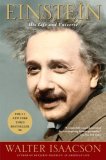
His Life and Universe
by Walter Isaacson Book Reviewed by:
Einstein's life and work reflected the disruption of societal certainties and moral absolutes in the modernist atmosphere of the early twentieth century. Imaginative nonconformity was in the air: Picasso, Joyce, Freud, Stravinsky, Schoenberg, and others were breaking conventional bonds. Charging this atmosphere was a conception of the universe in which space and time and the properties of particles seemed based on the vagaries of observations.
Einstein, however, was not truly a relativist, even though that is how he was interpreted by many, including some whose disdain was tinged by anti-Semitism. Beneath all of his theories, including relativity, was a quest for invariants, certainties, and absolutes. There was a harmonious reality underlying the laws of the universe, Einstein felt, and the goal of science was to discover it.
His quest began in 1895, when as a 16-year-old he imagined what it would be like to ride alongside a light beam. A decade later came his miracle year, described in the letter above, which laid the foundations for the two great advances of twentieth-century physics: relativity and quantum theory.
A decade after that, in 1915, he wrested from nature his crowning glory, one of the most beautiful theories in all of science, the general theory of relativity. As with the special theory, his thinking had evolved through thought experiments. Imagine being in an enclosed elevator accelerating up through space, he conjectured in one of them. The effects you'd feel would be indistinguishable from the experience of gravity.
Gravity, he figured, was a warping of space and time, and he came up with the equations that describe how the dynamics of this curvature result from the interplay between matter, motion, and energy. It can be described by using another thought experiment. Picture what it would be like to roll a bowling ball onto the two-dimensional surface of a trampoline. Then roll some billiard balls. They move toward the bowling ball not because it exerts some mysterious attraction but because of the way it curves the trampoline fabric. Now imagine this happening in the four-dimensional fabric of space and time. Okay, it's not easy, but that's why we're no Einstein and he was.
The exact midpoint of his career came a decade after that, in 1925, and it was a turning point. The quantum revolution he had helped to launch was being transformed into a new mechanics that was based on uncertainties and probabilities. He made his last great contributions to quantum mechanics that year but, simultaneously, began to resist it. He would spend the next three decades, ending with some equations scribbled while on his deathbed in 1955, stubbornly criticizing what he regarded as the incompleteness of quantum mechanics while attempting to subsume it into a unified field theory.
Both during his thirty years as a revolutionary and his subsequent thirty years as a resister, Einstein remained consistent in his willingness to be a serenely amused loner who was comfortable not conforming. Independent in his thinking, he was driven by an imagination that broke from the confines of conventional wisdom. He was that odd breed, a reverential rebel, and he was guided by a faith, which he wore lightly and with a twinkle in his eye, in a God who would not play dice by allowing things to happen by chance.
Einstein's nonconformist streak was evident in his personality and politics as well. Although he subscribed to socialist ideals, he was too much of an individualist to be comfortable with excessive state control or centralized authority. His impudent instincts, which served him so well as a young scientist, made him allergic to nationalism, militarism, and anything that smacked of a herd mentality. And until Hitler caused him to revise his geopolitical equations, he was an instinctive pacifist who celebrated resistance to war.
His tale encompasses the vast sweep of modern science, from the infinitesimal to the infinite, from the emission of photons to the expansion of the cosmos. A century after his great triumphs, we are still living in Einstein's universe, one defined on the macro scale by his theory of relativity and on the micro scale by a quantum mechanics that has proven durable even as it remains disconcerting.
Copyright © 2007 by Walter Isaacson







In order to become the master, the politician poses as the servant
Click Here to find out who said this, as well as discovering other famous literary quotes!

Can you name the title?
Test your book knowledge with our daily trivia challenge!
Your guide toexceptional books
BookBrowse seeks out and recommends the best in contemporary fiction and nonfiction—books that not only engage and entertain but also deepen our understanding of ourselves and the world around us.


