
-
Your next favorite book
is waiting.
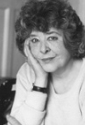
Diana Wynne Jones discusses her childhood, during which she was deprived of almost all books by her father - which caused her to start writing her own - despite the ridicule of her parents and her own battles with dyslexia.
When did you decide to be a writer?
I decided to be a writer at the age of eight, but I did not receive any
encouragement in this ambition until thirty years later. I think this ambition
was fired - or perhaps exacerbated is a better word - by early marginal contacts
with the Great, when we were evacuated to the English Lakes during the war. The
house we were in had belonged to Ruskin's secretary and had also been the home
of the children in the books of Arthur Ransome. One day, finding I had no paper
to draw on, I stole from the attic a stack of exquisite flower-drawings, almost
certainly by Ruskin himself, and proceeded to rub them out. I was punished for
this.
Soon after, we children offended Arthur Ransome by making a noise on
the shore beside his houseboat. He complained. So likewise did Beatrix Potter,
who lived nearby. It struck me then that the Great were remarkably touchy and
unpleasant (even if, in Ruskin's case, it was posthumous), and I thought I would
like to be the same, without the unpleasantness.
When did you start writing?
I started writing children's books when we moved to a village in Essex
where there were almost no books. The main activities there were hand-weaving,
hand-making pottery, and singing madrigals, for none of which I had either taste
or talent. So, in intervals between trying to haunt the church and sitting on
roofs hoping to learn to fly, I wrote enormous epic adventure stories which I
read to my sisters instead of the real books we did not have. This writing was
stopped, though, when it was decided I must be coached to go to University. A
local philosopher was engaged to teach me Greek and philosophy in exchange for a
dollhouse (my family never did things normally), and I eventually got a place at
Oxford.
At this stage, despite attending lectures by J. R. R. Tolkien and C. S.
Lewis, I did not expect to be writing fantasy. But that was what I started to
write when I was married and had children of my own.
You say you did not expect to write fantasy. What do you think was the
motivation?
I started writing fantasy, rather to my surprise, when my children were old
enough to start reading books for themselves. What they preferred was fantasy,
but there wasn't much in those days that was any good. When they had read
Kipling, Lewis, the Oz books, and Joan Aikin, they looked round for more, and my
eldest son said wistfully that what he really liked was books that made him
laugh. There were even fewer of those.
So I tried it myself. But as soon as I had got started, I realized that
what I was writing were the kind of books that I was never allowed as a child.
Here in my mind was a picture of the ideal book, which was magical and exciting,
and humorous too. I have been trying to write that book ever since.
Where do you write?
I write in the living room in the most comfortable chair there. It is
the only way I can concentrate on a story."
Which of your books is your favorite?
None of my books is my favorite. Each one was an individual joy to
write. For instance, Charmed Life came into my head all at once and complete,
and I couldn't write it down fast enough. That was amazing. Hexwood was truly
difficult, and just doing it was its own reward. In Archer's Goon I had no idea
what was going to happen next and I couldn't wait to find out. A Tale of Time
City was so exciting that I was on the edge of my comfortable seat. And Fire and
Hemlock was like a book I was reading and couldn't put down.
Where do your ideas come from?
My ideas come from all sorts of sources. Stories come to me in all
possible ways - sometimes I know the story first, sometimes I just have a
feeling in my head that says, 'Book. Now.'
One book started with my favorite road, chalky white and winding over
blue distance. My dog gave me the idea for Dogsbody. Some just started from the
characters in them, who were hanging around in my head demanding a book that
fitted them, and still others from a tiny word or phrase, like 'Hope is an
anchor' or 'Let's get weaving.'
One at least began because I was so fed up with the way other writers
handled a subject; and one began because Susan, my editor at Greenwillow, wanted
more, more, more about griffins. The Magicians of Caprona was odder than most,
because I heard a piece of music and thought, 'That ought to have words,' and
the story came into my head as I thought it.
You have written for both children and adults. Which do you prefer, and what
do you see as the differences between the two styles?
Writing for adults, you have to keep reminding them of what is going
on. The poor things have given up using their brains when they read. Children
you only need to tell things to once.
What authors have influenced you? And how do you feel when you are cited as
an influence on other writers?
What authors have influenced me? The very few fantasy writers I came
across as a child: Kipling, Elizabeth Goudge, P.L. Travers. These were augmented
by books in tiny print filched from my parents' shelves: Malory's Morte D'Arthur
and one called Epics and Romances of the Middle Ages, together with a lot of
fairy stories (the Brothers Grimm in a learned edition and other queer
collections) and a book of stories from The Arabian Nights. I did not meet the
usual books people read until my children were of an age to need them. It was
like discovering treasure.
If I am cited as an influence on others, I am always very surprised and pleased
- and just a bit exasperated, thinking, Why can't they think of things
themselves, the way I had to?
If you weren't a writer, what would you be?
If I were not a writer, I would be a very miserable person.
Unless otherwise stated, this interview was conducted at the time the book was first published, and is reproduced with permission of the publisher. This interview may not be reproduced or reprinted without permission in writing from the copyright holder.


Kate J. Armstrong has always had a fondness for adventure. After graduating college, she left her home state of Virginia and has never really looked back. She's explored many places and vocations, working as a high school ... (more)
If you enjoyed:
Howl's Moving Castle
Try:
Nightbirds
by Kate J. Armstrong
Susanna Clarke's debut novel Jonathan Strange & Mr Norrell was first published in more than 34 countries and was longlisted for the Man Booker Prize and shortlisted for the Whitbread First Novel Award and the Guardian First ... (more)
If you enjoyed:
Howl's Moving Castle
Try:
Piranesi
by Susanna Clarke
We recommend 11 similar authors
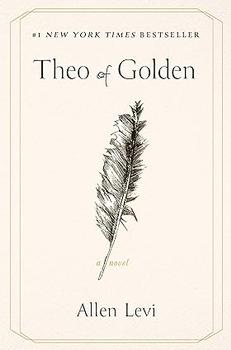
Theo of Golden by Allen Levi
One spring morning, a stranger arrives in the small southern city of Golden. No one knows where he has come from…or why…






Your guide toexceptional books
BookBrowse seeks out and recommends the best in contemporary fiction and nonfiction—books that not only engage and entertain but also deepen our understanding of ourselves and the world around us.

