
-
Your next favorite book
is waiting.

How to pronounce Neil Gaiman: kneel gay-mn
In a not to be missed essay, Neil Gaiman talks about where his ideas come from, the differences between writers and other people, and much more. In a separate interview he talks about American Gods.
Every profession has its pitfalls. Doctors, for example, are always being asked
for free medical advice, lawyers are asked for legal information, morticians are
told how interesting a profession that must be and then people change the
subject fast. And writers are asked where we get our ideas from.
In the beginning, I used to tell people the not very funny answers, the flip
ones: 'From the Idea-of-the-Month Club,' I'd say, or 'From a little ideas shop
in Bognor Regis,' 'From a dusty old book full of ideas in my basement,' or even
'From Pete Atkins.' (The last is slightly esoteric, and may need a little
explanation. Pete Atkins is a screenwriter and novelist friend of mine, and we
decided a while ago that when asked, I would say that I got them from him, and
he'd say he got them from me. It seemed to make sense at the time.)
Then I got tired of the not very funny answers, and these days I tell people the
truth:
'I make them up,' I tell them. 'Out of my head.'
People don't like this answer. I don't know why not. They look unhappy, as if
I'm trying to slip a fast one past them. As if there's a huge secret, and, for
reasons of my own, I'm not telling them how it's done.
And of course I'm not. Firstly, I don't know myself where the ideas really come
from, what makes them come, or whether one day they'll stop. Secondly, I doubt
anyone who asks really wants a three hour lecture on the creative process. And
thirdly, the ideas aren't that important. Really they aren't. Everyone's got an
idea for a book, a movie, a story, a TV series.
Every published writer has had it - the people who come up to you and tell you
that they've Got An Idea. And boy, is it a Doozy. It's such a Doozy that they
want to Cut You In On It. The proposal is always the same - they'll tell you the
Idea (the hard bit), you write it down and turn it into a novel (the easy bit),
the two of you can split the money fifty-fifty.
I'm reasonably gracious with these people. I tell them, truly, that I have far
too many ideas for things as it is, and far too little time. And I wish them the
best of luck.
The Ideas aren't the hard bit. They're a small component of the whole. Creating
believable people who do more or less what you tell them to is much harder. And
hardest by far is the process of simply sitting down and putting one word after
another to construct whatever it is you're trying to build: making it
interesting, making it new.
But still, it's the question people want to know. In my case, they also want to
know if I get them from my dreams. (Answer: no. Dream logic isn't story logic.
Transcribe a dream, and you'll see. Or better yet, tell someone an important
dream - 'Well, I was in this house that was also my old school, and there was
this nurse and she was really an old witch and then she went away but there was
a leaf and I couldn't look at it and I knew if I touched it then something
dreadful would happen...' - and watch their eyes glaze over.) And I don't give
straight answers. Until recently.
My daughter Holly, who is seven years of age, persuaded me to come in to give a
talk to her class. Her teacher was really enthusiastic ('The children have all
been making their own books recently, so perhaps you could come along and tell
them about being a professional writer. And lots of little stories. They like
the stories.') and in I came.
They sat on the floor, I had a chair, fifty seven-year-old-eyes gazed up at me.
'When I was your age, people told me not to make things up,' I told them. 'These
days, they give me money for it.' For twenty minutes I talked, then they asked
questions.
And eventually one of them asked it.
'Where do you get your ideas?'
And I realized I owed them an answer. They weren't old enough to know any
better. And it's a perfectly reasonable question, if you aren't asked it weekly.
This is what I told them:
You get ideas from daydreaming. You get ideas from being bored. You get ideas
all the time. The only difference between writers and other people is we notice
when we're doing it.
You get ideas when you ask yourself simple questions. The most important of the
questions is just, What if...?
(What if you woke up with wings? What if your sister turned into a mouse? What
if you all found out that your teacher was planning to eat one of you at the end
of term - but you didn't know who?)
Another important question is, If only...
(If only real life was like it is in Hollywood musicals. it only I could shrink
myself small as a button. If only a ghost would do my homework.)
And then there are the others: I wonder... ('I wonder what she does when she's
alone...')' and If This Goes On... ('If this goes on telephones are going to
start talking to each other, and cut out the middleman.,.') and Wouldn't it be
interesting if... ('Wouldn't it be interesting if the world used to be ruled by
cats?')...
Those questions, and others like them, and the questions they, in their turn,
pose ('Well, if cats used to rule the world, why don't they any more? And how do
they feel about that?') are one of the places ideas come from.
An idea doesn't have to be a plot notion, just a place to begin creating. Plots
often generate themselves when one begins to ask oneself questions about
whatever the starting paint is.
Sometimes an idea is a person (There's a boy who wants to know about magic').
Sometimes it's a place (There's a castle at the end of time, which is the only
place there is...'). Sometimes it's an image ('A woman, sifting in a dark room
filled with empty faces.')
Often ideas come from two things coming together that haven't come together
before. ('If a person bitten by a werewolf turns into a wolf what would happen
it a goldfish was bitten a werewolf? What would happen if a chair was bitten by
a werewolf?')
All fiction is a process of imagining: whatever you write, in whatever genre or
medium, your task is to make things up convincingly and interestingly, and new.
And when you've an idea - which is, after all, merely something to hold onto as
you begin - what then?
Well, then you write. You put one word after another until its finished -
whatever it is.
Sometimes it won't work, or not in the way you first imagined. Sometimes it
doesn't work at all. Sometimes you throw it out and start again.
I remember, some years ago, coming up with a perfect idea for a Sandman story.
It was about a succubus, who gave writers and artists and songwriters ideas, in
exchange for some of their lives. I called it Sex and Violets.
It seemed a straightforward story, and it was only when I came to write it I
discovered it was like trying to hold fine sand: every time I thought I'd got
hold of it, it would trickle through my fingers and vanish.
I wrote at the time:
I've started this story twice, now, and got about half-way through it each time,
only to watch it die on the screen.
Sandman is, occasionally a horror comic. But nothing I've written for it has
ever gotten under my skin like this story I'm now going to have to wind up
abandoning (with the deadline already a thing of the past). Probably because it
cuts so close to home. It's the ideas - and the ability to put them down on
paper, and turn them into stories, - that make me a writer. That mean I don't
have to get up early in the morning and sit on a train with people I don't know,
going to a job I despise.
My idea of hell is a blank sheet of paper. Or a blank screen. And me, staring at
it, unable to think of a single thing worth saying, a single character that
people could believe in, a single story that hasn't been told before.
Staring at a blank sheet of paper.
Forever.
I wrote my way out of it, though. I got desperate (that's another flip and true
answer I give to the where-do-you-get-your-ideas question. 'Desperation.' It's
up there with 'Boredom' and 'Deadlines'. All these answers are true to a point,)
and took my own terror, and the core idea, and crafted a story called Calliope,
which explains, I think pretty definitively, where writers get their ideas from.
It's in a book called Dream Country. You can read it if you like. And, somewhere
in the writing of that story, I stopped being scared of the ideas going away.
Where do I get my ideas from?
I make them up.
Out of my head.
Neil Gaiman Discusses American Gods
American Gods envisions a world in which the old gods co-exist with
the ordinary citizens of the world. What attracted you to this idea?
Mostly, how easily it allowed me to talk about the history and the
mythography of part of America. If I'd tried to tell the story as more
"mainstream" fiction I would have had to take much longer to tell a
story over generations.
In Norse mythology, Odin undergoes the trial of nine days hanging on an
ash tree. Why did you decide to have Shadow, rather than Wednesday, obtain
mystical insight through mortification of the flesh?
Wednesday had already hung from his tree. Now it was Shadow's turn.
Throughout American Gods, you intersperse short, disparate
narratives with the primary story of Shadow's odyssey. Why are these smaller
stories integral to the novel as a whole?
Well, mostly they allow me to broaden the scope of the story. I wanted to
show people coming to America, and bringing their gods with them, and abandoning
them, over and over and over...
Shadow reveals the seemingly benign figure of Hinzelmann as a monster, and
the ostensibly frightening figure of Czernobog as affectionate and gentle. What
is the attraction for you of characters who are the opposite of what they seem?
I've never known anyone who was what he or she seemed; or at least, was only
what he or she seemed. People carry worlds within them.
Many of your readers are familiar with Greek and Roman gods but ignorant
of Norse gods. Was it your hope that American Gods might encourage a
renewed interest in Norse mythology?
Not really. It was more that we are so familiar with the Greco-Roman gods,
and it was harder to come up with ways that they could have come to the United
States (although as I finished the book several fringe archaeological
discoveries gave me ways I could have done it); and that the Norse myths are so
bleak, and always end in Ragnarok ...
In your acknowledgments, you allude to the best line of dialogue in the
epilogue, but you don't identify it. Can you let your readers in on the secret?
Well, it was my favorite line, and I stole it from Gene Wolfe, in a short
story where he has St. Nicholas explaining his relationship to Santa Claus.
"He is me, but I am not him." It seemed to encapsulate the
relationship between my Odins very well ...
Unless otherwise stated, this interview was conducted at the time the book was first published, and is reproduced with permission of the publisher. This interview may not be reproduced or reprinted without permission in writing from the copyright holder.
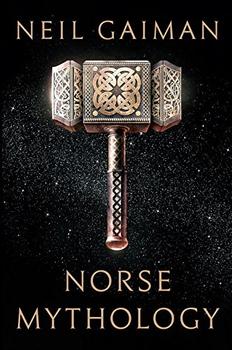

Peter Abrahams is the best-selling author of A Perfect Crime, The Tutor, The Fan, and Lights Out, for which he received an Edgar® Award nomination; and Down The Rabbit Hole, a novel for children. He lives in Falmouth, ... (more)
If you enjoyed:
Coraline
Try:
Down The Rabbit Hole
by Peter Abrahams

David Almond, in his own words:
I was born in Newcastle and I grew up in a big Catholic family in
Felling-on-Tyne. I had four sisters and a brother and lots of relatives in the
streets nearby. My dad had been in Burma ...
(more)
If you enjoyed:
The Ocean at the End of the Lane
Try:
The True Tale of the Monster Billy Dean
by David Almond
We recommend 50 similar authors
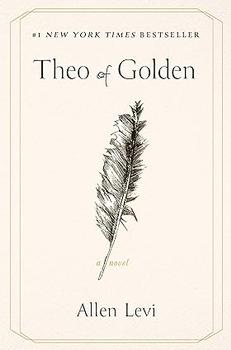
Theo of Golden by Allen Levi
One spring morning, a stranger arrives in the small southern city of Golden. No one knows where he has come from…or why…






Your guide toexceptional books
BookBrowse seeks out and recommends the best in contemporary fiction and nonfiction—books that not only engage and entertain but also deepen our understanding of ourselves and the world around us.

