
-
Your next favorite book
is waiting.

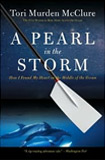
Tori McClure talks about rowing across the Atlantic Ocean, a story she records in Pearl in the Storm.
It's been almost ten years since you rowed across the ocean. Why did it take you so long to write about it?
There are many answers to this question:
It took me that long to dry out.
I had to get over being sea sick.
I've walked to the tops of mountains. I've skied 750-miles across a frozen continent. I've rowed 3,333-miles across an ocean. What would give anyone the impression that I am addicted to speed? Is there some prize in life for finishing first.
If a person can spend almost three months alone in a rowboat, it's a pretty safe bet that she's an introvert. My success has come as a scholar and an athlete. Aristotle taught us to live by the "golden mean." Most of the time I lead the relatively quiet life of a mild mannered university administrator, nothing in excess. About once a decade, I abandon Aristotle and follow the "uber" path of Nietzsche. I abandon the stability of a balanced life and I go after one thing with all my being. At the end of the 1980's, I skied to the South Pole. At the end of the 1990's, I rowed across an ocean. This decade I decided to write one book. The endeavor has been far more demanding than skiing or rowing. As with other "uber" endeavors, if I do it, well the introvert will be dragged beyond her comfort zone.
I'm not an adventurer. I'm an explorer. Exploration simply takes longer. Adventurers climb mountains so they can come home and brag about it. They write fast books full of testosterone and gorilla dust. Generally, these books tell us how great they are. I could not write such a book; I am not any better than the next person. I am a seeker after truth, and I am rarely so wrong as when I think I have found it. I wanted to row across the ocean because I knew I would learn something that I did not know. Other people can learn the very same things without ever leaving home; I seem inclined to go the hard way toward knowledge.
I think it took a long time because the standard "hero's journey" formula didn't fit me. Joseph Campbell wrote about the hero having a thousand faces but those faces are almost entirely male. I'm not a man. "I came. I saw. I conquered." For a woman to write such things is "theologically evil, biologically unnatural, psychologically unhealthy, and socially in bad taste." In the spring of 2000, I wrote my "fast" book. Genetically barred from chest-pounding, I wrote hundreds of pages about a boat rowing itself across an ocean. It was bad, and my agent told me so. I entered an MFA Program and wrote several other bad books. Slowly, a not-so-bad book emerged.
How big was your boat?
It was twenty-three feet long, four feet high, and six feet wide. It weighed about 1800 pounds.
It was a few feet longer and a bit narrower than a full size pickup truck and about half the weight.
In the ocean, it bobbed up and down like a cork.
It was small enough to submarine when a wave broke over the top.
It was about one-third the size of a sperm whale, and twice the size of a good size shark.
Cruise ships have bumpers bigger than the American Pearl.
The day before my arrival several small planes, with photographers, came out looking for me. They had my latitude and longitude. I could see them; they never saw me.
My racing shell is twenty-six feet long, ten inches wide and weighs about thirty pounds. It looks like a giant toothpick. The American Pearl is twenty-three feet long, six feet wide, four feet high and weighs sixty times more than my racing single. It looks like a tricked-out lifeboat. The only similarity between my racing single and the American Pearl is that both boats have sliding seats. When I row, most of the power is generated by my legs.
My ocean boat has a "cabin" that is a little larger than a double wide coffin (when I talk to school children I call it a big dog house). The rowing deck on the American Pearl is about the size of the bed of a pickup truck and there is a small storage compartment in the bow. In my racing boat I have room for a life vest, a sponge, and a water bottle. Aboard the American Pearl, I had room for food for one hundred days, repair equipment, a desalination system, navigational tools, communications equipment, sea anchors, lines, clothing, books, and two buckets. One bucket was for the laundry and the other served as the plumbing system. The plumbing system was bucket-and-chuck-it.
What did you find on the row that you were not expecting?
After a few months of the packages floating in salt water, you shouldn't eat the cracked M&Ms.
Squid can fly.
I was surprised by how much I missed people. In civilization, there are days when I'm not even sure I like people, but on the ocean I missed human contact.
I was surprised how quickly my emotions could turn from euphoric to desperate, from sublime to outrageous, from blissful to barbaric. With a tailwind, I was a saint. With a headwind, I was madness itself.
Yelling at the wind is like throwing water at the ocean.
What were the differences for you between the first row and the second row?
I padded the ceiling on the second row. I had not expected to spend so much time on the ceiling during my first row.
One my first trip I lost communications eight days from the start. I went for seventy-eight days with no communication with anyone on land. The second trip, I had four redundant communication systems. In many ways, I was lonelier on the second trip. I would talk to people at home. I'd hear the news of the day. Someone was going out for a walk. Someone was going out to dinner. When the communication ended, I was alone in a rowboat in the middle of the ocean. I couldn't go out for a walk and no one was coming to dinner.
The second trip I was in love. When I left on the second row, I really thought that I would get over my silly romantic crush on Mac McClure. I was wrong. I missed Mac terribly, and I couldn't wait to get home.
Why would anyone want to row by themselves across the Atlantic Ocean?
My backcountry endeavors began as a way to recharge the batteries after demanding urban endeavors had run me ragged. It was a way to outrun a deep-seated sense of helplessness. I thought that if I could just become a little stronger, a little faster, a little smarter, I could protect the people who needed my protection. I could stop bad things from happening to the people about whom I cared. If I can climb this mountain, I will no longer feel helpless. If I can ski across this continent, I will no longer feel helpless. If I can row across this ocean, I will no longer feel helpless. What I didn't understand was that rowing across the ocean would not make me any less human. To be human is to be flawed. To be human is to experience moments of doubt and moments of helplessness. The only thing that makes our humanity bearable is love. Like I said, most people don't have to row across and ocean to figure this out.
You had to be rescued on your first attempt. How did you feel about that?
Hurricane Danielle arrived before dawn on September 5, 1998. After the fifth or six capsize of the day, I decided to go on deck to get my distress beacon. When I went out into the full fury of the storm, I realized that I could not ask another human being to come out and rescue me. I tied the distress beacon to my life vest and I went through six more capsizes that day without setting off my beacon. The next day I bailed out the boat. On September 7, another hurricane, Hurricane Earl, passed well North of my position but it triggered a number of rogue waves that capsized the American Pearl four more times. In all, I'd capsized fifteen times during these storms. Two of the capsizes were end-over-end pitch-poles. Each capsize hit with the force of a car crash. One capsize dislocated my shoulder, the next capsize put it back into place. The morning of September 7, I looked out. The winds had calmed the seas were diminishing, I decided that it was safe enough to ask for help. That afternoon a passing container ship, the Independent Spirit, threw a cargo ladder over the side and I climbed up. It was not a dramatic rescue. September 7 was a lovely day. That night, a Force 10 gale hit the Independent Spirit and cracked quarter inch steel deck plates on the ship. I left at the right time.
I returned home feeling like a failure. Not long after that, I took a job working for Muhammad Ali. Muhammad understood what it feels like to get knock on one's backside. He saw past my brave facade. He seemed to know exactly what I was going through. He reminded me that a failure is not a person who falls: a failure is a person who does not get back up again. Muhammad Ali was the person who convinced me that I didn't want to go through life as the woman who almost rowed across the ocean.
Unless otherwise stated, this interview was conducted at the time the book was first published, and is reproduced with permission of the publisher. This interview may not be reproduced or reprinted without permission in writing from the copyright holder.

Liv (pronounced 'leave') Arnesen's rich life experiences, both on and off the ice, have made her an internationally recognized leader and role model for women and girls. A self-proclaimed "keen" but not ... (more)
If you enjoyed:
A Pearl in the Storm
Try:
No Horizon Is So Far
by Liv Arnesen

John Balzar is Senior Vice President, Communications, of the Humane Society of the United States. He joined the executive staff in 2007 after a 33-year career as a journalist, writer, and adventurer.
His opinion columns ...
(more)
If you enjoyed:
A Pearl in the Storm
Try:
Yukon Alone
by John Balzar
We recommend 10 similar authors

Theo of Golden by Allen Levi
One spring morning, a stranger arrives in the small southern city of Golden. No one knows where he has come from…or why…






Your guide toexceptional books
BookBrowse seeks out and recommends the best in contemporary fiction and nonfiction—books that not only engage and entertain but also deepen our understanding of ourselves and the world around us.

