
-
Your next favorite book
is waiting.

How to pronounce Lauren Groff: "Groff" rhymes with "off."
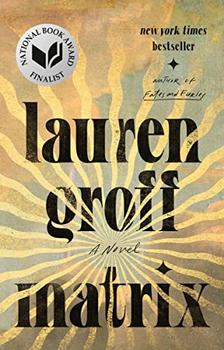
Lauren Groff's discusses her acclaimed first novel, The Monsters of Templeton and her 2021 novel, Matrix.
A Conversation with Lauren Groff about Matrix
Your first novel since Fates and Furies takes a dramatic shift from your usual contemporary settings. How did you land on this particular setting? Where did the idea first come to you?
I had a fellowship at the Radcliffe Institute for Advanced Study when I heard Dr. Katie Bugyis give a speech on medieval nuns' liturgical notes. I had thought, going in, that it perhaps wasn't something I would be interested in, but her talk just exploded my mind. Also, we were in the middle of the Trump presidency, and I was exhausted; I just wanted to live in a female utopia. After Katie's talk I knew I wanted to go to a nunnery, all the way back to the days of medieval Benedictine enclosures, to be entirely surrounded by women. Hers was the right lecture at the right time. It lit the wick.
Your main character was a real person, Marie de France. When you were conceptualizing Marie, how much came from historical text, and how much was your own creation?
Nobody knows all that much about the life of the historical figure Marie de France, who was the first published woman in French. Her identity is sort of shadowy. There are suppositions that she may have been an abbess, and/or the illegitimate sister of King Henry II. I found it beautiful to back into history, to attempt to find clues about who she was from her own records. If one is familiar with the lais of Marie de France, one will recognize in my book moments or images that are in her poems.
Historical fiction comes out of the time of its creation. One cannot not talk about the contemporary world. We are creatures of our moment. While Matrix is about the twelfth and thirteenth centuries, it's still also about the twenty-first century.
Where did the title come from?
The word "matrix" comes from the Latin for "mother." An abbess is obviously the mother of a community. Even if she doesn't give birth out of her own body, she's still the interlocutor between her nuns and God, there to protect and nourish them. But the word "matrix" also applies to mathematics, as sort of grid, whole in itself; it applies to creating things as a foundational mold, out of which come plaster casts or records. In geology, it's the bedrock in which you find gems; in biology, it's the substance between discrete elements. It's an organizational structure in which power runs through an individual. A matrix holds the pattern, the original pattern, for a great number of things. It was such a beautifully expressive word to talk about a potential model that might have been lost or that was lost through time, the way that many voices of very powerful women have been lost through time.
You've described your own religious upbringing as a sort of paternalistic Christianity. But it left its mark on you in deep ways, and many readers will see the biblical influence in your work. I'm curious how that background influenced the way you thought about this novel, especially given its religious setting.
I'm ambivalent about my preliminary religious training. A lot of what I was taught is profoundly hierarchical, profoundly patriarchal, and I resist that deeply. At the same time, when you are versed in biblical narratives, you're versed in the richest and most gorgeous stories. It's a great training for storytelling I think. And it's something against which I can write. Often when you're writing novels, you're not only writing toward an ideas or characters or images but also pushing against them. Fiction is an oppositional art. It's beautiful to have these deep narratives to write against.
In your work, you seem drawn to insulated communities. What fascinates you about these small groups?
I don't see the world in bifurcated ways, but I do feel as though many of the tensions happening to us right now are tensions that arise from an imbalance in impulses toward individualism and impulses toward communal care. I don't mean to be reductive, but I do think the political struggles we are now undergoing are informed by this unsettled push and pull. While novel-writing seems intensely individualistic, it's also never individualistic; it's always communal, because a novel just exists in a latent form until there's another person to read it. I'm trying to understand the difficult balance between individualism, particularly American individualism, and the way we are beholden to each other; the way that, in our society, we need to look out for each other. Art is the field in which we can explore these issues without devolving into binaries or knotting ourselves into too-tight explanations.
A Conversation with Lauren Groff about The Monsters of Templeton
What was your experience growing up in Cooperstown, New York? Did you always have a fascination with its history, or was that something that you came to later in life?
My family is not originally from Cooperstown, but I was born there, so I have always had a fierce, possessive pride in my town. I tried to mirror in my novel exactly the way I felt about Cooperstown: it's such a beautiful, rich place, though not without its irritations and drawbacks. I grew up in the heart of the town, about a block and a half from the Hall of Fame, right on the lake—in a house named Averell Cottage, exactly the way I described it in the book, all haunted and wonky—at least to my overactive imagination as a child. I was a really shy, really bookish, easily frightened little girl with horrible eyesight, so when I awoke at night in my my creaky, drafty old house and the light from the window slanted a certain way, I really did see ghosts. Living in a house so old, one just feels as if one is living in layers upon layers of history. Also, in the basement of the house they actually did at one time find slave fetters, and that made a huge impression on me—I wrote Hetty, in part, to try to rewrite what I knew about the house where I grew up.
Along those lines, did you discover anything surprising or unexpected about Cooperstown in your research? Do you think about Cooperstown in a different way when you return there?
Because my hometown was my companion for years and years, I do find that now I love it more deeply—not more—just with a better understanding and a better forgiveness of its flaws than I had when I was younger. I do grieve that Cooperstown has changed so much in my own lifetime, but one of the elements of my book is how we accept change, so I know I'm being a little bit of a hypocrite to mourn Smalley's Theater and the Farm-and-Home and all the non-baseball-related stores that used to line Main Street. Also, not everything I know about my town went into my book—there was so much history I learned that I wasn't able to put in. When I visit now, I find myself discoursing on great length about, say, the hops industry in the late nineteenth century or the life and times of James Fenimore Cooper—until I finally see that the eyes of my poor husband have been glazed over for half an hour. If he's lucky, I let him sidle away.
Willie and Vivienne are such great characters, both very layered, interesting, and complicated. Were there any people in your own life who inspired them?
Not per se—but every character in fiction comes from a place within that writer herself, so Vivienne and Willie both have some element of me in them, I guess. My mother would like for me to note that she is nothing like Vivienne—she is a hummingbird of a woman, very tiny and very happy, and was a majorette in college when Vivienne was a burgeoning hippie—but there are both a hidden depth and a fierce, overwhelming love in Vi that I think do come from my mother. Willie and I are mostly different—I grew up with a father, have brilliant, incredibly competitive siblings, and have always, for the most part, been much more secure than Willie is—but Willie and I obviously share a hometown and a house and a love of all things historical, and Willie's the kind of wild, reckless, beautiful girl I've admired from afar my whole life.
What was the writing process like for you? Did you write the story first and fill in the history later, or vice versa, or neither?
I always knew that I was going to write about my hometown, and that I was going to use a great deal of its history, but I did about a year's worth of research before I wrote even one word of the story. I ended up with four complete drafts, each vastly different, and Willie as she is wasn't even born until the last draft. At one point, the novel was a collection of six novellas, with little overlap; another, the ghost of Marmaduke narrated; in another, Willie was actually a boy. I write full drafts, then throw them out completely, and start anew. It's difficult, and very discouraging, but I do feel that I start the next draft in a much stronger way because at least I understand how I had failed the time before.
Who is your favorite character in the novel?
I wish I could be a good parent and say I love all my characters equally, but unfortunately I'd be lying. A few are especially dear to me, though for different reasons: Vivienne is so wacky and strange, deeply kind and
warm: Willie has the most in common with me, though, as I said, we're very different people: and I'm fascinated by Noname. I adore the Running Buds, because they're modeled on my father's group of running friends, all of whom have been proxy fathers to me throughout most of my life, and who have such an incredible depth of love for Cooperstown and one another that it's really all I could do to try to harness some of that.
Maybe most of all, I love Glimmey—he's the beating heart of the book, to me. I don't think I'd feel the same about my hometown if—in the summers, when
I'm deep in the middle of the lake, treading water—I didn't suspect that there's a benign, preternatural, ancient presence there below me, singing and beautiful.
Unless otherwise stated, this interview was conducted at the time the book was first published, and is reproduced with permission of the publisher. This interview may not be reproduced or reprinted without permission in writing from the copyright holder.


M.T. ANDERSON is the New York Times bestselling author of Feed, a National Book Award finalist and winner of the Los Angeles Times Book Prize; The Astonishing Life of Octavian Nothing, Traitor to the Nation, winner of the ... (more)

Sarah Braunstein is the author of Bad Animals and The Sweet Relief of Missing Children. Her writing has appeared in The New Yorker and The Best American Short Stories, among other publications, and she received a National ... (more)
If you enjoyed:
Brawler
Try:
Baby in a Box
by Sarah Braunstein
We recommend 19 similar authors



Books are the carriers of civilization
Click Here to find out who said this, as well as discovering other famous literary quotes!

Can you name the title?
Test your book knowledge with our daily trivia challenge!
Your guide toexceptional books
BookBrowse seeks out and recommends the best in contemporary fiction and nonfiction—books that not only engage and entertain but also deepen our understanding of ourselves and the world around us.
