
-
Your next favorite book
is waiting.
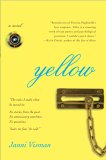
Janni Visman discusses her first novel, Yellow, about an an obsessive-compulsive shut-in.
In providing a map of Stella's apartment at the beginning of the book,
you exhibit a great deal of authorial control before the story even begins.
Why did you feel it was necessary for readers to see the physical
construction of the place as you pictured it, rather than leaving it up to
their own imaginations?
It was to do with remembering books I read as a child that had maps
outlining the world in which the story took place. (“X” marks the spot.) In
the case of Yellow, the map serves as an introduction to the limits
of Stella's world.
With Stella you have added to a literary history rich in unreliable
narrators. What are the merits and risks of this approach?
First-person narration allows the reader to become completely engaged in
the character's way of thinking. It is like a one-to-one, so to speak. The
risk is that the reader may find the whole experience too gothic. In Yellow, Stella's unreliable narration is integral to the story. In
writing this book, the benefits were that I could focus and concentrate on
one character, and the difficulties were in getting alternative perspectives
on Stella and in getting her to provide all the information, often provided
by other characters.
Were there any writers you turned to for inspiration during the
writing of Yellow or did you isolate yourself artistically as Stella does
psychologically?
I tend not to read novels when I'm writing. One of the inspirations was
Hitchcock's Vertigo, which has been a favorite for years. I think
writing, or any artistic process, requires and demands a degree of
isolation, if one is to become completely engaged in the work.
With the exception of Ivan, all your active characters are female.
What, if any, do you believe is the connection between the female psyche and
the issues of obsession, loyalty, and trust explored in the book?
I do not think any of the issues listed are necessarily gender specific.
In fact, Stella's character was partially based on a male. Stella's
obsessive nature and use of daily ritual gives her a sense of meaning and
being in control. The magic of these rituals, her various strict rules and
remedies for countering every emotional flux, keeps her from confronting her
issues of trust and loyalty with others.
Yellow is a study in suspense. For a novel such as this to succeed,
what do you believe must be provided and what withheld from the readers? How
do you maintain sympathy while keeping readers' suspicions aroused?
It is all about information, offering enough to raise interest and
curiosity through snippets and hints, but holding enough back to keep the
reader tantalized—a good striptease. Sympathy for Stella is maintained
through keys to understanding her suspicions, motivations, and mental
condition—plus, one hopes, making her likable and funny.
By creating Stella's hermetic life, you restricted the number of
characters and locations available to you. Was there an ascetic pleasure in
this kind of writing process that mirrored Stella's fictional experience?
Did the subject affect the spare language you used?
As I said before, writing is ascetic. You sit at your desk and you work
trying to ignore the phone and the sun shining outside. No matter what the
subject, I tend to write using spare language as I find it clear and direct.
You provide an unflinching look into the sexual relationship between
Stella and Ivan. When the novel was published in the UK, did you receive any
feedback from readers regarding the power and identity struggles you depict?
A few friends said it made them reevaluate their relationships with their
partners. Some other friends made teasing comments wondering about my
relationship with my husband.
There are many moments within Yellow that are exquisitely detailed,
almost painterly. Do you find that your training in the visual arts affects
your writing and, if so, how?
Without a doubt. Both my parents trained as fine artists and so did I. I
was brought up with continual invitations to “look” at things. It is part of
the way that I get into the work: I see everything. The space itself, the
arrangement of things within it, the way the light is falling, colors, and
textures. I place the events and characters in this space, imagining how
they would stand or sit, their body language. Building a whole atmosphere
before anything is even said.
What are you currently working on?
A love triangle set in the near future with thriller and supernatural
elements.
Janni Visman's Backstory
In a desperate rush to finish my first novel, Sex Education,
I was confined to my study for over a week. Anxious to avoid
any distractions, I got my food shopping delivered via the
internet or my husband kindly went out and got supplies. I was
beginning to get cabin fever but also experienced a strange
resistance to the prospect of going outside and being part of
the world again. It was very easy to stay in and have
everything brought to me. I began to think about writing a
book in which the main character never went outside their home
for the duration of the story. That was the initial starting
point for Yellow. To this I brought my three other
preoccupations of the time.
The first, although contradictory, is a concern that's
troubled me since childhood. If I was suddenly forced to leave
my home, what belongings would I need to take with me? As more
belongings accumulate this problem only gets worse. I wanted a
character who had found a solution to this problem and who had
prepared for this possibility. (It was 1998 and I was watching
the plight of Kosovan refugees daily on the television). The
notion of a survival kit though, also came from memories of my
father who would never leave home without certain essential
items and would return to get them if they were forgotten.
They were simple things, a pocket knife (he'd get arrested
now...), chewing gum, some water.
I was also thinking about the way women sometimes feel
compelled to try to change their appearance to fulfil their
imagined notion of their partner's ideal. And the way that men
(although I'm sure its not gender specific) often manipulate
women to do just this; through gifts of clothes, suggestions
on hair colour, complements given when she looks a certain way
etc. When this process occurs there is a strange sense of
counterfeit and fraud taking place. I was interested in the
idea of a woman letting herself be transformed as a means of
sustaining love and desirability, and with the possibility
that becoming someone else could also be a very liberating
experience. Needless to say, one of my favorite films is
Vertigo.
Finally, I received a letter from a neighbour, which had been
sellotaped to the outside of my window, complaining about the
noise of the bells on my cat's collar and how they kept her
awake at night. I somehow wanted to work this experience into
my next book.
Before I began to write anything, I read about agoraphobia and
other phobias. As a result I let my main character evolve into
one who was more obsessive and who, through strict ritual,
daily habit and rules, controlled all aspects of her life. I
wanted her various obsessions to be her 'magic' to keep the
world (and herself) at bay. I decided she could avoid
confronting any altered feelings by immediately trying to
neutralize them with various remedies or alternative
medicines. I made her ability to do the latter also become her
means of income. I liked the idea of having a character who
was continually in the process of pulling not only herself but
others back to what she saw as a harmonious state of being. A
sort of zero condition. I wanted her to exist without really
living. I didn't necessarily want this to be the result of
some psychological trauma. Although I knew that some hints as
to why she was the way she was had to be offered. I never
wanted these to be specifically cited just mentioned as if in
passing. So that fragments would slowly build up to give a
picture, even if vague, to what had happened.
To reflect Stella's journey, I decided to set myself some
rules about the writing. If the story was to be told entirely
from Stella's point of view, I would not allow her view to
extend outside the flat, apart from looking out of windows and
spyholes. For this to work there had to be a strong sense of
the space she occupied and the rhythms of her day. I also
decided, in keeping with Stella's character, not to use any
flashbacks or provide explanation of her back story as she is
someone who is trying to rid herself of the burden of the
past. I knew when I started to make notes, that there would be
a man whom she loved but lived with on certain conditions; a
past girlfriend of his to represent the imagined ideal; a
sister; a cat and a nosy neighbour. I plotted the book from
beginning to end. |This was not something that came easily to
me, as I did not follow this process for my first book and I
was impatient to start. But I felt that it was what Stella
would do if she wanted to keep control over her world, as I
wanted to keep control over the book. But as Stella broke her
rules and her world began to disintegrate, so too did I with
my plot line, which no longer seemed to work as I had planned.
I had to stop and rethink and replot a number of times. I had
to let the novel's tone change, as Stella was no longer in
control. I had to let the reins loosen a little to see where
the book would take me.
When I finally delivered the manuscript I was relieved no
major rewrites were required. I was so desperate to get out of
Stella's head and her flat.
This backstory originally appeared in M.J. Rose's blog - Backstory
Unless otherwise stated, this interview was conducted at the time the book was first published, and is reproduced with permission of the publisher. This interview may not be reproduced or reprinted without permission in writing from the copyright holder.

Mark Haddon is the author of the bestselling novels The Red House and A Spot of Bother. His novel The Curious Incident of the Dog in the Night-Time won the Whitbread Book of the Year Award and the Los Angeles Times Book Prize... (more)
If you enjoyed:
Yellow
Try:
The Curious Incident of the Dog in the Night-Time
by Mark Haddon
Liz Jensen was born in Oxfordshire, to an Anglo-Moroccan librarian mother and a Danish violin-maker father. She studied English at Somerville College, Oxford and worked first as a journalist in Hongkong and Taiwan. She then ... (more)
If you enjoyed:
Yellow
Try:
The Ninth Life of Louis Drax
by Liz Jensen
We recommend 5 similar authors
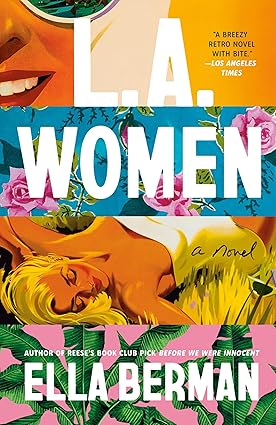
L.A. Women by Ella Berman
Two ambitious writers in 1960s LA face betrayal when one writes a novel based on the other's life.




Your guide toexceptional books
BookBrowse seeks out and recommends the best in contemporary fiction and nonfiction—books that not only engage and entertain but also deepen our understanding of ourselves and the world around us.

