-
Your next favorite book
is waiting.
Summary | Excerpt | Reading Guide | Reviews | Beyond the book | Read-Alikes | Genres & Themes | Author Bio
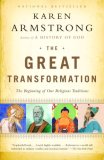
The Beginning of Our Religious Traditions
by Karen Armstrong Book Reviewed by:
In the ninth century BCE, the peoples of four distinct regions of the civilized world created the religious and philosophical traditions that have continued to nourish humanity to the present day: Confucianism and Daoism in China, Hinduism and Buddhism in India, monotheism in Israel, and philosophical rationalism in Greece. Now, Armstrong reveals how the sages of this pivotal "Axial Age" can speak clearly and helpfully to the violence and desperation that we experience in our own times.
In the ninth
century BCE, the peoples of four distinct regions of the civilized world
created the religious and philosophical traditions that have continued to
nourish humanity to the present day: Confucianism and Daoism in China,
Hinduism and Buddhism in India, monotheism in Israel, and philosophical
rationalism in Greece. Later generations further developed these initial
insights, but we have never grown beyond them. Rabbinic Judaism,
Christianity, and Islam, for example, were all secondary flowerings of the
original Israelite vision. Now, in The Great Transformation, Karen
Armstrong reveals how the sages of this pivotal "Axial Age" can speak
clearly and helpfully to the violence and desperation that we experience in
our own times.
Armstrong traces the development of the Axial Age chronologically, examining
the contributions of such figures as the Buddha, Socrates, Confucius,
Jeremiah, Ezekiel, the mystics of the Upanishads, Mencius, and Euripides.
All of the Axial Age faiths began in principled and visceral recoil from the
unprecedented violence of their time. Despite some differences of emphasis,
there was a remarkable consensus in their call for an abandonment of
selfishness and a spirituality of compassion. With regard to dealing with
fear, despair, hatred, rage, and violence, the Axial sages gave their people
and give us, Armstrong says, two important pieces of advice: first there
must be personal responsibility and self-criticism, and it must be followed
by practical, effective action.
In her introduction and concluding chapter, Armstrong urges us to consider
how these spiritualities challenge the way we are religious today. In our
various institutions, we sometimes seem to be attempting to create exactly
the kind of religion that Axial sages and prophets had hoped to eliminate.
We often equate faith with doctrinal conformity, but the traditions of the
Axial Age were not about dogma. All insisted on the primacy of compassion
even in the midst of suffering. In each Axial Age case, a disciplined
revulsion from violence and hatred proved to be the major catalyst of
spiritual change.
Contents
List of Maps and Plans
Acknowledgments
Introduction
1. THE AXIAL PEOPLES (c. 1600 to 900 bce)
2. RITUAL (c. 900 to 800 bce)
3. KENOSIS (c. 800 to 700 bce)
4. KNOWLEDGE (c. 700 to 600 bce)
5. SUFFERING (c. 600 to 530 bce)
6. EMPATHY (c. 530 to 450 bce)
7. CONCERN FOR EVERYBODY (c. 450 to 398 bce)
8. ALL IS ONE (c. 400 to 300 bce)
9. EMPIRE (c. 300 to 220 bce)
10. THE WAY FORWARD
Notes
Glossary
Bibliography
Index
ASRA
THE AXIAL PEOPLES
(c. 1600 to 900 BCE)
The first people to attempt an Axial Age spirituality were pastoralists living on the steppes of southern Russia, who called themselves the Aryans. The Aryans were not a distinct ethnic group, so this was not a racial term but an assertion of pride and meant something like "noble" ...
Armstrong suggests that we should not see one or another doctrine as right or wrong in of itself, but instead should look for the spiritual concept that lies at the root of each to find the commonalities of compassion and tolerance. Of course, the idea that we can solve the world's problems by finding common ground between religions is hardly a new idea. However, Armstrong's grasp of history and her ability to so lucidly explain it to us raises The Great Transformation well above the level of mere platitude...continued
Full Review
 (556 words)
(Reviewed by BookBrowse Review Team).
Karen Armstrong spent seven
years as a nun in the
Catholic
Society of the
Holy Child Jesus
during the 1960s
and later wrote
a tell-all book,
Through the
Narrow Gate
(1982) that
bemoaned the
restrictive
life.
She teaches
Christianity at
London's Leo
Baeck College
for the Study of
Judaism. It was
her first trip
to Jerusalem in
1983 that ...
If you liked The Great Transformation, try these:
by A.C. Grayling
Published 2017
Out of a 'fractured and fractious time,' the author asserts persuasively, the medieval mind evolved into the modern. Another thought-provoking winner from Grayling." - Kirkus
by Lesley Hazleton
Published 2017
A widely admired writer on religion celebrates agnosticism as the most vibrant, engaging - and ultimately the most honest - stance toward the mysteries of existence.
The Rise and Fall of Ancient Egypt
by Toby Wilkinson
Published 2013
In this landmark work, one of the world’s most renowned Egyptologists tells the epic story of this great civilization, from its birth as the first nation-state to its final absorption into the Roman Empire—three thousand years of wild drama, bold spectacle, and unforgettable characters.

L.A. Women by Ella Berman
Two ambitious writers in 1960s LA face betrayal when one writes a novel based on the other's life.