Book Club Discussion Questions
In a book club? Subscribe to our Book Club Newsletter!
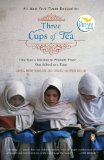
For supplemental discussion material see our Beyond the Book article, and our BookBrowse Review of Three Cups of Tea.
Please be aware that this discussion guide will contain spoilers!
Introduction
Three Cups of Tea is the true story of one of the most extraordinary
humanitarian missions of our time. In 1993, a young American mountain climber
named Greg Mortenson stumbles into a tiny village high in Pakistan's beautiful
and desperately poor Karakoram Himalaya region. Sick, exhausted, and depressed
after a failing to scale the summit of K2, Mortenson regains his strength and
his will to live thanks to the generosity of the people of the village of Korphe.
Before he leaves, Mortenson makes a vow that will profoundly change both the
villagers' lives and his own—he will return and build them a school.
The book traces how Mortenson kept this promise (and many more) in the high
country of Pakistan and Afghanistan, despite considerable odds. The region is
remote and dangerous, a notorious breeding ground for Al Qaeda and Taliban
terrorists. In the course of his work, Mortenson was kidnapped and threatened
with death. He endured local rivalries, deep misunderstandings, jealousy, and
corruption, not to mention treacherous roads and epic weather. But he believed
passionately that balanced, non-extremist education, for boys and girls alike,
is the most effective way to combat the violent intolerance that breeds
terrorism. To date, Mortenson's Central Asia Institute has constructed
fifty-five schools, and his work continues.
Mortenson initially approached Karakoram as a climber and he never lost the
mountaineer's appreciation for the region's austere beauty and incredible
physical challenges. His coauthor David Oliver Relin deftly evokes high-altitude
landscapes haunted by glaciers, snow leopards, and the deaths of scores of
climbers. As Mortenson transformed himself from down-and-out climbing bum to the
director of a humanitarian enterprise, he came to appreciate more and more
deeply the struggles that people of the region endure every day—struggles that
have intensified with the recent explosion of war and sectarian violence.
In the course of this narrative, readers come to know Mortenson as a friend, a
husband and father, a traveling companion, a son and brother, and also as a
flawed human being. Mortenson made enemies along the way and frustrated his
friends and family. Relin does not shy away from depicting the man's
exasperating qualities—his restlessness, disorganization, sleeplessness, and
utter disregard for punctuality. But Mortenson never asks others to make
sacrifices that he has not already made himself time and time again.
The war-torn mountains of Pakistan and Afghanistan appear in the news as the
breeding grounds of terrorist training camps, Al Qaeda hide-outs, and fierce
religious extremism. In
Three Cups of Tea, Mortenson and Relin take
readers behind the headlines to reveal the true heart and soul of this explosive
region and to show how one man's promise might be enough to change the world.
Discussion Questions
- There is a telling passage about Mortenson's change of direction at the
start of the book: "One evening, he went to bed by a yak dung fire a
mountaineer who'd lost his way, and one morning, by the time he'd shared a
pot of butter tea with his hosts and laced up his boots, he'd become a
humanitarian who'd found a meaningful path to follow for the rest of his
life." What made Mortenson particularly ripe for such a transformation? Has
anything similar happened in your own life?
- Relin gives a "warts and all" portrait of Mortenson, showing him as a
hero but also as a flawed human being with some exasperating traits. Talk
about how Relin chose to write about Mortenson's character—his choice of
details, his perspective, the way he constructs scenes. Is Mortenson someone
you'd like to get to know, work with, or have as a neighbor or friend?
- At the heart of the book is a powerful but simple political message: we
each as individuals have the power to change the world, one cup of tea at a
time. Yet the book powerfully dramatizes the obstacles in the way of this
philosophy: bloody wars waged by huge armies, prejudice, religious
extremism, cultural barriers. What do you think of the "one cup of tea at a
time" philosophy? Do you think Mortenson's vision can work for lasting and
meaningful change?
- Have you ever known anyone like Mortenson? Have you ever had the
experience of making a difference yourself through acts of generosity, aid,
or leadership?
- The Balti people are fierce yet extremely hospitable, kind yet rigid,
determined to better themselves yet stuck in the past. Discuss your
reactions to them and the other groups that Mortenson tries to help.
- After Haji Ali's family saves Greg's life, he reflects that he could
never "imagine discharging the debt he felt to his hosts in Korphe." Discuss
this sense of indebtedness as key to Mortenson's character. Why was
Mortenson compelled to return to the region again and again? In your
opinion, does he repay his debt by the end of the book?
- References to paradise run throughout the book—Mortenson's childhood
home in Tanzania, the mountain scenery, even Berkeley, California, are all
referred to as "paradise." Discuss the concept of paradise, lost and
regained, and how it influences Mortenson's mission.
- Mortenson's transition from climbing bum to humanitarian hero seems very
abrupt. However, looking back, it's clear that his sense of mission is
rooted in his childhood, the values of his parents, and his relationship
with his sister Christa. Discuss the various facets of Mortenson's
character—the freewheeling mountain climber, the ER nurse, the devoted son
and brother, and the leader of a humanitarian cause. Do you view him as
continuing the work his father began?
- "I expected something like this from an ignorant village mullah, but to
get those kinds of letters from my fellow Americans made me wonder whether I
should just give up," Mortenson remarked after he started getting hate mail
in the wake of September 11. What was your reaction to the letters Mortenson
received?
- Mortenson hits many bumps in the road—he's broke, his girlfriend dumps
him, he is forced to build a bridge before he can build the school, his
health suffers, and he drives his family crazy. Discuss his repeated brushes
with failure and how they influenced your opinion of Mortenson and his
efforts.
- The authors write that "the Balti held the key to a kind of
uncomplicated happiness that was disappearing in the developing world." This
peaceful simplicity of life seems to be part of what attracts Mortenson to
the villagers. Discuss the pros and cons of bringing "civilization" to the
mountain community.
- Much of the book is a meditation on what it means to be a foreigner
assimilating with another culture. Discuss your own experiences with foreign
cultures—things that you have learned, mistakes you have made,
misunderstandings you have endured.
- Did the book change your views toward Islam or Muslims? Consider the
cleric Syed Abbas, and also the cleric who called a fatwa on Mortenson. Syed
Abbas implores Americans to "look into our hearts and see that the great
majority of us are not terrorists, but good and simple people." Discuss this
statement. Has the book inspired you to learn more about the region?
Unless otherwise stated, this discussion guide is reprinted with the permission of Penguin Books.
Any page references refer to a USA edition of the book, usually the trade paperback version, and may vary in other editions.

 Book Reviewed by:


.png)