Book Club Discussion Questions
In a book club? Subscribe to our Book Club Newsletter and get our best book club books of 2025!
Please be aware that this discussion guide will contain spoilers!
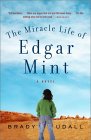
The introduction and discussion questions that follow are designed to enhance your group's discussion of Brady
Udall's extraordinary first novel, The Miracle Life of Edgar Mint.. Also at BookBrowse, you'll find reviews, an extensive excerpt, an interview and a short biography.
ABOUT
At the beginning of this high-spirited and inexhaustibly inventive novel of
the American West, a seven-year-old boy on an Apache Indian reservation has his
head run over by a mail truck. Though his skull is crushed, Edgar miraculously
survives the accident after being resuscitated by a possibly deranged hospital
intern, Dr. Barry Pinkley. After three months in a coma, Edgar wakes up to find
himself in St. Divine's Hospital in Globe, Arizona, surrounded by other
survivors of horrific accidents. Alcoholic Art Crozier, pieced together after
the car crash that killed his wife and daughters, takes the boy under his wing.
When Edgar recovers his health but loses the ability to write with a pen, Art
gives him an old Hermes typewriter. He is soon filling up page after page in an
attempt to make sense of his increasingly dismal fate. Abandoned by his
grandmother and alcoholic mother, Edgar is sent to live at Willie Sherman
School, a boarding school cum dumping ground for unwanted Indian children. After
several years and many run-ins with the pathologically cruel bully Nelson
Norman, Edgar is finally taken into foster care by a Mormon family in Utah. But
despite this turn of better fortune, Edgar's one wish remains: to bring the
good news of his survival to the mailman who ran him over. His search leads him
to a small town in Pennsylvania, where a profoundly ironic tragedy awaits, and
where he finally finds a loving home.
The Miracle Life of Edgar Mint is an immensely enjoyable story, with an
unforgettable hero whose troubles and yearnings are completely captivating.
While Edgar suffers many losses, including the loss of most of the illusions
that make people's lives bearable, he maintains his innate goodness and his
belief in the redeeming power of language. The result is a miracle of
storytelling, bursting with heartache and hilarity and inhabited by characters
as outsized as the landscape of the American West.
READERS GUIDE
- "If I could tell you only one thing about my life it would be this:
when I was seven years old the mailman ran over my head. As formative events go,
nothing else comes close; my careening, zigzag existence, my wounded brain and
faith in God, my collisions with joy and affliction, all of it has come, in one
way or another, out of that moment on a summer morning when the left rear tire
of a United States postal jeep ground my tiny head into the hot gravel of the
San Carlos Apache Indian Reservation"[p.13]. How does the novel's opening
paragraph—and more broadly its opening chapter—work to draw the reader into
the story? How does the immediacy of the first-person narration affect the
reader's involvement with Edgar and his story?
- Edgar's mother doesn't even get up from the kitchen table when he
is run over by the mail truck [p. 16]. Why is Edgar so forgiving of her, even
though she abandons him and effectively kills herself with alcohol? Does she
provoke any sympathy in the reader?
- Edgar's father is a young white man from Connecticut who has come
west in the hope of becoming a cowboy. Is it surprising that Edgar never meets
or even tries to find his real father? Which characters take on parental roles
in his life?
- On arriving at Willie Sherman, Edgar overhears Principal Whipple say,
"The last thing I need right now is another goddamn orphan without any
paperwork." In response to hearing the word
"orphan," Edgar thinks, "It
comforted me to understand my place in the world, to put a name to it" [p.
107]. Is it useful to see The Miracle Life of Edgar Mint as an example
of the classic genre of orphan novels, like Dickens' Great Expectations?
How loosely or tightly structured is The Miracle Life of Edgar Mint? What
are the driving forces behind the novel's plot?
- What is the effect of the chapter called "Edgar Gets It," which is
Edgar's and the reader's introduction to life at Willie Sherman. Why are
violence and sadism so casual here? What effect does the school have on Edgar's
behavior? What changes does he make in himself in order to survive?
- Edgar is "obsessed with memory, with facts, with history on the
smallest scale" [p. 14]. He makes daily use of the typewriter Art has given
him. What does language do for Edgar? Why is it so necessary for him to write
down what happens to him?
- What does Edgar's friendship with Cecil mean to him? If thinking
about and writing to Cecil have become some of Edgar's few emotional
lifelines, what is the significance of the events that occur when he makes his
visit to the juvenile detention center [pp. 301–309]?
- Note that Udall's use of narrative point of view often switches
between first and third person [see, for instance, the first two paragraphs on
page 215]. Why does he choose to do this? Who is telling the story?
- What does Sterling Yakezevitch represent to Edgar? Why does Edgar say
to himself, "I was just like Sterling Yakezevitch. I knew it, but nobody else
seemed to" [p. 193]? What is the significance of "the jumping place" for
Edgar and for Sterling?
- Udall does a superb job of incorporating the landscape of the West
into the story. What are the scenes in which the landscape plays an important
role? How does the landscape affect the moods and meanings of the novel? Is
there any significance to the fact that Edgar ends up in Pennsylvania, far from
his Apache homeland?
- How well does Edgar fit into the Madsen family? Does he have a
chance for happiness there? Why does he leave, and is he right to do so?
- Barry Pinkley's role in the story evolves over the course of Edgar's
life. Edgar says, "Like Dr. Frankenstein who gave the monster life, I think
Barry felt a kind of ownership toward me, a responsibility" [p. 25]. Does
Barry's history as a foster child explain his behavior? Edgar also says, "Barry
was a mystery to me . . . I knew that he loved me, in his own way, more than
anyone in my life ever had" [p. 347]. Despite Barry's constant attention and
love, why does Edgar reject him as a possible adoptive parent? What compels
Edgar to perform his ultimate act of rejection? Is it shocking or unsurprising
that he does so?
- Edgar says, "God was out there. He had touched me and I had felt His
presence, which was more than I could say about my own father." But he also
believes that "either God was a crazed lunatic or He was just plain mean" [p.
311]. How important is religion in this novel?
- Edgar is a child with no home and almost no belongings. What
particular objects take on meaning for him? What is the significance of the
objects that are given and received in friendship in this story? What is the
significance of his trunk?
- How significant for Edgar's story is the fact that he is half
Apache? What does the novel tell us about racial discrimination and its effect
on Native Americans? How interested is Udall in bringing the reader's
attention to the problems bequeathed to the Native American population?
- There is much in The Miracle Life of Edgar Mint that is
bleak—suicide, alcoholism, drug addiction, physical suffering, emotional
deprivation. Which aspects or episodes of the novel are the most difficult for
the reader from an emotional perspective? How does Udall manage to keep the mood
so light, comical, and life-affirming?
- Apart from his brilliance as an inventor of character and plot, what
aspects of Udall's writing style are most impressive? Are there particular
sentences or paragraphs that are especially moving, effective, or funny?
- Edgar's lifelong quest is to relieve the postman of guilt, to
bring him the good news of his survival. "I imagined him with his white skin,
his orange hair and blue uniform . . . transformed in an instant from a man
twisted inside out with guilt and grief to someone struck with the realization
that our worst mistakes can be retrieved, that death can be traded in for life,
that what has been destroyed can be made whole again" [p. 312]. Why does Udall
deny him this wish? Is finding a long-lost mother in Rosa a good enough
substitute for his original wish? What are the ironies of the novel's ending?
Unless otherwise stated, this discussion guide is reprinted with the permission of Vintage.
Any page references refer to a USA edition of the book, usually the trade paperback version, and may vary in other editions.

.png)


