
-
See Our Summer
Books to Watch!
Summary | Excerpt | Reviews | Readalikes | Genres & Themes | Author Bio
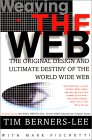
The Original Design and Ultimate Destiny of the World Wide Web by its Inventor
by Tim Berners-Lee
Enquire Within upon Everything
When I first began tinkering with a software program that eventually gave
rise to the idea of the World Wide Web, I named it Enquire, short for Enquire
Within upon Everything, a musty old book of Victorian advice I noticed
as a child in my parents' house outside London. With its title suggestive
of magic, the book served as a portal to a world of information,
everything from how to remove clothing stains to tips on investing money.
Not a perfect analogy for the Web, but a primitive starting point.
What that first bit of Enquire code led me to was something much
larger, a vision encompassing the decentralized, organic growth of ideas,
technology, and society. The vision I have for the Web is about anything
being potentially connected with anything. It is a vision that provides us
with new freedom, and allows us to grow faster than we ever could when we
were fettered by the hierarchical classification systems into which we
bound ourselves. It leaves the entirety of our previous ways of working as
just one tool among many. It leaves our previous fears for the future as
one set among many. And it brings the workings of society closer to the
workings of our minds.
Unlike Enquire Within upon Everything, the Web that I have tried
to foster is not merely a vein of information to be mined, nor is it just
a reference or research tool. Despite the fact that the ubiquitous www
and .com now fuel electronic commerce and stock markets all over
the world, this is a large, but just one, part of the Web. Buying books
from Amazon.com and stocks from E-trade is not all there is to the Web.
Neither is the Web some idealized space where we must remove our shoes,
eat only fallen fruit, and eschew commercialization.
The irony is that in all its various guises - commerce, research, and
surfing - the Web is already so much a part of our lives that familiarity
has clouded our perception of the Web itself. To understand the Web in the
broadest and deepest sense, to fully partake of the vision that I and my
colleagues share, one must understand how the Web came to be.
The story of how the Web was created has been told in various books and
magazines. Many accounts I've read have been distorted or just plain
wrong. The Web resulted from many influences on my mind, half-formed
thoughts, disparate conversations, and seemingly disconnected experiments.
I pieced it together as I pursued my regular work and personal life. I
articulated the vision, wrote the first Web programs, and came up with the
now pervasive acronyms URL (then UDI), HTTP, HTML, and, of course, World
Wide Web. But many other people, most of them unknown, contributed
essential ingredients, in much the same almost random fashion. A group of
individuals holding a common dream and working together at a distance
brought about a great change.
My telling of the real story will show how the Web's evolution and its
essence are inextricably linked. Only by understand ing the Web at this
deeper level will people ever truly grasp what its full potential can be.
Journalists have always asked me what the crucial idea was, or what the
singular event was, that allowed the Web to exist one day when it hadn't
the day before. They are frustrated when I tell them there was no
"Eureka!" moment. It was not like the legendary apple falling on
Newton's head to demonstrate the concept of gravity. Inventing the World
Wide Web involved my growing realization that there was a power in
arranging ideas in an unconstrained, weblike way. And that awareness came
to me through precisely that kind of process. The Web arose as the answer
to an open challenge, through the swirling together of influences, ideas,
and realizations from many sides, until, by the wondrous offices of the
human mind, a new concept jelled. It was a process of accretion, not the
linear solving of one well-defined problem after another.

Excerpted from Weaving The Web by Tim Berners-Lee. (c)Tim Berners-Lee 1999. Published by permission of the publisher, HarperCollins.
.png)
The only real blind person at Christmas-time is he who has not Christmas in his heart.
Click Here to find out who said this, as well as discovering other famous literary quotes!
Your guide toexceptional books
BookBrowse seeks out and recommends the best in contemporary fiction and nonfiction—books that not only engage and entertain but also deepen our understanding of ourselves and the world around us.


