
-
Your next favorite book
is waiting.
Summary | Excerpt | Reading Guide | Reviews | Beyond the book | Read-Alikes | Genres & Themes | Author Bio
 Book Reviewed by:
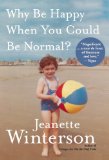
Witty, acute, fierce, and celebratory, Why Be Happy When You Could Be Normal? is a tough-minded search for belonging, for love, identity, home, and a mother.
Jeanette Winterson's novels have established her as a major figure in world literature. She has written some of the most admired books of the past few decades, including her internationally bestselling first novel, Oranges Are Not the Only Fruit, the story of a young girl adopted by Pentecostal parents that is now often required reading in contemporary fiction.
Why Be Happy When You Could Be Normal? is a memoir about a life's work to find happiness. It's a book full of stories: about a girl locked out of her home, sitting on the doorstep all night; about a religious zealot disguised as a mother who has two sets of false teeth and a revolver in the dresser, waiting for Armageddon; about growing up in an north England industrial town now changed beyond recognition; about the Universe as Cosmic Dustbin.
It is the story of how a painful past that Jeanette thought she'd written over and repainted rose to haunt her, sending her on a journey into madness and out again, in search of her biological mother.
Witty, acute, fierce, and celebratory, Why Be Happy When You Could Be Normal? is a tough-minded search for belonging, for love, identity, home, and a mother.
1
The Wrong Crib
When my mother was angry with me, which was often, she said, 'The Devil led us to the wrong crib'.
The image of Satan taking time off from the Cold War and McCarthyism to visit Manchester in 1960 - purpose of visit: to deceive Mrs Winterson - has a flamboyant theatricality to it. She was a flamboyant depressive; a woman who kept a revolver in the duster drawer, and the bullets in a tin of Pledge. A woman who stayed up all night baking cakes to avoid sleeping in the same bed as my father. A woman with a prolapse, a thyroid condition, an enlarged heart, an ulcerated leg that never healed, and two sets of false teeth - matt for everyday, and a pearlised set for 'best'.
I do not know why she didn't/couldn't have children. I know that she adopted me because she wanted a friend (she had none), and because I was like a flare sent out into the world - a way of saying that she was here - a kind of X Marks the Spot.
She ...

The essence of Winterson's own tenuous life-story is mimicked in the structure of her memoir, a jumble of hazy pieces coalescing into a mind, a self. What felt unformed and gangly in the first half becomes svelt and athletic; what was meandering becomes as sure and steady as a freight train.... Winterson offers a reader much more than the satisfaction of voyeuristic curiosity that marks so many train-wreck memoirs; this is a memoir about how we deal with our lot in life. Not how we can endure it, but how we might meet it, how we begin a dialogue with it, how we become who we are when we are done being our past...continued
Full Review
 (1044 words)
(Reviewed by Lucia Silva).
In a passage on suicide, Winterson remarks that "when natural gas was introduced in the 1960's, the British suicide rate fell by one-third." I thought that perhaps she was using some creative math for dramatic effect, but a little research revealed that she wasn't exaggerating at all. Here's a summary of the way things were in Great Britain before the introduction of natural gas, from the New York Times:
For generations, the people of Britain heated their homes and fueled their stoves with coal gas. While plentiful and cheap, coal-derived gas could also be deadly; in its unburned form, it released very high levels of carbon monoxide, and an open valve or a leak in a closed space could induce asphyxiation in a matter of minutes. This ...
If you liked Why Be Happy When You Could Be Normal?, try these:

by Melissa Febos
Published 2026
From the national bestselling author of Girlhood, an examination of the solitude, freedoms, and feminist heroes Melissa Febos discovered during a year of celibacy. A wise and transformative look at relationships and self-knowledge.

by Jeanette Winterson
Published 2026
"One of the most daring and inventive writers of our time" (Elle) weaves together memoir, manifesto, and a feminist reimagining of One Thousand and One Nights in this impassioned exploration of the power of reading.
by Tara Westover
Published 2022
Winner of the 2018 BookBrowse Nonfiction Award
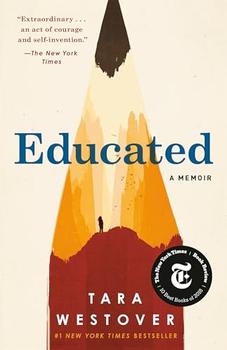
An unforgettable memoir about a young girl who, kept out of school, leaves her survivalist family and goes on to earn a PhD from Cambridge University.




The fact of knowing how to read is nothing, the whole point is knowing what to read.
Click Here to find out who said this, as well as discovering other famous literary quotes!

Can you name the title?
Test your book knowledge with our daily trivia challenge!