
-
Your next favorite book
is waiting.
Summary | Excerpt | Reading Guide | Discuss | Reviews | Read-Alikes | Genres & Themes | Author Bio
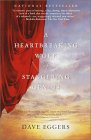
'When you read his extraordinary memoir you don't laugh, then cry, then laugh again; you somehow experience these emotions all at once.'
"Well, this was when Bill was sighing a lot. He had decided that after our parents died he just didn't want any more fighting between what was left of us. He was twenty-four, Beth was twenty-three, I was twenty-one, Toph was eight, and all of us were so tried already, from that winter. So when something would come up, any little thing, some bill to pay or decision to make, he would just sigh, his eyes tired, his mouth in a sorry kind of smile.
But Beth and I...Jesus, we were fighting with everyone, anyone, each other, with strangers at bars, anywhere -- we were angry people wanting to exact revenge. We came to California and we wanted everything, would take what was ours, anything within reach. And I decided that little Toph and I, he with his backward hat and long hair, living together in our little house in Berkeley, would be world-destroyers. We inherited each other and, we felt, a responsibility to reinvent everything, to scoff and re-create and drive fast while singing loudly and pounding the windows. It was a hopeless sort of exhilaration, a kind of arrogance born of fatalism, I guess, of the feeling that if you could lose a couple of parents in a month, then basically anything could happen, at any time -- all bullets bear your name, all cars are there to crush you, any balcony could give way; more disaster seemed only logical.
And then, as in Dorothy's dream, all these people I grew up with were there, too, some of them orphans also, most but not all of us believing that what we had been given was extraordinary, that it was time to tear or break down, ruin, remake, take and devour. This was San Francisco, you know, and everyone had some dumb idea -- I mean, wicca? -- and no one there would tell you yours was doomed. Thus the public nudity, and this ridiculous magazine, and the Real World tryout, all this need, most of it disguised by sneering, but all driven by a hyper-awareness of this window, I guess, a few years when your muscles are taut, coiled up and vibrating. But what to do with the energy? I mean, when we drive, Toph and I, and we drive past people, standing on top of all these hills, part of me wants to stop the car and turn up the radio and have us all dance in formation, and part of me wants to run them all over."
Chapter One, Part One
Through the small tall bathroom window the December yard is gray and scratchy, the trees calligraphic. Exhaust from the dryer billows clumsily out from the house and up, breaking apart while tumbling into the white sky.
The house is a factory.
I put my pants back on and go back to my mother. I walk down the hall, past the laundry room, and into the family room. I close the door behind me, muffling the rumbling of the small shoes in the dryer, Toph's.
"Where were you?" my mother says.
"In the bathroom," I say.
"Hmph," she says.
"What?"
"For fifteen minutes?"
"It wasn't that long."
"It was longer. Was something broken?"
"No."
"Did you fall in?"
"No."
"Were you playing with yourself?"
"I was cutting my hair."
"You were contemplating your navel."
"Right. Whatever."
"Did you clean up?"
"Yeah."
I had not cleaned up, had actually left hair everywhere, twisted brown doodles drawn in the ...
What are you reading this week? And what did you think of last week’s books? (1/1/2026)
I am reading a book I've heard about for years but never got around to – A Heartbreaking Work of Staggering Genius by Dave Eggers. It is a memoir which is probably at least a little fictional.
-Harriet_T
 David Remnick
Eggers is an original new voice, the real thing. When you read his extraordinary memoir you don't laugh, then cry, then laugh again; you somehow experience these emotions all at once -- and powerfully. David Sedaris
The force and energy of this book could power a train. Lawrence Weschler
Truly splendid. The key word in the title, of course, is "Staggering" -- and not just because of the subliminal pun off "Eggers." Rather, Eggers is some kind of Staggering Genius the way Pavarotti is a Singing one. When Kierkegaard got in this deep -- this endlessly self-ironizingly, loopily down-spiralingly deep -- he had to rely on God to save him. But Eggers somehow manages to save himself -- all his endlessly knowing self-undercutting somehow managing to cut clean through to something more bottomlessly profound: a simple wonder; a knowing wonder, to be sure, but no less abiding a Wonder for all that.
David Remnick
Eggers is an original new voice, the real thing. When you read his extraordinary memoir you don't laugh, then cry, then laugh again; you somehow experience these emotions all at once -- and powerfully. David Sedaris
The force and energy of this book could power a train. Lawrence Weschler
Truly splendid. The key word in the title, of course, is "Staggering" -- and not just because of the subliminal pun off "Eggers." Rather, Eggers is some kind of Staggering Genius the way Pavarotti is a Singing one. When Kierkegaard got in this deep -- this endlessly self-ironizingly, loopily down-spiralingly deep -- he had to rely on God to save him. But Eggers somehow manages to save himself -- all his endlessly knowing self-undercutting somehow managing to cut clean through to something more bottomlessly profound: a simple wonder; a knowing wonder, to be sure, but no less abiding a Wonder for all that.
If you liked A Heartbreaking Work of Staggering Genius, try these:
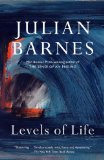
by Julian Barnes
Published 2014
Julian Barnes's new book is about ballooning, photography, love and grief; about putting two things, and two people, together, and about tearing them apart.
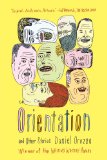
by Daniel Orozco
Published 2012
Orientation introduces a writer at the height of his powers, whose work surely invites us to reassess the landscape of American fiction.

by Adam Ross
Published 2011
Mesmerizing, exhilarating, and profoundly moving, Mr. Peanut is a police procedural of the soul, a poignant investigation of the relentlessly mysterious human heart—and a first novel of the highest order.




The worth of a book is to be measured by what you can carry away from it.
Click Here to find out who said this, as well as discovering other famous literary quotes!

Can you name the title?
Test your book knowledge with our daily trivia challenge!