
-
Your next favorite book
is waiting.
Summary | Excerpt | Reviews | Beyond the book | Read-Alikes | Genres & Themes | Author Bio
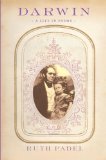
A Life in Poems
by Ruth Padel Book Reviewed by:
This remarkable book brings us an intimate and moving interpretation of the life and work of Charles Darwin, by Ruth Padel, an acclaimed British poet and a direct descendant of the famous scientist.
Charles Darwin, born in 1809, lost his mother at the age of eight, repressed all memory of her, and poured his passion into solitary walks, newt collecting, and shooting. His five-year voyage on H.M.S. Beagle, when he was in his twenties, changed his life. Afterward, he began publishing his findings and working privately on groundbreaking theories about the development of animal species, including human beings, and he made a nervous proposal to his cousin Emma.
Padel’s poems sparkle with nuance and feeling as she shows us the marriage that ensued, and the rich, creative atmosphere the Darwins provided for their ten children. Charles and Emma were happy in each other, but both were painfully aware of the gulf between her deep Christian faith and his increasing religious doubt. The death of three of their children accentuated this gulf. For Darwin, death and extinction were nature’s way of developing new species: the survival of the fittest; for Emma, death was a prelude to the afterlife.
These marvelous poems—enriched by helpful marginal notes and by Padel’s ability to move among multiple viewpoints, always keeping Darwin at the center—bring to life the great scientist as well as the private man and tender father. This is a biography in rare form, with an unquantifiable depth of family intimacy and warmth.
More Funny Ideas About Grandeur
(from Chapter Four: Emma (1838-1851)
'To Emma, in case of my sudden death.
I have just finished this sketch
of my species theory. If true, as I believe,
it will be a considerable step
in science. My most solemn last request
is that you devote 400 pounds
to its publication.'
'There is grandeur, if you look
at every organic being
as the lineal successor of some other form,
now buried under thousands of feet of rock.
Or else as a co-descendant, with that buried form,
from some other inhabitant of this world
more ancient still, now lost.
Out of famine, death and struggle for existence,
comes the most exalted end
we're capable of conceiving: creation
...
Padel divides Darwin: A Life in Poems into five chapters, one for each discrete stage of his life. Chapter Two, which addresses his travels on the H.M.S. Beagle, pulsates with rich, sensuous imagery that echoes Darwin's enchantment with the natural world. In a parallel to Shannon's encounter with the angelically blossoming tree, Darwin, exploring a Brazilian rainforest, has his own arboreal revelation: "Bristles of orchid leaves on every black branch/like green flames over Bibles./Botanical forms gyrate and pour/through rivers of otherworld bark/and a wrestling musculature of pure/live wood." Far from diminishing his reverence for nature, his burgeoning belief in evolution opens vistas as immense as the sparsely populated American prairies that the Lewis and Clark Expedition had mapped not long before the voyage of the Beagle.
Darwin covers its subject's life not only as a scientist but also as a devoted husband and father, and these poems in the collection prove equally resplendent and moving. In "He Ignores His Father's Advice," the renegade geologist metamorphoses into a shy yet determined suitor as he proposes to Emma. The advice that he ignores is to keep his religious doubts secret from his wife-to-be; Darwin, however, believes in totally honesty, and although his agnosticism pains Emma, she sublimates her concern for his spiritual welfare to her love for him. "How Do Species Recognize Their Mate?" even frames natural selection in the context of a beautiful, unsentimental love poem. Despite the vast differences in their approaches to faith, Charles and Emma Darwin's love sustains them both through a series of difficult pregnancies, Darwin's poor health, and the death of their daughter Annie at age ten. This last occurrence in particular haunted Darwin, as he feared that marrying his first cousin may have doomed Annie to become an example of his own doctrine, "survival of the fittest."
Most scholars agree that Annie's death in 1851 had a profound impact on solidifying Darwin's religious doubts and in giving him the courage to publish ever bolder accounts of evolution that challenged the prevailing notions of "intellectual design." In "Salting the Seeds," Padel hints at this in the lines "Dawn fog dissolves/among the medlars into a wraith/you see, then lose, in the shape/of a running girl." While Darwin clearly adored his other children (Padel deftly incorporates their loving recollections of him into the later poems), he admits that Annie was his favorite, and the poems in the final section of the book all carry a sense of resigned melancholy despite the fact that he published his scientific theories to great recognition during this period. Padel's empathy with Darwin along with her literary gifts result in a powerful portrait of a man whose ideas have revolutionized the way that we view the world.
Abbreviated from "Biography-in-verse" by Marnie Colton..continued
Full Review
 (513 words)
(Reviewed by Marnie Colton).
As reviewer Marnie Colton points out in her blog post at BookBrowse, biographies in poetry form allow for freedom of expression that a more constraining non-fiction prose form might not. Marnie calls the biography-in-verse "a dynamic form that allows poets to revisit the lives of their subjects through imagery, rhythm, and metaphor instead of the more rigid bounds of chronology that biographers must follow. Considering that biographies, autobiographies, and memoirs usually make a strong showing on bestseller lists, the poetic analogues to these forms deserve a wider audience and also provide an ideal introduction to newcomers wishing to dip a tentative toe into the rushing waters of poetry."

 It is not just Darwin who has been the subject...
If you liked Darwin, try these:
by Iain McCalman
Published 2010
Darwin's Armada tells the stories of Charles Darwin, Thomas Huxley, Joseph Hooker and Alfred Wallace, four young amateur naturalists from Britain who voyaged to the southern hemisphere during the first half of the nineteenth century in search of adventure and scientific fame.

by Tracy Chevalier
Published 2010
A voyage of discoveries, a meeting of two remarkable women, and an extraordinary time and place enrich bestselling author Tracy Chevalier's enthralling new novel.

by Campbell McGrath
Published 2009
From the inimitable Campbell McGrath comes an epic poem of George Shannon, the youngest member of the Lewis and Clark expedition, who wandered the prairie alone for sixteen days.




Harvard is the storehouse of knowledge because the freshmen bring so much in and the graduates take so little out.
Click Here to find out who said this, as well as discovering other famous literary quotes!

Can you name the title?
Test your book knowledge with our daily trivia challenge!