Summary | Excerpt | Reviews | Read-Alikes | Genres & Themes | Author Bio
Critics' Opinion:
Readers' Opinion:
First Published:
Aug 1970, 64 pages
Paperback:
Aug 1970, 64 pages
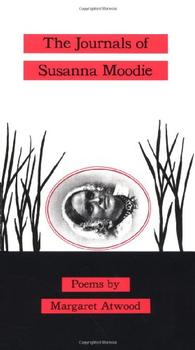
The poetic/artistic exploration of what it means to find yourself thrown into a hostile environment, these poems by Margaret Atwood and silk-screen illustrations by Charles Pachter are based on the journals of Canadian pioneer Susanna Moodie. The setting allows Atwood to write cutting lines about the fundamental tensions in creating and defining a self. One such tension, the assertion of will on the world as well as on one's self, set against the spirit-crushing tribulations of loneliness and hopelessness, is especially electric. The Journals of Susanna Moodie is a beautiful and hypnotic book.
Disembarking at Quebec
Is it my clothes, my way of walking,
the things I carry in my hand
- a book, a bag with knitting -
the incongruous pink of my shawl
this space cannot hear
or is it my own lack
of conviction which makes
these vistas of desolation,
long hills, the swamps, the barren sand, the glare
of sun on the bone-white
driftlogs, omens of winter,
the moon alien in day-
time a thin refusal
The others leap, shout
Freedom!
The moving water will not show me my reflection.
The rocks ignore.
I am a word
in a foreign language.
Margaret Atwood's The Journals of Susanna Moodie distills the frontierswoman's travails as an English immigrant to Canada, conducting a three-part examination of the duality inherent in the immigrant experience. Moodie, along with her husband, immigrates in 1832, when she is 27, [and] northern Canada proves to be a harsh, desolate land that Moodie must learn to endure for seven years. It is a place of
"long hills, the swamps, the barren sand, the glare
of sun on the bone-white
driftlogs, omens of winter,
the moon alien in day-
time a thin refusal"
She is not rescued nor does she ever return to her homeland, instead choosing to adapt to the climate by growing "a chapped tarpaulin/skin." Eventually her "heirloom face" evolves into "a crushed eggshell/among other debris," "pocked ravines" sear her cheeks, and her "eye-/sockets [become] 2 craters…"
Eyes play prominent roles in these poems, as the following short poem that prefaces the journals shows:
"I take this picture of myself
and with my sewing scissors
cut out the face.
Now it is more accurate:
where my eyes were,
every-
thing appears"
The collages that Atwood uses to punctuate these poems further illustrate this preoccupation with seeing. One striking collage depicts a wolf at the lower right of the page, shaggy and wild, mouth gaping, while diagonally opposite, in the upper right corner, we see a gentleman in aristocratic dress encircled in the midst of a snowy, frosted wasteland. In the accompanying poem, "The Wereman," Moodie imagines her husband turning into an animal when he traverses the land: "Unheld by my sight/what does he change into." The power of sight (and, by extension, insight) to change our preconceived notions of the world and its inhabitants, even those closest to us, resonates throughout the collection.
The final poem in the Journals resurrects Moodie, who died in 1885, and places her on a Toronto bus in 1969. Now a kind of sorceress who has made her peace with the land she alternately loved and hated, she wields the power to bewitch the modern reader: "Out of her eyes come secret/hatpins, destroying/the walls, the ceiling". Buried far from her native England, Moodie, via Atwood's characteristically sharp and witty voice, revels in claiming Canadian territory for her own ends and in pulling no punches about how it feels to be "nested in by the velvet immoral/uncalloused and armourless mammals" that now populate the once-wild hinterlands.
Abbreviated from "Biography-in-verse" by Marnie Colton

If you liked The Journals of Susanna Moodie, try these:
by Ruth Padel
Published 2012
This remarkable book brings us an intimate and moving interpretation of the life and work of Charles Darwin, by Ruth Padel, an acclaimed British poet and a direct descendant of the famous scientist.
by Kay Ryan
Published 2011
A major event in American poetry: The poet’s own selection of more than two hundred poems, offering both longtime followers and new readers a stunning retrospective of her earlier work as well as a generous selection of powerful new poems.


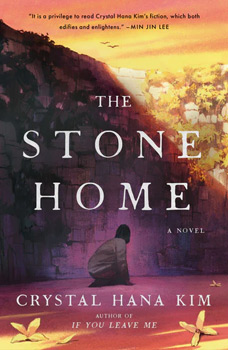
The Stone Home
by Crystal Hana Kim
A moving family drama and coming-of-age story revealing a dark corner of South Korean history.

The House on Biscayne Bay
by Chanel Cleeton
As death stalks a gothic mansion in Miami, the lives of two women intertwine as the past and present collide.

The Funeral Cryer by Wenyan Lu
Debut novelist Wenyan Lu brings us this witty yet profound story about one woman's midlife reawakening in contemporary rural China.
Your guide toexceptional books
BookBrowse seeks out and recommends the best in contemporary fiction and nonfiction—books that not only engage and entertain but also deepen our understanding of ourselves and the world around us.