Summary | Excerpt | Reviews | Beyond the book | Read-Alikes | Genres & Themes | Author Bio
Critics' Opinion:
Readers' Opinion:
First Published:
Nov 2006, 264 pages
Paperback:
Sep 2007, 288 pages
 Book Reviewed by:
BookBrowse Review Team
Buy This Book
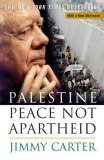
Following his #1 New York Times bestseller, Our Endangered Values, the former president, winner of the Nobel Peace Prize, offers an assessment of what must be done to bring permanent peace to Israel with dignity and justice to Palestine.
President Carter, who was able to negotiate peace between Israel and Egypt, has remained deeply involved in Middle East affairs since leaving the White House. He has stayed in touch with the major players from all sides in the conflict and has made numerous trips to the Holy Land, most recently as an observer in the Palestinian elections of 2005 and 2006.
In this book President Carter shares his intimate knowledge of the history of the Middle East and his personal experiences with the principal actors, and he addresses sensitive political issues many American officials avoid. Pulling no punches, Carter prescribes steps that must be taken for the two states to share the Holy Land without a system of apartheid or the constant fear of terrorism.
The general parameters of a long-term, two-state agreement are well known, the president writes. There will be no substantive and permanent peace for any peoples in this troubled region as long as Israel is violating key U.N. resolutions, official American policy, and the international "road map" for peace by occupying Arab lands and oppressing the Palestinians. Except for mutually agreeable negotiated modifications, Israel's official pre-1967 borders must be honored. As were all previous administrations since the founding of Israel, U.S. government leaders must be in the forefront of achieving this long-delayed goal of a just agreement that both sides can honor.
Palestine Peace Not Apartheid is a challenging, provocative, and courageous book.
17
SUMMARY
Since the Israeli-Egyptian peace treaty was signed in 1979, much blood has been shed unnecessarily and repeated efforts for a negotiated peace between Israel and her neighbors have failed. Despite its criticism from some Arab sources, this treaty stands as proof that diplomacy can bring lasting peace between ancient adversaries. Although disparities among them are often emphasized, the 1974 Israeli-Syrian withdrawal agreement, the 1978 Camp David Accords, the Reagan statement of 1982, the 1993 Oslo Agreement, the treaty between Israel and Jordan in 1994, the Arab peace proposal of 2002, the 2003 Geneva Initiative, and the International Quartet's Roadmap all contain key common elements that can be consolidated if pursued in good faith.
There are two interrelated obstacles to permanent peace in the Middle East:
There is much in the book that is of value, such as the chapter devoted to the humiliations of every day life for the Palestinians under Israeli occupation, the confiscation of farm produce, unfair competition from Israeli goods, the withholding of foreign donations, leveling of houses without legal recourse, and so on and so forth; and the fact does remain that Israel is in violation of key U.N. resolutions. However, whereas Carter goes out of his way to cite examples of Israeli bad faith frequently, he allows many apparently hollow statements and arguable misrepresentations by Israel's enemies to pass into print with little in the way of counter-argument or even comment.
There will always be people ready to criticize any book written about the Israel-Palestine conflict, especially one from a pro-Palestinian viewpoint; but it seems a great pity that Carter, one of the highest-profile authorities on the area, has left himself open to such easy pot-shots with what, at times, comes across as an unnecessarily unbalanced account of the conflict...continued
Full Review
(825 words)
This review is available to non-members for a limited time. For full access,
become a member today.
(Reviewed by BookBrowse Review Team).
A Short History of Palestine
This "beyond the book" feature is available to non-members for a limited time. Join today for full access.

If you liked Palestine, try these:
by Moriel Rothman-Zecher
Published 2019
In this lyrical and searing debut novel written by a rising literary star and MacDowell Fellow, a young man is preparing to serve in the Israeli army while also trying to reconcile his close relationship to two Palestinian siblings with his deeply ingrained loyalties to family and country.
by Yaroslav Trofimov
Published 2008
The dramatic and immensely consequential story of the violent takeover of Islam's holiest shrine, the Grand Mosque in Mecca, by Muslim fundamentalists in 1979. With nearly 100,000 worshipers trapped inside the holy compound, Mecca’s bloody siege lasted two weeks, inflaming Muslim rage against the United States with repercussions we still feel...





The House on Biscayne Bay
by Chanel Cleeton
As death stalks a gothic mansion in Miami, the lives of two women intertwine as the past and present collide.

The Flower Sisters
by Michelle Collins Anderson
From the new Fannie Flagg of the Ozarks, a richly-woven story of family, forgiveness, and reinvention.

The Funeral Cryer by Wenyan Lu
Debut novelist Wenyan Lu brings us this witty yet profound story about one woman's midlife reawakening in contemporary rural China.
Your guide toexceptional books
BookBrowse seeks out and recommends the best in contemporary fiction and nonfiction—books that not only engage and entertain but also deepen our understanding of ourselves and the world around us.