
-
Your next favorite book
is waiting.
Summary | Excerpt | Reading Guide | Reviews | Read-Alikes | Genres & Themes | Author Bio
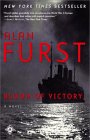
November 1940, and the battle to cut Germany's oil supply rages through the spy haunts of the Balkans amid the street fighting of a fascist civil war. This is classic Alan Furst, combining remarkable authenticity and atmosphere with the complexity and excitement of an outstanding spy thriller.
"In 1939, as the armies of Europe mobilized for war, the British secret services undertook operations to impede the exportation of Roumanian oil to Germany. They failed.
Then, in the autumn of 1940, they tried again."
So begins Blood of Victory, a novel rich with suspense, historical insight, and the powerful narrative immediacy we have come to expect from bestselling author Alan Furst. The book takes its title from a speech given by a French senator at a conference on petroleum in 1918: "Oil," he said, "the blood of the earth, has become, in time of war, the blood of victory."
November 1940. The Russian writer I. A. Serebin arrives in Istanbul by Black Sea freighter. Although he travels on behalf of an émigré organization based in Paris, he is in flight from a dying and corrupt Europe—specifically, from Nazi-occupied France. Serebin finds himself facing his fifth war, but this time he is an exile, a man without a country, and there is no army to join. Still, in the words of Leon Trotsky, "You may not be interested in war, but war is interested in you." Serebin is recruited for an operation run by Count Janos Polanyi, a Hungarian master spy now working for the British secret services.
The battle to cut Germany's oil supply rages through the spy haunts of the Balkans; from the Athenée Palace in Bucharest to a whorehouse in Izmir; from an elegant yacht club in Istanbul to the river docks of Belgrade; from a skating pond in St. Moritz to the fogbound banks of the Danube; in sleazy nightclubs and safe houses and nameless hotels; amid the street fighting of a fascist civil war.
Blood of Victory is classic Alan Furst, combining remarkable authenticity and atmosphere with the complexity and excitement of an outstanding spy thriller. As Walter Shapiro of Time magazine wrote, "Nothing can be like watching Casablanca for the first time, but Furst comes closer than anyone has in years."
On 24 November, 1940, the first light of dawn found the Bulgarian ore freighter Svistov pounding through the Black Sea swells, a long night's journey from Odessa and bound for Istanbul. The writer I. A. Serebin, sleepless as always, left his cabin and stood at the rail, searched the horizon for a sign of the Turkish coast, found only a blood red streak in the eastern sky. Like the old saying, he realized--red sky at morning, sailor take warning. But, a private smile for that. So many ways, he thought, to drown in autumn. The Svistov creaked and groaned, spray burst over the bow as she fought the sea. With cupped hands, Serebin lit a Sobranie cigarette, then watched the dark water churning past the hull until the wind drove him back to the cabin.
As he pulled the door shut, a soft shape stirred beneath the blanket. "Ah, mon ours," she said. My bear. A muffled voice, tender, half asleep. "Are we there?"
"No, not for a long time."
"Well then..." One side of the blanket rose ...

If you liked Blood of Victory, try these:
by William Brodrick
Published 2004
For readers of John Le Carré and Alan Furst, a remarkable debut thriller about love, betrayal and the shadows that war leaves behind.
by Michael Mewshaw
Published 2004
A beautifully made thriller set in Central Asia that evokes a world of subterfuge, potential chaos and nuance hovering just this side of disbelief.
by Ken Follett
Published 2001
Declared "a master" by Time magazine, Ken Follett returns with Code to Zero - a page-turning novel of suspense in the bestselling tradition of Eye of the Needle, The Key to Rebecca, and The Man from St. Petersburg.



The fact of knowing how to read is nothing, the whole point is knowing what to read.
Click Here to find out who said this, as well as discovering other famous literary quotes!

Can you name the title?
Test your book knowledge with our daily trivia challenge!