Reading Guide Questions

Please be aware that this discussion guide will contain spoilers!
About This Book
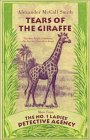
Tears of the Giraffe finds Precious Ramotswe firmly established as Botswana's first and
only lady detective. She's not getting rich, but she's not losing money
either, and under the imaginary ledger for
happiness, her account is
full. Indeed, she is about to marry Mr J.L.B. Matekoni, owner of Tlokweng Road
Speedy Motors. Mr J.L.B. Matekoni is a thoroughly honest and loving man, a man
whose generous impulses not only send him to the local orphanage to fix a water
pump free of charge but also, somehow, bring him home with two small children.
Now Mma Ramotswe has not only a husband but a family to care for, something she
had not allowed herself to hope for after her own child died at birth.
But into this rich, full life comes Mrs. Curtain, an American whose son
disappeared in the Kalahari desert ten years ago. Michael Curtain had been
living in a commune, working on finding a better way to grow vegetables in the
harsh land of Botswana, when he vanished one night without warning and without a
trace. Stricken with grief, Mrs. Curtain has searched in every way possible for
years, exhausting every avenue of inquiry, until the American Embassy
recommended Mma Ramotswe. And even though Mma Ramotswe knows that old unsolved
cases such as the one Mrs. Curtain brings her are what is known in the business
as "stale enquiries," she agrees to try to discover what happened to Michael
Curtain.
Given her own experience of losing a child, she can empathize with Mrs. Curtain.
And in many ways empathy—between Mma Ramotswe and Mrs. Curtain, between Mr
J.L.B. Matekoni and the orphan children, even between wheelchair-bound Motholeli
and the engine of a van—is the central theme of Alexander McCall Smith's
extraordinary novel. The idea that we are all "brothers and sisters" is what
guides the story, sustains the lives of its remarkable characters, and offers
readers so much more than the satisfaction of seeing a mystery solved.
Reader's Guide
- What distinguishes Tears of the Giraffe from most other mysteries?
What qualities make it such a charming and affirmative book? In what ways does
Mma Ramotswe differ from such archetypal detectives as Sherlock Holmes, Sam
Spade, and Philip Marlowe?
- Mrs. Curtain says that when she first came to Africa, she had "the usual
ideas about it—a hotchpotch of images of big game and savannah and Kilimanjaro
rising out of the cloud . . . famines and civil wars and potbellied, half-naked
children staring at the camera, sunk in hopelessness" [p. 27]. How does her
experience of Africa alter these ideas? Why does she feel that "everything
about my own country seemed so shoddy and superficial when held up against what
I saw in Africa" [p. 29]? What deeper and truer understanding of Africa does
the novel itself offer readers who might share Mrs. Curtain's preconceptions?
- Mma Ramotswe knows that Mrs. Curtain's case—finding out what happened
to her son ten years ago—is what is referred to in The Principles of
Private Detection as "a stale enquiry" [p. 61]. Why does she accept the
case, in spite of that? What special empathy does she feel for Mrs. Curtain?
- When Mr J.L.B. Matekoni wonders why his apprentice mechanics take
everything for granted, a friend explains, "Young people these days cannot
show enthusiasm. . . . It's not considered smart to be enthusiastic" [pp.
80-81]. Is this an accurate observation? Where else does the novel demonstrate
this kind of understanding of human behavior?
- Why does Mr J.L.B. Matekoni allow himself to be talked into adopting the
orphans? What specific memory enables him to open his heart to them? What does
this act say about his character?
- Mma Ramotswe thinks that "the Americans were very clever; they sent
rockets into space and invented machines which could think more quickly than any
human being alive, but all this cleverness could also make them blind" [p.
113]. What is it that she thinks Americans are blind to? Is she right? How do
her own values differ from those of mainstream America?
- Tears of the Giraffe poses some difficult moral dilemmas for Mma
Ramotswe. Should one always tell the truth, or is lying sometimes the better
choice? Does a moral end justify immoral means? Which cases raise these
questions? How do Mma Ramotswe and her assistant Mma Makutsi answer them?
- When Mma Ramotswe prepares her accounts for the end of the financial year,
she finds that "she had not made a lot of money, but she had not made a loss,
and she had been happy and entertained. That counted for infinitely more than a
vigorously healthy balance sheet. In fact, she thought, annual accounts should
include an item specifically headed Happiness, alongside expenses and
receipts and the like. That figure in her accounts would be a very large one,
she thought" [p. 225]. What enables Mma Ramotswe to live happily? How would
most American CEOs and CFOs respond to the accounting innovation she suggests in
the above passage?
- How is Mma Ramotswe able to solve the mystery of Mrs. Curtain's son's
disappearance? What role does her intuition play in figuring out what happened
to him? Why is this information so important for Mrs. Curtain?
- When Mma Potokwane tells Mr J.L.B. Matekoni that their pump makes a
noise, "as if it is in pain," he replies that "engines do feel pain. . . .
They tell us of their pain by making a noise" [p. 77]. Later, he tells his
apprentice, "you cannot force metal. . . . If you force metal, it fights
back" [p. 198]. What do these statements reveal about Mr J.L.B. Matekoni's
character? About his approach to being a mechanic? Are his assertions merely
fanciful or do they reveal some deeper truth about the relationship between the
human and the inanimate world?
- One of Mma Makutsi's classmates at the Botswana Secretarial College
tells her that "men choose women for jobs on the basis of their looks. They
choose the beautiful ones and give them jobs. To the others, they say: We are
very sorry. All the jobs have gone" [p. 109]. In what ways does Tears of
the Giraffe suggest ways around the stifling roles dictated by "brute
biology"? What examples does it provide of girls and women overcoming the
restrictions placed on them and assuming traditionally male roles?
- The housemother of the orphanage explains to Motholeli, "We must look
after other people. . . . Other people are our brothers and sisters. If they are
unhappy, then we are unhappy. If they are hungry, then we are hungry" [p.
124]. In what ways does the novel demonstrate this ethic in action? How is this
way of relating to other people different from the starker examples of American
individualism?
- In what ways are Mr J.L.B. Matekoni and Mma Ramotswe well-suited to each
other? How do they treat each other in the novel? How do they complement each
other?
- In what ways is Tears of the Giraffe as much about family
relationships as it is about solving crimes? How does the novel provide
emotionally satisfying resolutions to the parental pain that both Mrs. Curtain
and Mma Ramotswe have suffered?
Suggested Reading
Robert Barnard, The Bones in the Attic
J. M. Coetzee, Disgrace
Deborah
Crombie, And
Justice There is None
Alexandra Fuller, Don't Let's Go to the Dogs
Tonight: An African Childhood
Peter Godwin, Mukiwa: A White Boy in
Africa
Nadine Gordimer, Six Feet of the Country; Tony Hillerman, The
Wailing Wind
J. Nozipo Maraire, Zenzele: A Letter for My Daughter
Melville Davisson Post, The Sleuth of St. James' Street
Peter
Robinson, Aftermath.
Copyright Anchor Books
Unless otherwise stated, this discussion guide is reprinted with the permission of Anchor Books.
Any page references refer to a USA edition of the book, usually the trade paperback version, and may vary in other editions.