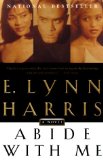
Abide With Me by E Lynn Harris: Questions, plus a reading group guide, with links to reviews, excerpt, author interview and author biography at BookBrowse.com.
Abide With Me
by
E Lynn Harris
Hardcover: Mar 1999,
350 pages.
Paperback: May 2000,
368 pages.
Caution! It is likely that the following questions will reveal, or at least allude to, key plot details. Therefore, if you haven’t yet read this book, but are planning on doing so, you may wish to proceed with caution to avoid spoiling your later enjoyment.
The life Raymond long dreamed about has become a reality. He is living openly and happily with Trent, a successful architect, in Seattle, and his high-powered legal career has earned him a nomination for a federal judgeship. On the other side of the country, Nicole is married to Raymond's best friend, Jared, and enjoying lots of attention as a hot new singer and actress. But demons, both old and new, suddenly disrupt the happiness they've worked so hard to achieve. Unsettling rumors about Trent and the reappearance of Basil Henderson, his irresistible and volatile ex-lover, send Raymond into a tailspin. For Nicole, trouble comes in the form of an ambitious colleague, whose wily schemes threaten more than Nicole's career.
For discussion: Abide with Me
What does Basil hope to prove by stripping in front of his therapist [p. 16]? Why does he brag about leaving his date sitting in a restaurant? How are these two acts related? Are Basil's opinions about women and sex unusual or warped [pp. 30-31]? Do other men feel the same way, even if they hesitate to talk about it as openly as Basil does? Do you agree or disagree with Basil when he says, "I understand the power of sex. And once you understand something completely, you can control it" [p. 32]?
What techniques does Yancey use to ingratiate herself with Nicole? Is Nicole nave in accepting Yancey's friendship so readily? Yancey declares that after Albert, her high-school boyfriend, betrayed her "Every brother I meet is paying for what Albert did" [p. 54]. Do you think that Albert's marriage to a white woman made the situation more painful for Yancey than it would have been had he chosen a black wife? How do her opinions of men compare to Basil's views of women?
Trent is concerned that he won't get an assignment he wants because the project leader is a black woman. Are his fears understandable? Why does he say "you know how we can sometimes be our worst critics" [p. 63]? Are there examples of this tendency in the book? Have you encountered situations in which blacks are overly critical of other blacks? Do other groups exhibit the same behavior? Why do you think this happens?
Raymond and Trent briefly discuss getting married. Do you think that gay marriages should be legal? Why or why not?
After they meet an old friend of Nicole's at a restaurant, Nicole and Yancey talk about the way women compete with one another [p. 84]. How do their reactions to the "bad seeds" they've encountered differ? Is Nicole too forgiving of the actress the rest of the cast called "Evilene"? Was Yancey's "trick" for defeating her rival justifiable or unethical? How important is it for black women to stick together, particularly when it might entail sacrificing their own goals?
The NAACP withdraws its support of Raymond's nomination to back a candidate who "understands the needs of our community, especially on issues regarding the survival of the African-American family" [p. 95]. Is a gay candidate like Raymond incapable of understanding and supporting the basic values of the community? Can his partnership with Trent be defined as a "family"?
In what ways does Raymond Sr.'s objection to Kirby's involvement with an Asian woman parallel his discomfort with Raymond and Trent's relationship? Do members of minority groups have a moral obligation to date and/or marry within the group? Do interracial or interreligious marriages necessarily undermine individual cultures?
Why is Raymond so reluctant to confront Trent when he learns of his arrest? By betraying his promise to Trent to be open and honest, is Raymond betraying himself as well? What is the significance of the fight he has with his father about the situation? Is his father only concerned with Raymond's political future? Why does Raymond Sr. say "Stop letting people fuck you over, especially black folks"[p. 161]? What does this indicate about his own biases and beliefs?
When Raymond and Trent finally discuss Trent's infidelities, whose side are you on? Does Trent take their relationship too casually or is Raymond demanding a level of perfection that is impossible to achieve? Are the conflicts between Nicole and Jared more clear cut [pp. 284-285]? Do they handle them better than Raymond and Trent? Why is Nicole so ambivalent about starting a family? In addition to her reluctance to give up her career, what other factors contribute to her hesitations?
When she tells Raymond about his father's affair early in their marriage, Raymond's mother says "People sometimes do hurtful things just to get the other person's attention" [p. 291]. How does this relate to the events in the book? Are Basil's and Yancey's schemes, for example, mean-spirited and evil? Or are they desperate attempts to generate the attention and love that is missing from their lives?
Suggestions for further reading
Maya Angelou, I Know Why the Caged Bird Sings; James Baldwin, Another Country; Bebe Moore Campbell, Brothers and Sisters; Eric Jerome Dickey, Cheating; Ralph Ellison, Invisible Man; Gloria Naylor, The Men of Brewster Place; April Sinclair, Coffee Will Make You Black; Omar Tyree, Sweet St. Louis; John Edgar Wideman, Philadelphia Fire
Page numbers refer to the Anchor paperback edition. Reading group guide and suggested reading list reproduced with the permission of the publisher, Anchor Books.
Unless otherwise stated, this discussion guide is reprinted with the permission of Anchor Books.
Any page references refer to a USA edition of the book, usually the trade paperback version, and may vary in other editions.
One of the most celebrated writers of our time gives us his first cycle of short fiction: five brilliantly etched, interconnected stories in which music is a vivid and essential character.
In her most accomplished novel, Barbara Kingsolver takes us on an epic journey from the Mexico City of artists Diego Rivera and Frida Kahlo to the America of Pearl Harbor, FDR, and J. Edgar Hoover. The Lacuna is a poignant story of a man pulled between two nations as they invent their...
The acclaimed author of Motherless Brooklyn and The Fortress of Solitude returns with a roar with this gorgeous, searing portrayal of Manhattanites wrapped in their own delusions, desires, and lies.
The Pulitzer Prize-winning author "an immensely gifted writer and a magical prose stylist" (Michiko Kakutani, New York Times)offers his first major work of nonfiction, an autobiographical narrative as inventive, beautiful, and powerful as his acclaimed, award-winning fiction.
Like Robin Hood, Zorro is a story that almost everyone knows, but few have read. The original book by Johnston McCulley is out of print and ...
read more
I'm 13 years old and my teacher handed me this book and told me to read and do a report on it. I looked at the cover, saw the title (which made no ...
read more
I'm 13 years old and my teacher handed me this book and told me to read and do a report on it. I looked at the cover, saw the title (which made no ...
read more
The 2009 National Book Award Winners(Nov 19 2009) The winners of the 2009 National Book Awards have been announced at the National Book Foundation's 60th National Book Awards Ceremony and Benefit...
Full Story
Google Settlement Filed(Nov 13 2009) After two delays, attorneys for the AAP, Authors Guild and Google filed an amended settlement agreement today in an effort to end litigation brought by the...
Full Story
Become a member!
BookBrowse seeks out and recommends only the most interesting and well written books and provides you with everything you need to decide which are
right for you - so you can browse the best and ignore the rest.
One Month Free Trial