Reading Guide Questions

Please be aware that this discussion guide will contain spoilers!
INTRODUCTION
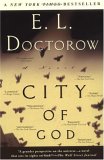
City of God
City of God opens a vast window on a range of religious, scientific, historic, and aesthetic concerns. E. L. Doctorow’s novel promises to strike readers as a wonderfully unusual novel with a liberating narrative technique that breaks many of the so-called "rules" of the novel and also echoes and riffs on styles and themes from a wide range of literary and historical antecedents. The works of such disparate authors as John Dos Passos, Virginia Woolf, Walter Benjamin, Tony Kushner, Elie Wiesel, and Jorge Luis Borges might be discussed alongside City of God with fruitful results.
A novel as thematically playful, nonlinear, and wide-ranging as
City of God invites a similarly atypical approach to discussing it in a reading group. Hardly a narrative suitable for chapter-by-chapter analyses and succinct plot summaries, Doctorow’s novel concerns itself centrally with the kind of capital "M" mysteries (the natures of God, creation, and human destiny) that finally defy satisfying solutions. Casting readers as apprenticing detectives to the Reverend Dr. Thomas Pemberton, the self-anointed Divinity Detective,
City of God allows for a lot of intellectual "play" and features what Doctorow has called a "kitchen sink" prose style. The book conflates all sorts of literary forms and genres and serves up a stew of fragmented biographical sketches, Homeric verse poems, prayers, and jazz-like improvisations on pop standards, all of which orbit around the narrative’s central issue—the mystery of the stolen cross.
The plot of
City of God, such as it is, will likely seem confusing to readers because it is so fragmented and jittery, and because the narrative, especially at the outset, rarely supplies us with the standard clues to establish who is speaking and what the situation is. A useful metaphor which could be discussed and assigned to the novel is that of an intricate puzzle, the assembly of which is up to the reading group to perform together. Perhaps more than any book since Joyce’s
Ulysses,
City of God all but defies critical distillation or reduction. And like
Ulysses,
City of God is more than anything a work of skilled mimesis, mirroring in prose the nature of one New York writer’s consciousness and concerns at the dawn of the twenty-first century.
ABOUT THE BOOK
As diversely populated and wide-ranging as it seems, E. L. Doctorow's novel can nonetheless be viewed as a singular, intricately rendered portrait of one man's peripatetic imagination and streaming consciousness. Everything we read about in
City of God—from the Episcopal priest in the throes of a crisis of faith and the bereaved rabbi endeavoring to redirect the destiny of the entire Jewish tradition, to a Holocaust survivor's harrowing ghetto narrative and the pair of lushly imagistic verse poems about the World Wars—presumably flows from a single, blinking computer cursor that is manipulated by a middle-aged New York novelist named Everett. With Everett as his protagonist and millennially harried Everyman, Doctorow takes readers on a sweeping survey of the twentieth century, channeling the voices of Albert Einstein, Ludwig Wittgenstein, and Frank Sinatra, as well as the voices of Everett's fellow fictional beings, who occupy the novel's principal narrative. Beginning with his novel's title and its Augustinian overtones, every aspect of Doctorow's survey is in the service of the novel's thematic preoccupation with the nature of belief, the mystery of human consciousness, and above all, "our wrecked romance with God."
As
City of God begins, readers find Everett—a secular man without extensive training in astronomy or physics—riffing on the cosmos and dropping some poetry-tinged science. As he summarizes modern conceptions of the history of the universe, Everett struggles with the mind-dwarfing notions of two tenets that are central both to the novel itself as well as to the Judeo-Christian religious tradition writ large: the notion of a "singular original" Creator, and the belief in an ever-approaching and ultimately unknowable human destiny. If the Big Bang engendered fifteen billion years of spatial expansion, then to what end is this expansion progressing? And as to the space itself (our universe) that is expanding: what, exactly, is it filling up or replacing? And above all, Everett wonders, what kind of "fearsome" God could be involved in these concepts of "disastrous, hopeless infinitude," this "fluke happenstance," this apparently "accidental" genesis? Here, in Everett's universal musings, which appear frequently in the first forty or so pages of the book, Doctorow illuminates an unresolvable disconnect between Reason and Faith, or between scientific understandings about the origin of life and organized religion's increasingly untenable narratives about the same. This same crucial disconnect comes to play a primary part in the story of the Reverend Dr. Thomas Pemberton, to whom we are introduced as the first-person narrator of the new book Everett is sketching out.
In the early pages of the novel, an enormous brass cross is heisted from St. Timothy's Episcopal on the Lower East Side. Pemberton, D.D. (for "Divinity Detective"), sets off in search of it, yet he senses from the start that this is no ordinary theft, with no ordinary solution. "So now these people," Pem says, "have lifted our cross. It bothered me at first. But now I'm beginning to see it differently. That whoever stole the cross had to do it. And wouldn't that be blessed? Christ going where He is needed?" When the cross turns up on the roof of the fledgling Synagogue for Evolutionary Judaism on the Upper West Side, Pem realizes he is being led by fate. With Rabbi Sarah, Pem seeks to transcend the constraints of storytelling and to reclaim an elusive, pre-scriptural (pre-narrative) state of "unmediated awe."
City of God's own story climaxes here, with Pem on the verge of Jewish conversion, giving what is in a sense his final sermon, telling God that consciousness, our stories, our language, all of them are "not enough." "If we are to remake [rewrite] ourselves, we must remake you, Lord."
Through Everett, E. L. Doctorow serves up an amalgam of literary genres dealing with a common theme. He introduces a series of tenuously related stories comprised of philosophical meanderings, sleuthing narratives, cultural histories, theological musings, science lessons on the life of ants, explications and deconstructions of pop lyrics, film treatments, poetry, and even a head-spinning monologue from the twentieth century's silver-throated Chairman of the Board. The dizzying array of styles, tones, and rhythms pile up on us like so much history. Doctorow has rendered what might be viewed as a prose simulation of contemporary Western consciousness: eclectic, scattered, unresolved, attention-deficit-disordered, overloaded with information, and tremendously burdened by the weight of so much devastating human history. Clearly, a linear, A-to-B narrative has no chance of reproducing the disjointed, poignant rhythms of the shell-shocked, end-of-the-century New York City which Doctorow imagines here. Like the Bible (the prototypical fusion of disparate stories on a common theme), like a city, like the whole of literature, and like contemporary life itself, Everett's stream of fragments in
City of God resembles "a great historically amassed communal creation" derived from the Word and from the evolutions of culture that language makes possible.
TOPICS AND QUESTIONS FOR DISCUSSION
The following are intended to enrich your conversation and help your reading group find new and interesting angles and topics for approaching this novel.
1. One critic has written that
City of God is a story about storytelling—about the ubiquity of narrative; about the whole of language existing as a storytelling tool to reflect and respond to reality; about consciousness perceived as a narrative (hi)story. Do you agree with this characterization? Discuss the dozens of stories that comprise Doctorow's book, from the story of the universe to Yehoshua's ghetto narrative, highlighting the interplay that exists among them.
2. Discuss the structure, language, and imagery of
City of God. In what ways does it mimic or recreate the rhythms of contemporary thought and life? How might Doctorow's structure—full as it is of spiraling ideas, images, and themes which recur and continually double back on themselves—be viewed as a sort of jazz-like innovation on the Wagnerian leitmotif? To what end do these spiraling repetitions of theme progress? How do they all relate to and riff upon the central mystery of the missing cross?
3. When Pem goes to the cancer ward just after leaving the priesthood, he encounters a group of dying people singing twentieth-century standards. Discuss the implications of this scene. Why does it affect Pem the way it does? What does it mean when the pop song, that most "self-referential" and instantly recognizable of all musical genres, is transformed into a sort of secular hymnal?
4. Compare and contrast the spiritual and metaphysical quests of Pem, Everett, and Sarah.
5. Chart the course of Pem's relationship with Sarah Blumenthal, from their first meeting at the synagogue where the stolen cross is discovered, to their wedding reception at the close of the book. What qualities attract Pem to Sarah? Sarah to Pem? And in terms of the book's major themes, what are the implications of their union? How does their marriage affect Everett? What is it about these two ecclesiastics that Everett finds so fascinating?
6. "You say all history has contrived to pour this beer into my glass," says the nameless Vietnam veteran to Everett. Later, Pem speaks of "a great historically amassed communal creation." And finally, much earlier in the novel, Rabbi Joshua asks, "Is time a loop? Do you have the same feeling I have—that everything seems to be running backwards? That civilization is in reverse?" What is going on in all of these lines? What theme is Doctorow underscoring here?
7. How might the Jewish notion of Messianic time, in which all of history becomes meaningful retrospectively by the sudden and unexpected coming of the Messiah, be linked to the themes in
City of God?
8.
City of God is one of those perfect books for reading clubs and discussions among friends, because much of the power in this novel derives from what the author leaves unsaid, from what lies in the spaces between the characters' perceptions, and from the ways Doctorow invites the reader to draw her/his own conclusions and make her/his own conjectures. Discuss your reactions to Doctorow's characters and their relationships to each other. What techniques does the author use to develop the novel's central characters? What particular qualities make these people so believable and/or affecting?
9. Discuss the book's extended portrait of the man who discovers that his life is gradually becoming a movie. What is going on here? Fill in the blanks of Doctorow's metaphor.
10. Pem ferociously struggles with the Judeo-Christian tradition—in much the way his real-life forebear, James Pike, did—because it appears to him to be more a narrative about power, genocidal destruction, and the renunciation of human reason and intellect than about faith, hope, and love. "I take the position that true faith is not a supersessional knowledge. It cannot discard the intellect. . . . How can we presume to exalt our religious vision over the ordinary pursuits of our rational minds?" Interpret Pem's remarks here to the bishop's examiners. Then re-read Pem's crowning toast at the wedding, the culmination of his struggle. How does this impassioned and captivating speech serve to bring together the myriad fragments that have preceded it in
City of God?
Unless otherwise stated, this discussion guide is reprinted with the permission of Plume.
Any page references refer to a USA edition of the book, usually the trade paperback version, and may vary in other editions.