
-
Your next favorite book
is waiting.
Summary | Excerpt | Reading Guide | Discuss | Reviews | Beyond the Book | Read-Alikes | Genres & Themes | Author Bio
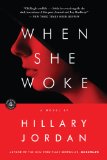
A Novel
by Hillary Jordan Book Reviewed by:
For supplemental discussion material see our Beyond the Book article, Roe vs. Wade and our BookBrowse Review of When She Woke.
Please be aware that this discussion guide will contain spoilers!
An Interview with Hillary Jordan about When She Woke and Questions for Discussion
When She Woke is, to say the least, a very different book from
your debut novel, Mudbound. What inspired you to go in such
a radically different direction?
I actually wrote the first pages of When She Woke in the spring
of 2000, in the same workshop where I started Mudbound. And
I didn't know what to do with When She Woke, so I wrote Mudbound
instead. I didn't return to it until the summer of 2007, after
I'd finished Mudbound. By then, we'd seen profound and disturbing
changes in America: a rise in religious fundamentalism, the
muddying of the line between church and state, infringements on
civil rights in the name of patriotism and national security. When She Woke was my response.
And you've clearly chosen to use an American classic, The Scarlet Letter, to tell your story. Can you talk about why you
turned to Nathaniel Hawthorne?
The original story fragment of When She Woke centered on a
young woman who'd been turned red as punishment for murdering
her sister's abusive husband. At first (and unbelievably to
me now) I didn't make the connection between my stigmatized
heroine and Hawthorne's. And then one day Hester Prynne and
her scarlet A popped into my mind, and I thought, Huh, I should
reread that book. And I did, that very afternoon, for the first time
since high school, and it sparked all sorts of interesting connections
and ideas. Hester is made to stand on a scaffold in front of the
whole community and exhibit the mark of her shame. So what, I
asked myself, would the futuristic equivalent of a scaffold be? Reality
TV, of course, only in a more sinister form. Hester is impregnated
by a charismatic clergyman, the analogue of which would be ... a
megachurch preacher. And because of The Scarlet Letter, my future
America ended up being not just cruel and repressive but also
essentially a theocracy, as seventeenth-century Boston was. But
while the beginning of When She Woke owes a lot to Hawthorne,
the two story lines diverge sharply after that. I didn't adhere to The Scarlet Letter as much as riff on it. Which was a lot of fun because
it's a book I truly love.
How do you think fans of Mudbound will react to this one?
I think it will be love or hate, with very little in between! (Though
I'm hoping for more of the former.) But I also think readers will
find that the two books have more in common than might be immediately
apparent. Both have strong female protagonists whose
desire for self-realization leads them to defy the cultural expectations
that bind them; both are concerned with discrimination and
alienation; both take issue with absolutism. And obviously, they're
both perfect, lighthearted beach reads.
When She Woke begins with Hannah, who wakes up on a pallet
in a prison cell and learns that she is now colored red from
head to toe. From that startling opening, the curtain is drawn
back slowly to reveal this different America and Hannah's
place in it.
Why did you choose to start the novel this way?
I wanted to catapult readers into Hannah's reality from page one,
to make them experience what she was experiencing in an immediate
and visceral way. And I wanted to create dramatic tension.
In that sense I'm pretty traditional, both as a storyteller and as a
reader: bring on the drama, and the juicier, the better.
In this new America, criminals are "chromed" a color to match
their crime and reintroduced into society. It's such a radical
idea; what was your inspiration for the concept of "chroming"?
The idea was sparked by a conversation I had with a family member
about the drug problem in America. He said something to the
effect of, "I think all drugs ought to be legal and provided by the
government; they just ought to turn you bright blue." Meaning,
go get as high as you want, but other people will be able to see you
coming and stay the hell away from you. And this conversation,
and the idea of what it would be like to be stigmatized in this way,
stuck in my mind, and some fifteen years later bore the strange red
fruit that became When She Woke.
In Mudbound you wrote about racism and sexism in the South,
and with When She Woke you explore governmental control,
faith, crime and punishment, sexual politics, and civil rights.
Do you set out to write political fiction, or is that where your
books end up taking you?
I set out to write literature. And I think it's the job of literature to
tackle the really big issues, to say to people, "Hey, you may believe
X, but have you ever considered Y, did you know there was a Z?"
With Mudbound I knew I was going to write about race, but I initially
thought it would be secondary to the McAllan family drama.
Little did I know where Ronsel (who didn't even exist for the first
several years) and my own deep-seated feelings about racial injustice
would take the book. With When She Woke I was more cognizant
of wanting to explore certain issues that were on my mind at
the time, like government invasions of privacy, abortion rights, and
the intersection of faith and politics. Having said that, I'm a storyteller,
not a polemicist. Very few people outside university political
science departments want to read a 341-page political tract, and I
have zero interest in writing one.
Your use of The Scarlet Letter might lead some to conclude
that you think we're moving toward an increasingly puritanical
society. Do you?
I think there's a small, loud group of people who would have us
move in that direction, but really they're no different from any of
the other extremists in our history who have sought to impose their
morality on the rest of us. The problem with the religious fundamentalist
political agenda - besides the fact that it's unconstitutional -
is that it's fundamentally un-American. Like all extremist
movements, its success depends on making people afraid of each
other. And while we've certainly seen periods in America when
fear and paranoia have won out over reason and compassion -
post-9/11, the Cold War, and Jim Crow are just a few of the more
recent examples - they've never lasted. I believe that's because most
of us want to find our own way to happiness. We're here for such a
short, precious time; we want to choose how we live, how we love,
how we worship; and because we want that freedom for ourselves,
we have to see the justice in giving it to our neighbors. This is who
we are as a people. When She Woke is about the consequences of
letting fear and paranoia make us forget who we are.
A subplot running through the novel is how Chromes are
broadcast live on TV 24/7, which seems an extension of a culture
obsessed with reality TV, a culture where the notion of
Big Brother is fully and openly embraced. In what ways do you
think a surfeit of reality TV changes how we see (and treat)
others?
People don't always want to be in their own lives, their own realities.
I certainly don't, which is why I'm grateful for literature and
theater and art and music and film. The difference I see with reality
TV is that so much of it seems to be about humiliation, about
showing people at their smallest and meanest, their lowest and
most abject. It turns human life into a cheap spectacle and serves
it up for mass consumption. And by devouring it as mindlessly as a
bag of potato chips, we, the audience, end up being willing participants
in our own cheapening.
What was the hardest part about writing When She Woke?
Sticking so close to just one character. With Mudbound I had
six voices to choose from; when I got tired of being an educated
middle-aged white mother of two, I could become a young black
soldier or an illiterate farmer or a charmer with a drinking problem.
With When She Woke there was no escaping Hannah, and her
head was often a very dark place to be.
What do you hope readers will take away from the novel?
An increased respect for the beliefs of other people, however different.
And a strong desire to read more fiction!
Questions For Discussion
Join BookBrowse free to unlock all 10 discussion questions, author background, themes, and more for When She Woke.
Join free — it takes 30 secondsAlready a member? Log in →
Unless otherwise stated, this discussion guide is reprinted with the permission of Algonquin Books. Any page references refer to a USA edition of the book, usually the trade paperback version, and may vary in other editions.



Every good journalist has a novel in him - which is an excellent place for it.
Click Here to find out who said this, as well as discovering other famous literary quotes!

Can you name the title?
Test your book knowledge with our daily trivia challenge!
Your guide toexceptional books
BookBrowse seeks out and recommends the best in contemporary fiction and nonfiction—books that not only engage and entertain but also deepen our understanding of ourselves and the world around us.
