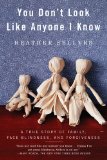
You Don't Look Like Anyone I Know by Heather Sellers: Questions, plus a reading group guide, with links to reviews, excerpt, author interview and author biography at BookBrowse.com.
You Don't Look Like Anyone I Know A True Story of Family, Face-Blindness and Forgiveness
by Heather Sellers
Hardcover: Oct 2010,
368 pages.
Paperback: Oct 2011,
368 pages.
Please be aware that this discussion guide may contain spoilers!
Sellers struggles, as a child, to find safety with her mother and then with her father. As an adult, in what ways does she comes to terms with each parent's failure to provide that safety and constancy?
Sellers' mother constantly checks locked doors, and worries she is being followed. Her father cross-dresses and drinks around the clock. In what ways are her parents alike, and in what key ways are they different?
Sellers never finds out the cause of her face blindness. She also never discovers a diagnosis for her father's strange, disturbing behaviors. A major theme running through the book is this: how do we come to know anything for certain, and how do we come to terms with what we will never know about our own families? In your experience, is this a universal truth of growing up?
There is so much chaos, difficulty, despair, and even terror in Sellers's childhood. Yet the author sees humor in mother's weird rituals, and finds delight in the perfect pink skirt. What do you make of the humor, warmth, honesty, and courage that runs through many of the chapters? What emotions did you experience while reading the book?
What do you make of Sellers's stance towards her family? Would you feel similarly or different, if the circumstances of your childhood were comparable to the difficult home life portrayed in You Don't Look Like Anyone I Know?
How do you think face blindness affected the author as a writer?
In the Afterword to the book, Sellers talks about "the gift of prosopagnosia." What do you think she sees as the gifts of face blindness? Are these truly gifts?
Sellers figures out her face blindness and her mother's illness almost simultaneously. How are the two quests similar? How are they different?
When Sellers presents her research and self-diagnosis to her primary care physician and then a local neurologist her certainty is met with disbelief. Have you had experiences where you weren't believed? How did you react? Does not being believed help us stake a claim?
Sellers recalls that when she presented her first draft of the memoir to her writer's group and an editor, people responded, This is too raw. How could you live this way? Is the story she tells "too raw"? Why or why not?
By Heather Sellers' own account, prosopagnosia (face blindness) caused her constant confusion and anxiety. Yet she did not identify her disability until she was nearly 40. Why did it take her so long?
When Sellers marries Dave, a warm and loving man with two sons, the marriage unravels almost before it begins. Why do you suppose they married? Why did they divorce? What does Sellers take away from each of those decisions?
Unless otherwise stated, this discussion guide is reprinted with the permission of Riverhead Books.
Any page references refer to a USA edition of the book, usually the trade paperback version, and may vary in other editions.

A very large book - in number of pages and in content - and every page worth reading. Thoroughly enjoyed this one and her first book on the...
read more
Two Lives is a memoir written by international best-selling author, Vikram Seth. In this interesting and engaging book, Seth writes about his great...
read more
Z, the novel about the life of Zelda Sayre Fitzgerald is at points charming and; like another reviewer, I kept thinking of the movie, "Midnight...
read more
Judge rules unused Borders gift cards to be worthless(May 23 2013) Borders owes nothing to holders of roughly $210.5 million of gift cards that had not been used by the time the bookstore chain shut down, a Manhattan federal...
Full Story