The Boy Who Harnessed the Wind by William Kamkwamba: Questions, plus a reading group guide, with links to reviews, excerpt, author interview and author biography at BookBrowse.com.
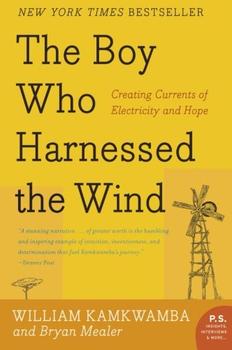
The Boy Who Harnessed the Wind Creating Currents of Electricity and Hope
by William Kamkwamba
Hardcover: Oct 2009,
288 pages.
Paperback: Aug 2010,
320 pages.
Please be aware that this discussion guide may contain spoilers!
Introduction
As a young boy, William Kamkwamba read about windmills and dreamed of building one that would bring electricity and water to his village in Malawi, a country withered by drought and hunger. In 2002, when his country was stricken with a famine, William's family's farm was devastated and his parents were left destitute. With nothing more than a fistful of cornmeal in his stomach and his own determination, William used scrap metal, tractor parts, and bicycle halves, to forge a crude yet operable windmill, an unlikely contraption complete with homemade switches and a circuit break made from nails and wire. Eventually it powered four lights. In time, a second machine turned a water pump that could battle the drought and famine that loomed with every season. Soon, news of William's magetsi a mphepohis "electric wind"spread beyond the borders of his home and he became an inspiration around the world. Here is the remarkable story about human inventiveness and its power to overcome crippling adversity. The Boy Who Harnessed the Wind will inspire anyone who doubts the power of one individual's ability to change his community and better the lives of those around him.
Questions for Discussion
Could you imagine living without electricity? What would your life be like? Describe William's life and compare it to American teenagers and even your own.
How did the villagers compensate for not having electricity, telephones, or most of the modern conveniences we take for granted?
What is the role of magic in the story? What about education? Contrast the two. Is there room for both in a culture? What about education and religion? How do the two impact each other? How did William's religion influence his outlook?
What did electricity and the creation of the windmill mean for William, his family, and his village? What might his accomplishment mean for the world?
What motivates people like William to attempt the unthinkable? How would you describe him to someone who's never heard of his achievement?
Compare William to his father and to his mother. How are they alike? How did his parents shape William's outlook?
Imagine what a handful of Williams with some encouragement and financial backing from government and private sources might accomplish. Offer some ideas.
Malawi is an extremely poor nation. What are the causes of this poverty and what exacerbates it? How might these causes and influences be overcome? How has the Westthink of organizations like the International Monetary Fund and the World Bank, run by Americans and Europeanshelped to contribute to nations like Malawi's troubles?
William writes of the corruption, greed, nonexistent services, and lack of empathy that turned the drought into a disaster for average people like him and his family. Can you see any similarities with our own culture, both past and present? Think about the American Depression. How did that compare to Malawi's drought?
William was desperate to stay in school but could not because of money. Think about American students. Why do you think with all the opportunities for schooling, students are disinterested in learning? In your opinion, what accounts for the differences between William and his American counterparts?
Many Americans criticize public schools and some even question the need for them. Others argue that money doesn't matter when it comes to education. How does William's experience address our own debates on the subject? Think about his school, and compare it to American schools. Might William's life be different if he had access to education without having to pay? How so?
What lessons did you take away from William's story?
Unless otherwise stated, this discussion guide is reprinted with the permission of Harper Perennial.
Any page references refer to a USA edition of the book, usually the trade paperback version, and may vary in other editions.
Fearless, gripping, at once darkly funny and tender, spanning three continents and numerous lives, Americanah is a richly told story set in today's globalized world.
The story of an American family, middle class in middle America, ordinary in every way but one. But that exception is the beating heart of this extraordinary novel.
The best book I've read in a very long time and the first ever Bo Caldwell novel for me. I'd never before read anything about missionaries to China,...
read more
With a poetic voice, Ratner plunges us into this personal trial of a royal family wrenched from their home in Phnon Penh, Cambodia, during the late...
read more
First time novelist Vaddey Ratner captured my heart and senses in this novel based on her childhood in Cambodia. Her story transcends any news story...
read more
Amazon cuts off 5200 affiliates in Minnesota(Jun 19 2013) With Minnesota's online sales tax law due to take effect July 1, Amazon has played a familiar card by cutting ties with 5,200 members of its Associates...
Full Story