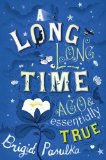
A Long, Long Time Ago and Essentially True by Brigid Pasulka: Questions, plus a reading group guide, with links to reviews, excerpt, author interview and author biography at BookBrowse.com.
A Long, Long Time Ago and Essentially True
by Brigid Pasulka
Hardcover: Aug 2009,
320 pages.
Paperback: May 2010,
368 pages.
Please be aware that this discussion guide may contain spoilers!
Introduction
On the eve of World War II, in a place called Half-Village, a young man nicknamed the Pigeon falls in love with a girl fabled for her angelic looks. To court Anielica Hetmanská he offers up his "golden hands" to transform her familys modest hut into a beautiful home, thereby building his way into her heart. Then war arrives to cut short their courtship, delay their marriage, and wreak havoc in all their lives, even sending the young lovers far from home, to the promise of a new life in Kraków. Nearly fifty years later, their granddaughter, Beata, repeats their postwar journey, seeking a new life in the fairy-tale city of her grandmothers stories. But when she arrives in Kraków, instead of the whispered prosperity of the New Poland, she discovers a city caught between its future and its past. Whimsical, wise, magical, and sometimes heartbreaking, A Long, Long Time Ago and Essentially True weaves together two remarkable stories, reimagining half a century of Polish history through the legacy of one unforgettable love affair.
Discussion Points
Early in the novel, Beata introduces herself as Baba Yaga, the name she goes by for most of the book. We dont learn her given name until her grandfather returns to Poland and greets her with it. Why do you think the author made this choice? What effect, if any, did it have on your reading experience to know the narrator only by a nickname?
On page 3, the narrator says, "We Poles have always been known by our golden hands." Do you think Beata carries on her grandfathers legacy? Why do you think Beata is ultimately the narrator of both stories, that of her grandparents and her own?
Beata describes the TV retrospectives and commercials that she and Irena watch as symbolic of the New Poland caught between the past and the future, communism and capitalism. Where else in the novel does Pasulka illustrate Polands "in-betweenness."
Many of the older Polish citizens in the novel are unsure just how grateful they are to be rid of the communists, if it means becoming capitalists. What do you think Irena means on page 53 when she says, "Capitalists are just communists without the polyester"?
Irena, Magda, and Beata form a constantly shifting triangle of alliances. What binds these women together, and, ultimately, what does Beata fear will tear them apart? Discuss the various incarnations of family that appear throughout the novel what binds any of these people together? Do you think extraordinary circumstances cause people to behave in ways they never would otherwise, or do such circumstances merely expose the true colors of peoples hearts?
Beata sees herself as the "responsible" daughter, compared with Magda, who constantly gives her mother aggravation. How do you think this perception influences Beatas behavior in Kraków and the way she relates to her aunt and cousin?
How do you feel about the betrayal Beata thinks she has committed against Magda? How do her feelings of betrayal affect her throughout the novel?
After filming Pani Bozena, the grande dame of Kraków retreats into depression and emerges as a simpler, kinder woman, which Beata thinks must be her true self. What really triggers this transformation for Bozena? Discuss other transformations that occur in the novel, and compare the mechanics of each.
"Act as if." This motto is repeated throughout the novel. What meaning does this phrase have for the people of Half-Village? For the communist Poland of Irenas youth? What does it mean for Beata and her generation?
On page 244, Beata describes her feelings of hopelessness, despite the elation she should expect to feel after having roundly berated Ronan and his English friends. Do you think her pessimism is justified?
Why do you think Beata is so lost in her own life, existing but without direction or even a clear desire? What events finally come together to set her on her own path?
Beata tells Irena that Nela told her stories with only happy endings. Do you think A Long, Long Time Ago and Essentially True has a happy ending? How do you feel about the ending?
Unless otherwise stated, this discussion guide is reprinted with the permission of Mariner Books.
Any page references refer to a USA edition of the book, usually the trade paperback version, and may vary in other editions.
Fearless, gripping, at once darkly funny and tender, spanning three continents and numerous lives, Americanah is a richly told story set in today's globalized world.
The story of an American family, middle class in middle America, ordinary in every way but one. But that exception is the beating heart of this extraordinary novel.
First time novelist Vaddey Ratner captured my heart and senses in this novel based on her childhood in Cambodia. Her story transcends any news story...
read more
From the first page, I was drawn in by the lyrical writing of the author and mesmerized as the narrator, eight year old Raami, remembered the years...
read more
Trite but true, all good things must come to an end. I so wanted to keep reading the wonderful prose, the settings that let one think they are part...
read more
Amazon cuts off 5200 affiliates in Minnesota(Jun 19 2013) With Minnesota's online sales tax law due to take effect July 1, Amazon has played a familiar card by cutting ties with 5,200 members of its Associates...
Full Story