Discover Well-Read Black Girl Books and the projects reshaping publishing →

Strength in What Remains Reading Guide & Discussion Questions

Summary |  Excerpt |  Reading Guide |  Reviews |  Beyond the Book |  Read-Alikes |  Genres & Themes |  Author Bio
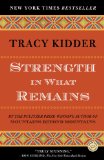
Strength in What Remains by Tracy Kidder

Strength in What Remains

A journey of remembrance and forgiveness

by Tracy Kidder
  • BookBrowse Review:
  • Critics' Consensus (7):
  • Readers' Rating (5):
  • First Published:
  • Aug 25, 2009, 304 pages
  • Paperback:
  • May 2010, 304 pages
  • Rate this book

About this Book

Book Club Discussion Questions

Print PDF


For supplemental discussion material see our Beyond the Book article, The Burundian Genocide and our BookBrowse Review of Strength in What Remains.


Please be aware that this discussion guide will contain spoilers!

Teacher's Guide

If you'd like a printable version of this guide, download the PDF attachment at the bottom of this page.

Note to Teachers
Strength in What Remains (hereinafter Strength), recounts the story of Deogratias (Deo) – his flight from civil war in Burundi and Rwanda to homelessness in Central Park, New York City, to graduation from Columbia University, and to the fulfillment of the dream of his youth: to build a health care clinic in his homeland, free to those who can't pay. Deo grows up in Burundi, and eventually becomes a United States citizen.

In September, 1993, while Deo is in his third year of medical school, the president of Burundi is assassinated.  Ethnic civil war ensues. Through the recounting of Deo's experiences of survival against all odds, Kidder provides us a window into the devolution of a country and a people. While it's difficult to read about such tragedies, Kidder compels the reader to be a witness to the inhuman conditions that afflict many of the impoverished regions of the world. Deo's experience is also one of redemption, of overcoming the morbid absurdities of human nature to become what he always has been – a healer.

Notably, Kidder, while astute and thorough in recounting and substantiating Deo's story, is not the detached observer of events for this book. Through writing about his own fear and reservations as Deo guides him on a tour of six months of terror, the reader is allowed to witness, to some extent, the horrors Deo also endured. By communicating to the reader his own attempts to conceal his reactions from Deo, and by acknowledging the intrusive nature of his own questioning, Kidder gives us the latitude to accept and work through our own emotions, misconceptions, and misunderstandings as we address some of the profound social, psychological, and political issues raised in Strength.

This guide is separated into three sections, Style and Structure, Comprehension and Discussion, and Personal Essays.  The prompts in the first two sections are constructed for the purpose of fostering classroom and group discussion. The intent of the Personal Essay section is to cull in-depth reflective and/or investigative individual responses.

Finally, as you read this account of life over death, please take the time to visit Deo's Village Health Works clinic at http://www.villagehealthworks.org/. There, you will realize that Deo's youthful, "primal sympathy which having been must ever be" is an enduring strength.


Style and Structure

  1. Strength is composed of a short prologue and two sections: 1) Flights and 2) Gusimbura. In the Flights section, Kidder writes in the restricted third person. The reader understands the 1990s upheaval in the African countries of Burundi and Rwanda through Deo's experiences. Deo also describes surviving the immigrant experience in New York City. In general, his African flights recount how he physically survived; in New York, his flights of survival are mostly psychological. The second section of the book, Gusimbura, is written in the first person – giving a voice not just to Deo, but also to the author, and to individuals integral to the redemption of Deo, his intellectual fortitude, and his childhood aspirations. Discuss the structure of the book. What kind of effect does it have on the reading experience?
  2. Strength opens with a post-genocide account of Deo returning to his family's former home in Butanza, Burundi. The author accompanies Deo on this trip. Deo warns Kidder not to mention Deo's friend, Clovis, by name when they arrive in Butanza. To do so would gusimbura (a Kirundi term) all those who knew Clovis. To gusimbura someone, means that an individual, upon hearing the name of a dead loved one, is forced to relive the suffering and sorrow of that loved one's death.  Why do you think Kidder opens the book with this incident?
  3. The title of this nonfiction work is derived from a William Wordsworth poem, "Ode 536: Intimations of Immortality from Recollections of Early Childhood."  An excerpt of the poem is reprinted in the front of Strength. Read the full-length poem and draw thematic comparisons between it and Strength, specifically as it relates to the following quote from Chapter 5:
    "In her company . . .  he could talk as if he still imagined himself becoming a doctor, even though, as it had been from the start, this was usually just a way of telling her who he used to be."
    Wordsworth's poem can be found online at http://www.bartleby.com/101/536.html

Comprehension and Discussion

FLIGHTS

📖

Get the full reading guide

Join BookBrowse free to unlock all 41 discussion questions, author background, themes, and more for Strength in What Remains.

Join free — it takes 30 seconds

Already a member? Log in →

  1. How does the author develop themes of identity and belonging throughout the narrative?
  2. What role does the setting play in shaping the characters' decisions and relationships?
  3. Discuss how the ending reframes the events of the story. Were you surprised?


Unless otherwise stated, this discussion guide is reprinted with the permission of Random House. Any page references refer to a USA edition of the book, usually the trade paperback version, and may vary in other editions.


Membership Advantages
  • Reviews
  • "Beyond the Book" articles
  • Free books to read and review (US only)
  • Find books by time period, setting & theme
  • Read-alike suggestions by book and author
  • Book club discussions
  • and much more!
  • Just $60 for 12 months or $20 for 3 months.
  • More about membership!

Beyond the Book:
  The Burundian Genocide

BookBrowse Book Club

  • Book Jacket
    When No One Else Will
    by Amanda Skenandore
    1940s Chicago nurse risks everything at an illegal women’s clinic during a high-profile trial of courage and sisterhood.
  • Book Jacket
    A Pair of Aces
    by Marie Benedict, Victoria Christopher Murray
    Two women on opposite sides of the law team up to bring down gangster Lucky Luciano in this gripping novel.

Members Recommend

  • Book Jacket
    The Reimagining of Thornwood House
    by Jaleigh Johnson
    A witch and her ward discover a magical walking house and find the true meaning of home.
  • Book Jacket
    Feast
    by Catherine Kurtz
    In 19th-century France, a girl with a magical taste becomes a duc’s poison taster amid nobility and danger.
  • Book Jacket
    The Jellyfish Problem
    by Tessa Yang
    A marine biologist rescues a Maine island menaced by a giant glowing jellyfish in this inventive debut.
  • Book Jacket
    Summer's Never Over
    by Darby Bozeman
    A woman revisits a Southern summer camp where a counselor's death may not have been an accident.
Who Said...

When all think alike, no one thinks very much

Click Here to find out who said this, as well as discovering other famous literary quotes!

Book
Trivia
  • Book Trivia

    Can you name the title?

    Test your book knowledge with our daily trivia challenge!

Wordplay

Solve this clue:

Q S, S

and be entered to win..

Your guide toexceptional          books

BookBrowse seeks out and recommends the best in contemporary fiction and nonfiction—books that not only engage and entertain but also deepen our understanding of ourselves and the world around us.