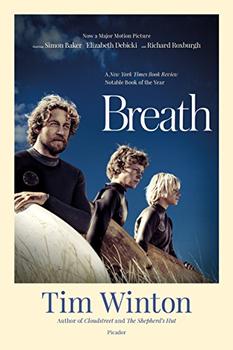
Please be aware that this discussion guide may contain spoilers!
Discussion Questions
The story of Pikelet's experiences with Sando and Loonie are framed by
scenes from his
life as an older man. How would you describe his attitude towards the young man
he was back
then, and toward the choices he made?
Is Sando a good influence on the boys? Does help them in any way? Do you
think he has their
best interests at heart?
Pikelet and Loonie come together as friends over their shared fascination
with risk. How do
they ultimately experience surfing differently? What is it about them that leads
their paths to diverge over the course of the story?
What is Eva's attitude toward Sando's relationship with the boys? What
feelings does it bring
up about her own situation and her own history?
What do you think draws Pikelet and Eva together? What does each of them get
from their
relationship? Do you think Pikelet bears some responsibility for what happens
between them?
Look the scene where Sando, Loonie and Pikelet go to surf the Nautilus (p.
144-147). Why do
you think Pikelet chooses not to surf that day? How does his refusal affect the
course of his
relationship with Sando and Loonie?
Several times in the story characters mention a resistance to being an
"ordinary person," and
many of the risks they take are motivated by a desire to stand outside ordinary
life. Is this a
healthy impulse? Have you experienced it, or known people who have? How do
people you
know handle it?
Later in the book we learn that Pikelet spent some time in an institution.
What do you think
happened in his mind to get him there? How did the surfing and the relationship
with Eva affect
him later in life?
Near the end of the story Pikelet sees footage of an aerial skier falling,
howling in agony, and
it reminds him of himself, a "slow-motion replay of how my mind had worked for
too long"(p.
214). What do you think he recognizes in the skier and himself?
Do you think Pikelet and Loonie learn something of value from the risks they
take? Are they
better off for having endured the fear and surfed with Sando? Is it necessary to
take these kinds
of risks in order to feel alive?
Why do you think it's so important for the narrator to show his daughters
that he surfs, that
he "also does something completely pointless and beautiful"? What kind of
relationship do you
think he has with them?
How do the two boys' relationships with their parents contribute to their
behavior as
teenagers? Is surfing and their bond with Sando somehow a reaction against the
place they came
from?
For more information on Picador Reading Group Guides: Call: 646-307-5259 Fax: 212-253-9627 E-mail: readinggroupguides@picadorusa.com For a complete listing of reading group guides visit: www.picadorusa.com
Unless otherwise stated, this discussion guide is reprinted with the permission of Picador.
Any page references refer to a USA edition of the book, usually the trade paperback version, and may vary in other editions.

A bold, mesmerizing novel about the woman known as "Typhoid Mary," the first known healthy carrier of typhoid fever in the burgeoning metropolis of early twentieth century New York.
Z, the novel about the life of Zelda Sayre Fitzgerald is at points charming and; like another reviewer, I kept thinking of the movie, "Midnight...
read more
Although heavy on the scientific details, which slowed down the story for me (OK, I admit, I was one of those liberal arts majors who skipped out on...
read more
Loved this book. Magical, quirky, enchanting I could go on. All books do not have to be literary fiction, sometimes it is just so comforting to read...
read more
British Parliament asks Amazon to clarify why it pays $9 million in income tax on $23 billion of UK sales.(May 20 2013) Amazon will be called back to give further evidence to members of the British Parliament "to clarify how its activities in the U.K. justify its low corporate...
Full Story