return to home  
Join   |  Gift   |  Member Login   |  Library Login
BookBrowse Mobile
Follow Us: 
   Reading Guides

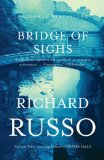
Bridge of Sighs by Richard Russo: Questions, plus a reading group guide, with links to reviews, excerpt, author interview and author biography at BookBrowse.com.

Bridge of Sighs

Bridge of Sighs
by Richard Russo
Hardcover: Sep 2007,
480 pages.
Paperback: Sep 2008,
688 pages.

Publication information
Author Information
Critics' Opinion:   
Readers' Rating:  
About BookBrowse Rankings
Share: 
Buy This Book

Reading Guide Questions

 Printer Friendly Guide

Please be aware that this discussion guide may contain spoilers!

  1. Bridge of Sighs alternates two narratives: Lucy’s first-person memoir and the story of Robert Noonan. What are the advantages of this structure? How does it affect the way plot unfolds? Does it influence your impressions of the main characters?

  2. How does Lucy’s description of Thomaston [pp.9–11] create an immediate sense of time and place? What details did you find particularly evocative? What does Lucy’s tone, as well as the way he presents various facts about Thomaston and its history, reveal about his perceptiveness and his intelligence?

  3. Lucy says, “I’ve always known that there’s more going on inside me than finds its way into the world, but this is probably true of everyone. Who doesn’t regret that he isn’t more fully understood?” [p. 12]. To what extent does this feeling lie at the heart of his decision to write his book? Does it play a central role in memoir-writing in general? What else does Lucy hope to accomplish by recalling his past? At the beginning, does he see the dangers, as well as the benefits, of examining his life and the people and events that shaped him?

  4. The horrific prank the neighborhood boys play on Lucy [pp. 21–30] triggers the first of many “spells” he will have throughout his life. What is the significance of his spells? What do they reveal about the emotional attachments, anxieties, and doubts that define him both as a child and as an adult?

  5. Lucy makes many references to the pursuit of the American Dream and its implications within his own family and in society in general [pp. 52–55, 78, 92–93, for example]. In what ways did American attitudes in the postwar years embody both the best parts of our national character and its darker undercurrents? What incidents in the novel illuminate the uneasiness and enmity that results from the class, racial, and economic divisions in Thomaston? Do Lucy’s beliefs, judgments, and achievements (as a businessman and as a happily married husband and father) color his reconstruction of these events?

  6. Unlike Lucy’s story, Noonan’s story is told in the third person. Is the change of voice a literary device, a way of adding variety to the novel, or does it serve another purpose? In what ways does it help to convey the basic difference between Lucy and Noonan and the way they see themselves and their place in the world? Compare the tone and language Russo uses in creating Lucy’s voice with the style he uses in his portraits of Noonan. What aspects of Noonan’s character and personality come to life in his conversations with his art dealer and his mistress [pp. 35–51]; his reactions to Lucy’s missives [pp. 131–134] and to Mr. Berg’s class in high school [pp. 310–314]; and, ultimately, his thoughts and behavior on arriving in New York [pp. 500—508].

  7. Lucy and Bobby [p. 130 and p. 141–142 respectively] attempt to explain why their lives—and Sarah’s—have turned out they way they have. Do you agree with Lucy that “To see a life back to front, as everyone begins to do in middle age, is to strip it of its mystery and wrap it in inevitability, drama’s enemy”? To what extent does Bobby share this view? Why does Bobby see himself as being in control of his life in a way that neither Sarah nor Lucy is? Is this a result of his background and the circumstances that forced him to prepare himself for a second act? From the evidence in the book, is it accurate to describe Lucy as a passive participant in life, and Bobby as a man who actively responds to events, rather than becoming a pawn—or a victim—of things beyond his control?

  8. Tessa is the practical, steady member of the Lynch family. In what ways does her behavior reflect her own choices, needs, and desires, and in what ways are these determined by the time and place in which she lives? What qualities make her stand out, not only in Lucy’s eyes, but also within the community as a whole?

  9. Does Lucy’s identification with his father distort his image of his mother and his understanding of her strengths and her weaknesses? Beyond her immediate anger, what drives her to tell Lucy, “I never wanted you to not to love your father. . . . I wanted you to love me. . . . Did it ever occur to you, even once during all those years, that you might have taken my side? That I might have needed a friend?” [p. 217]? Is this a valid criticism, or is Tessa herself responsible, either inadvertently or intentionally, for the differences between Lucy’s relationships with each parent?

  10. Sarah comes from an unconventional family, especially in the context of Thomaston. Is her ability to deal with the eccentricities of her parents and the summer/winter living arrangements they established unusual? In what ways does she not only adapt to but also benefit from the very things that set her apart? Is her attraction to the Lynches in part a reaction to her dysfunctional family?

  11. Are Mr. Berg’s obsessions—with perpetuating his image as a rebel, with the “great” book he is writing, and with his failed marriage—sympathetically drawn? What is the significance of the fact that he is Jewish? What biases, both good and bad, do the people of Thomaston (including Lucy) have about Jews and what impact does this have on Berg and his reputation within the community?

  12. What role does her mother play in Sarah’s sense of self? What are the implications of her views on marriage [p.326]? Do they influence Sarah’s feelings about her own marriage and that of her in-laws? Why is Sarah drawn back to the home she shared with her mother when she faces a crisis in her relationship with Lucy [pp. 464–499]? What does she learn by revisiting the past?

  13. What traits do Tessa and Sarah share? In what ways do their marriages mirror one another? Do you think either—or both—foolishly gave up their own dreams and desires, sacrificing a life of adventure and sexual passion for the love and security of a “good” man? Behind their apparent contentment, are there indications that they regret the choices they made?

  14. The Bridge of Sighs in Venice connects the Doge Palace to an adjacent prison, and, as Lucy relates, “Crossing this bridge, the convicts—at least the ones without money or influence—came to understand that all hope was lost” [p. 320]. How does the historical function of the bridge, as well as the myths surrounding it, relate to characters’ lives? Why has Russo chosen it as the title of the novel?

  15. Does the ending bring the various threads of the novel to a satisfactory conclusion? What would have happened if Lucy, Sarah, and Noonan had met again after so many years? In what ways are their memories and imaginings a more powerful—and truer—version of reality?

  16. In an interview Russo said, “The future and the past are repeatedly getting mixed up in people’s minds. They think that which is gone is going to come back” (Powells.com). Which characters Bridge of Sighs are particularly prone to getting the past and the future mixed up? Do any of the characters fully escape this way of thinking?

  17. Richard Russo has written about small towns throughout his career. What are some similarities between Bridge of Sighs and previous novels like Empire Falls and Nobody’s Fool? In what ways does Bridge of Sighs enhance and expand the portrait of America that is so central to Russo’s writing?

SUGGESTED READING
Sherwood Anderson, Winesburg, Ohio;
Russell Banks, The Sweet Hereafter;
Robert Bausch, A Hole in the Earth;
Charles Baxter, The Feast of Love;
Leif Enger, Peace Like a River;
Richard Ford, The Lay of the Land;
Jonathan Franzen, The Corrections;
Alice McDermott, After This;
Susan Minot, Evening;
Marilynne Robinson, Gilead;
Jane Smiley, A Thousand Acres;
Anne Tyler, Dinner at the Homesick Restaurant.


Unless otherwise stated, this discussion guide is reprinted with the permission of Vintage. Any page references refer to a USA edition of the book, usually the trade paperback version, and may vary in other editions.

Become a Member
Click Here
Editor's Choice
  •  May 20 
  •  May 18 
  •  May 16 
Fever
Mary Beth Keane

Fever Jacket

A bold, mesmerizing novel about the woman known as "Typhoid Mary," the first known healthy carrier of typhoid fever in the burgeoning metropolis of early twentieth century New York.
The Woman Upstairs
Claire Messud

The Woman Upstairs Jacket

The riveting confession of a woman awakened, transformed, and betrayed by passion and desire for a world beyond her own.
How to Create the Perfect Wife
Wendy Moore

How to Create the Perfect Wife Jacket

Stranger than fiction, blending tragedy and farce, How to Create the Perfect Wife is an engrossing tale of the radicalism, and deep contradictions, at the heart of the Enlightenment.
Click Here
   Most Recent Blog Entries
Movies Based on Books: Summer 2013 (May - August)
Jewish Young Adult Books That Are Not About The Holocaust
Books to Give This Mother's Day
rss  RSS   rss  subscribe
Recent Reader Reviews
Z: A Novel of Zelda Fitzgerald by Therese Fowler
Z, the novel about the life of Zelda Sayre Fitzgerald is at points charming and; like another reviewer, I kept thinking of the movie, "Midnight... read more
Flight Behavior by Barbara Kingsolver
Although heavy on the scientific details, which slowed down the story for me (OK, I admit, I was one of those liberal arts majors who skipped out on... read more
The House at the End of Hope Street by Menna van Praag
Loved this book. Magical, quirky, enchanting I could go on. All books do not have to be literary fiction, sometimes it is just so comforting to read... read more
RSS RSS feed More...  
Most Viewed This Week
1. The Help
Kathryn Stockett
2. The Immortal Life of Henrietta Lacks
Rebecca Skloot
3. A Child Called It
Dave Pelzer
4. Half the Sky
Nicholas D. Kristof, Sheryl WuDunn
5. The Glass Castle
Jeannette Walls
More...
Book Club Recommendations
The Gods of Gotham
by Lyndsay Faye
Paperback (Mar/13)
Forgotten Country
by Catherine Chung
Paperback (Mar/13)
Philida
by André Brink
Paperback (Feb/13)
Gone Girl
by Gillian Flynn
Hardback (Jun/12)
More...
First Impressions
Members read and review books often months before they're published. See what they think in First Impressions!
A Dual Inheritance
by Joanna Hershon
Four Stars            (May/13)
The Laws of Gravity
by Liz Rosenberg
4.5 Stars            (May/13)
The Sisterhood
by Helen Bryan
Four Stars            (Apr/13)
More...
  Latest BookBrowse News
British Parliament asks Amazon to clarify why it pays $9 million in income tax on $23 billion of UK sales. (May 20 2013)
Amazon will be called back to give further evidence to members of the British Parliament "to clarify how its activities in the U.K. justify its low corporate... Full Story
rss RSS feed More...
 
BookBrowse Poll
Q: Which of these Summer movies based on books would you like to see? (Info on each movie here)
The Great Gatsby
Epic
Man of Steel
World War Z
The Lone Ranger
The Wolverine
R.I.P.D.
Percy Jackson
Paranoia
The Mortal Instruments
Select Any That Apply
Search: Title or Author
Free Newsletters
Bring Up the Bodies

Online Book Club
More about
Five Days
Join the discussion!


Win This Book!
The Pigeon Pie Mystery


Enter To Win Now!

wordplay
Solve this clue:
"I I M B T Give T T R"

and be entered
to win....
frame top
New Author
Interviews
Menna van Praag
Erica Brown
Helga Weiss
Kate Morton
frame bottom
HOME Book Submissions | Advertising | Library Subscriptions | Reviewing for BookBrowse | Contact Us