Reading Guide Questions

Please be aware that this discussion guide will contain spoilers!
An Introduction to Uniform Justice
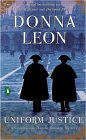
The snaking, unmarked streets of canal-crossed Venice provide the perfect backdrop for intrigue and mystery in Donna Leon's
Uniform Justice, a novel in this elegant mystery series featuring the affable Commissario Guido Brunetti.
Guido Brunetti is a born-and-bred middle-class Venetian who investigates murder and high crime among the patrician families of old Venice. From his headquarters at the Questura, Brunetti pieces together his cases with the help of a few clever colleagues: the beautiful secretary and researcher Signorina Elettra, the loyal Vianello, the persistent Pucetti, and the often duplicitous and self-aggrandizing Vice-Questore Patta. But the Commissario is not just another heartless, hard-nosed sleuth whose sole life goal is the pursuit of the criminal. Every night he comes home to his wife and children and must bear the burden of being witness to terrible crimes without allowing his work to affect his family life. This humanity tempers his sleuthing with humility and empathy, allowing him to delve more deeply into the minds of his adversaries and uncover clues he might not otherwise be privy to.
In
Uniform Justice, Commissario Brunetti arrives at the elite San Martino Military Academy to investigate the suicide of Ernesto Moro, a young, promising cadet who turns out to be the son of a prominent government official. The student's family denies that Ernesto was the kind of boy who could kill himself. The Commissario casts a skeptical eye on the original pronouncement of suicide, but the further he tries to delve into the events that led up to the young man's death, the more vague and openly hostile the military students become. Brunetti uncovers what may be a conspiracy to silence a report by Fernando Moro that would have blown the whistle on payola corruption in government spending. He sets out to accomplish the difficult task of proving that Ernesto Moro's death was not suicide, but murder.
A longtime resident of Venice, Leon paints a perfectly rendered portrait of the city's clash of Old World charms and New World treachery with vibrant depictions so convincing that you can practically taste the
spaghetti alla vongole and hear the din of the
vaporettos in the canals. Every scene bursts forth with the minute detail and stylish prose of a master of the genre. Lovers of crime fiction will embrace Commissario Brunetti and his cohorts in this exhilarating new addition to the annals of mystery.
Questions for Discussion
General - Donna Leon's stories paint a vivid picture of a Venice full of intrigue, with beauty and corruption in almost equal measures. How does the Venice of her books compare to the Venice of popular imagination—or to the real Venice?
- Commissario Brunetti often uses his own experience (for example, as a loving father and husband) to understand the perpetrators' motives. Do you think the antagonists are at all sympathetic characters? Why or why not?
- A unique feature of Commissario Brunetti is that he comes home to a family he values above all else. In what ways does his being a family man make him a better detective? How does this compare to the typical characteristics of a great hero in mystery novels?
Uniform Justice
- In your opinion, was Commissario Brunetti right to let Signor Moro make the decision about whether or not to pursue justice in his son's death? What might you have done in Signor Moro's situation?
- If, like Signor Moro, you knew that a report you were compiling about government corruption was endangering your family's lives, would you drop everything to save your family or pursue the truth in spite of threats? Would you be able to separate yourself from your family and live without them, as Signor Moro did, in order to save them?
- Brunetti manages to conduct a casual conversation with Giuliano Ruffo, one of the students at the academy, before being pushed out the door by the barking Comandante. Why do you think Ruffo felt comfortable talking to Brunetti?
- When Brunetti reaches for the phone to call Signora Moro, he says, "Who was it whose gaze could turn people to stone? The Basilisk? Medusa? With serpents for hair and an open glaring mouth." What is the significance of these images?
- Dottor Moro asks Brunetti whether or not he has read the short story "The Death of Ivan Ilyich." How does this relate to Moro's dilemma? What are the parallels between Moro's life and Ivan Ilyich's?
- When Signorina Elettra tells Brunetti the story of the girl who cried rape at the academy but never pressed charges, he replies, "Tanto fumo, poco arrosto." Why does Brunetti add quickly, "But thank God for the girl"? Why does Signorina Elettra go cold upon hearing his response to the story? How did you react to Brunetti's nonchalance? Was your first impulse to believe that the girl in the story was raped or not?
- Brunetti uses scare tactics to force a confession from Filippi's roommate, Cappellini. The testimony would not be permissible in any court of law, but his words sound more truthful than almost anything anyone else has been able to tell Brunetti. What purpose does this truth-serum affirmation serve to the rest of the story? Without it, could you have believed Filippi's dramatic tale of suicide as an autoerotic accident?
Unless otherwise stated, this discussion guide is reprinted with the permission of Penguin.
Any page references refer to a USA edition of the book, usually the trade paperback version, and may vary in other editions.