Seabiscuit by Laura Hillenbrand: Questions, plus a reading group guide, with links to reviews, excerpt, author interview and author biography at BookBrowse.com.
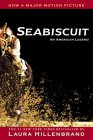
Seabiscuit An American Legend
by Laura Hillenbrand
Hardcover: Mar 2001,
416 pages.
Paperback: Mar 2002,
448 pages.
Please be aware that this discussion guide may contain spoilers!
Seabiscuit grew so popular as a cultural icon that in 1938, he commanded
more space in American newspapers than any other public
figure. Considering the temper of the times as well as the horses
early career on the racetrack, what were the sources of The Biscuits
enormous popularity during that benchmark period of U.S. history?
Would he be as popular if he raced today? What did the public need
that it found in this horse?
The Great Match Race between Seabiscuit and War Admiral in 1938
evoked heated partisan passions. These passions spilled over on
radio and into the daily prints, with each colt leading a raucous
legion of followers to the barrier at Pimlico Race Course that autumn
day. What were the differences separating these two horses, and
what did each competitor represent in the American experience that
set one apart from the other?
All jockeys in the 1930s endured terrible hardships and hazards,
starving themselves to make weight, then competing in an exceptionally
dangerous sport. For George Woolf and Red Pollard, there
were additional factors that compounded the difficulties and dangers
of their jobsdiabetes for the former and half-blindness for the
latter. Why, in spite of this, did they go on with their careers? What
were the allures of race riding that led them to subject themselves to
such risk and torment?
What was the role of the press and radio in the Seabiscuit phenomenon?
How did Howard use the media to his advantage? How did
the media help Seabiscuits career, and how was it a hindrance?
Seabiscuit possessed all the qualities for which the Thoroughbred
has been prized since the English imported the breeds three foundation
sires from the Middle East three hundred years ago. What
were those qualities? What made this horse a winner?
Horses of Seabiscuits stature, from Man o War in the 1920s to
Cigar in the 1990s, have always generated a powerful gravitational
field of their own, attracting crowds of people into their immediate
orbit, shaping relationships among them, and even affecting the
personalities of those nearest them. How did Seabiscuit shape and
influence the lives of those around him?
Red Pollard, Tom Smith, and Charles Howard formed an unlikely
partnership. In what ways were these men different? How did their
differences serve as an asset to them?
What critical attribute did Howard, Smith, and Pollard share? How
did this shared attribute serve as a key to their success?
In what ways was each man in the Seabiscuit partnership similar, in
his own way, to Seabiscuit himself? How did these similarities help
them cultivate the horses talents and cure his ailments and neuroses?
What lessons can be drawn from the successes of the Seabiscuit
team? What does their story say about the role of character in life?
Unless otherwise stated, this discussion guide is reprinted with the permission of Ballantine Books.
Any page references refer to a USA edition of the book, usually the trade paperback version, and may vary in other editions.
Stranger than fiction, blending tragedy and farce, How to Create the Perfect Wife is an engrossing tale of the radicalism, and deep contradictions, at the heart of the Enlightenment.
Z, the novel about the life of Zelda Sayre Fitzgerald is at points charming and; like another reviewer, I kept thinking of the movie, "Midnight...
read more
Although heavy on the scientific details, which slowed down the story for me (OK, I admit, I was one of those liberal arts majors who skipped out on...
read more
Loved this book. Magical, quirky, enchanting I could go on. All books do not have to be literary fiction, sometimes it is just so comforting to read...
read more
U.S. ebook sales up in 2012, but rate of growth is slowing(May 16 2013) In 2012, trade book sales (i.e. non academic book sales) rose 6.9%, to $15.049 billion, and e-book sales continued to grow, although the rate of growth...
Full Story