Reading Guide Questions

Please be aware that this discussion guide will contain spoilers!
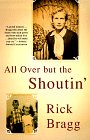
The questions, discussion topics, and author biography that follow are intended to enhance your group's reading of Rick Bragg's
All Over but the Shoutin', a haunting memoir about growing up dirt-poor in the deep South, and about struggling to leave the past behind while still deeply tied to it through bonds of love and responsibility.
Rick Bragg was born in the pinewoods of Alabama to a mean-tempered, hard-drinking father and a strong-willed, loving mother, who struggled to protect her sons from the effects of poverty and ignorance that had constricted her own life. After years of abusing his wife and children, Charles Bragg abandoned the family when Rick was six. Margaret Bragg moved her three sons into her parents' house, going eighteen years without a new dress so that her children could have school clothes and working in the cotton fields so that they wouldn't have to live on welfare alone. Brash and wild like his father, Rick graduated from high school, seemingly destined for either the cotton mills or the penitentiary. Instead, he signed up for a journalism class at a nearby college and before long was offered a job as a sportswriter for the local paper. From there, he moved from small papers in northeast Alabama to
The St. Petersburg Times and eventually became a Pulitzer Prize-winning reporter for
The New York Times.
All Over but the Shoutin' is the moving account of one man's determination to rewrite his family history and to carve out a life for himself based on the strength of his mother's encouragement and belief. Written with refreshing honesty and marvelous humor, it paints an unforgettable picture of the love and suffering that lie at the heart of every family.
For discussion
- Why does Bragg begin his memoir with the image of redbirds fighting? Why do you think he includes the story of a bird attacking its own image in the mirror?
- In the prologue, Bragg claims several times that "this is not an important book." Does he convince us that in fact it is important? If so, how? Why does he feel that he "cannot take the chance of squandering the knowledge and the stories that [my mother] and my people hold inside them" [p. xvi]?
- Bragg describes a memory of himself on a gunny sack that his mother is pulling through a cotton field as she works; at three, he "rides the back of the six-foot-long sack like a magic carpet" [p. 23]. How does this particular image sum up his mother's love for him? Is his mother's devotion to her sons' welfare out of the ordinary?
- Does Bragg regret his inability to forgive his dying father? Would reconciliation have alleviated Bragg's need to compensate his mother for his father's failures? What is the significance of the gift of books by an illiterate father to his clever son?
- Although many aspects of his family's life were ruled by poverty, Bragg was immersed in the traditions of the pinewoods, where self-reliant people were adept at music, building, and handcrafts, where "likker and religion flowed together" [p. 34]. Are certain elements of the life he describes enviable? Do you get the impression that his memories of childhood are colored by nostalgia? To what extent do you think nostalgia plays a role in the memories and experiences of everyone?
- While many African-Americans--from Frederick Douglas to Maya Angelou--have given us their stories of growing up poor and black, the segment of society disparagingly called "poor white trash" has produced relatively few writers. Does this book change your view of the large segment of whites who live in rural poverty?
- Although Bragg sees his background as a handicap in his profession, the unmistakably Southern way he uses the English language can be part of the appeal of his writing. One editor warned him about exploiting his gift to produce "too many pretty lines" [p. 228]. Do you agree that this is a danger for Bragg? What do you notice about his style, imagery, humor, and approach to news stories that is distinctive?
- Did luck make the difference between Rick Bragg's life and the lives of his two brothers? Or do their different choices have more to do with temperament and character than with the hazards of fortune? Do you see Rick Bragg as a man who is more determined and driven than he admits? Why does he insist on attributing his success to luck?
- Race relations, as Bragg shows, are complicated for poor whites in the South. What do you learn from the story of the black family down the road bringing food to Rick's mother? From his family's devotion to the demagogue George Wallace? From his work in Haiti?
- Why is Bragg particularly drawn to stories about "living and dying and the trembling membrane in between" [p. 139]? Why is he so good at writing about violence and tragedy? What is it about journalism that most disturbs him?
- Has Bragg's attempt to compensate for his mother's unhappy life contributed to his inability to settle down with someone? Is his avoidance of intimacy a legacy from his father or is it simply the syndrome of a successful and driven man who doesn't have time to attend to the emotional side of life?
- Despite the revolution in American life that was brought about by the women's movement, the culture of the South is well known for its lingering devotion to ideals of chivalry. Does Rick Bragg raise his mother onto a pedestal? Does he risk turning her into a passive heroine who depends upon his help?
- What, if any, are the definitive class barriers in our society? Does having been born poor mean that a person will always feel inferior to those who weren't? Do financial or professional achievements raise a person's "class" level? Is Bragg justified in his resentment of those who seem sophisticated or "elite" to him--the wealthy people of the South or people he meets at Harvard and at The New York Times?
- Bragg's response to the Susan Smith case is particularly interesting. What does he identify with in her? Why is he so scornful of her?
- What aspect of Bragg's youth was most damaging to his sense of himself? Is it possible for him to "belong" anywhere? Can winning the Pulitzer Prize make him an insider in the profession of journalism? Is the rootless life of a journalist appropriate for him?
- With his urgent desire to make up his mother's losses, Bragg struggles between his impulse to "rewrite history so late in the volume of our lives" [p. 272] and the more realistic, if discouraging, realization that "you can't fix everything" [p. 312]. Is he sacrificing himself for his mother? Or is he what he does more for his own sake than hers?
- Why does Bragg address one of the final chapters of his book to his father? How accurate is he in saying to his father, "I am just like you" [p. 318]? What has he learned in the process of writing this memoir? Why is his honesty so moving?
Suggestions for further reading
James Agee, Let Us Now Praise Famous Men; Dorothy Allison, Trash, Bastard Out of Carolina; Maya Angelou, I Know Why the Caged Bird Sings; Russell Baker, Growing Up; Erskine Caldwell, Tobacco Road; Carolyn Chute, The Beans of Egypt, Maine; Jill Ker Conway, The Road from Coorain, When Memory Speaks: Reflections on Autobiography; Harry Crews, A Childhood; Ralph Ellison, The Invisible Man; William Faulkner, As I Lay Dying; Kaye Gibbons, Ellen Foster; James McBride, The Color of Water; Patrick McCabe, The Butcher Boy; Frank McCourt, Angela's Ashes; Flannery O'Connor, A Good Man Is Hard to Find; Mark Twain, Huckleberry Finn; Tobias Wolff, This Boy's Story; Richard Wright, Black Boy.
Page numbers refer to the Vintage paperback edition. Reading group guide and suggested reading list reproduced with the permission of the publisher, Vintage.
Unless otherwise stated, this discussion guide is reprinted with the permission of Vintage.
Any page references refer to a USA edition of the book, usually the trade paperback version, and may vary in other editions.