return to home  
Join   |  Gift   |  Member Login   |  Library Login
BookBrowse Mobile
Follow Us: 
   Reading Guides

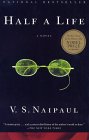
Half A Life by V.S. Naipaul: Questions, plus a reading group guide, with links to reviews, excerpt, author biography at BookBrowse.com.

Half A Life

Half A Life
by V.S. Naipaul
Hardcover: Oct 2001,
224 pages.
Paperback: Oct 2002,
224 pages.

Publication information
Author Information
Critics' Opinion:   
Readers' Rating:  
About BookBrowse Rankings
Share: 
Buy This Book

Reading Guide Questions

 Printer Friendly Guide

Please be aware that this discussion guide may contain spoilers!

  1. The novel begins with Willie’s question to his father about why he was named after the English novelist W. Somerset Maugham. If a name is a crucial piece of a person’s identity, how useful is the information Willie receives? How does Maugham come across in his responses to Willie’s and his father’s letters?

  2. How does Willie’s father become a holy man? What is comical, and what is reprehensible, in the choices he makes? Is he a person trapped in circumstances beyond his control, or might he have done things differently? What is the source of his narcissism? Considering that in Maugham’s The Razor’s Edge, the holy man is believed by his Western admirers to be a person of true integrity, why does Naipaul portray this character as a fraud?

  3. Naipaul has written about India’s caste system in several of his nonfiction books. How does he recreate the social world of a caste-based culture in this novel? Why does he choose to root the circumstances of a novel about identity–or the lack of it–in a character’s half-hearted effort to rebel against the caste system? Given the feelings he expresses for his wife and child on pages 32 and 33, is Willie’s father a racist at heart, despite his admiration for Gandhi?

  4. Willie has a painful love for his mother and despises his father. Why do his mother and sister seem immune to the sense of shame that Willie’s father has passed along to his son? What are the effects, in Willie’s later life, of this internalized shame?

  5. What do the stories that Willie writes while in school [pp. 38—45] communicate to the reader? Which of them is the most powerful? Does Willie’s creativity spring solely from his hatred for his father? In his “Prologue to an Autobiography,” Naipaul wrote, “To become a writer, that noble thing, I had thought it necessary to leave [home]. Actually to write, it was necessary to go back. It was the beginning of self-knowledge.” How does this statement relate to Willie’s brief writing career?

  6. What is the reason for Willie’s lack of knowledge about the world? How does he adapt to life in London? What point is Naipaul making about the insular world from which Willie comes?

  7. How does it change his outlook when Willie realizes that a culture’s rules are largely “make-believe,” and that “he was free to present himself as he wished. He could, as it were, write his own revolution” [p. 57]? What difference does this new sense of freedom make for his life in the immigrant community in London? How does he attempt to remake himself? How successful is he in shedding his past?

  8. Is it significant that Willie’s first book is, “in substance . . . like the story Willie had heard over many years from his father” [p. 96]? How is Willie like his father, and in what ways does his life, as it develops throughout the novel, mirror his father’s life?

  9. What is the effect on Willie of his father’s letter telling him of Sarojini’s “international marriage” [pp. 105—06]? What do Sarojini’s letters, and the way she conducts her own life, say about her? Why is she so different from her brother?

  10. In the aftermath of his book’s publication, Willie believes, “All that he had now was an idea—and it was like a belief in magic—that one day something would happen, an illumination would come to him, and he would be taken by a series of events to the place he should go. What he had to do was to hold himself in readiness, to recognise the moment” [p. 114]. What sort of revelation is this? Is Willie’s passivity simply the deepest expression of his character, or can it be attributed to his status as an exile who has willingly cut himself off from his past?

  11. Is Ana’s letter the sign Willie has been waiting for? Is Ana’s plantation “the place he should go” [p. 114]? Why does Ana choose Willie? Why does he attempt to keep the truth of his background from her? Why, in the end, does he decide to leave her? Is he unable to face the political changes, as well as the violence, that may come to Ana’s part of the world?

  12. In Half a Life, Willie moves from India to an unnamed country in East Africa; both are areas about which Naipaul has written at length. If you have read Naipaul’s nonfiction travel writing, or any his novels set in Africa, what is familiar or unfamiliar about his treatment of India and Africa in this novel? How does Willie’s life in Africa differ from his family’s life in India? Why is race such a preoccupation in the plantation society in which Willie moves?

  13. Willie’s friend Percy Cato comes from a similar colonial background and is also of mixed blood, as is the tile worker Willie observes at work in the Portuguese seafood restaurant. How does Willie compare with Percy? Why is Willie so moved at the sight of the persecuted tile worker that he thinks to himself, “Who will rescue that man? Who will avenge him?” [p. 155]

  14. What is notable about Naipaul’s writing style in Half a Life? How does the novel’s structure reflect Naipaul’s themes of time, memory, and the retelling of experience? Why does the novel end where it does?


Unless otherwise stated, this discussion guide is reprinted with the permission of Vintage. Any page references refer to a USA edition of the book, usually the trade paperback version, and may vary in other editions.

Become a Member
Click Here
Editor's Choice
  •  May 18 
  •  May 16 
  •  May 15 
The Woman Upstairs
Claire Messud

The Woman Upstairs Jacket

The riveting confession of a woman awakened, transformed, and betrayed by passion and desire for a world beyond her own.
How to Create the Perfect Wife
Wendy Moore

How to Create the Perfect Wife Jacket

Stranger than fiction, blending tragedy and farce, How to Create the Perfect Wife is an engrossing tale of the radicalism, and deep contradictions, at the heart of the Enlightenment.
Happier Endings
Erica Brown

Happier Endings Jacket

A wise and affirming meditation on living fully and preparing for death, written by a highly regarded spiritual teacher.
Click Here
   Most Recent Blog Entries
Jewish Young Adult Books That Are Not About The Holocaust
Books to Give This Mother's Day
A Short History of Chechnya
rss  RSS   rss  subscribe
Recent Reader Reviews
Flight Behavior by Barbara Kingsolver
Although heavy on the scientific details, which slowed down the story for me (OK, I admit, I was one of those liberal arts majors who skipped out on... read more
The House at the End of Hope Street by Menna van Praag
Loved this book. Magical, quirky, enchanting I could go on. All books do not have to be literary fiction, sometimes it is just so comforting to read... read more
Ordinary Grace by William Kent Krueger
Can an wiser, older narrator view the past with more wisdom than he might have possessed forty years earlier in the summer he was thirteen? Ordinary... read more
RSS RSS feed More...  
Most Viewed This Week
Book Club Recommendations
The Gods of Gotham
by Lyndsay Faye
Paperback (Mar/13)
Forgotten Country
by Catherine Chung
Paperback (Mar/13)
Philida
by André Brink
Paperback (Feb/13)
Gone Girl
by Gillian Flynn
Hardback (Jun/12)
More...
First Impressions
Members read and review books often months before they're published. See what they think in First Impressions!
The Sisterhood
by Helen Bryan
Four Stars            (Apr/13)
The Laws of Gravity
by Liz Rosenberg
4.5 Stars            (May/13)
A Dual Inheritance
by Joanna Hershon
Four Stars            (May/13)
More...
  Latest BookBrowse News
U.S. ebook sales up in 2012, but rate of growth is slowing (May 16 2013)
In 2012, trade book sales (i.e. non academic book sales) rose 6.9%, to $15.049 billion, and e-book sales continued to grow, although the rate of growth... Full Story
rss RSS feed More...
 
BookBrowse Poll
Q: Do you mainly read newly published or older books?
Mainly newer books
Mainly older books
A mix of new and old books
Search: Title or Author
Free Newsletters
Bring Up the Bodies

Online Book Club
More about
Five Days
Join the discussion!


Win This Book!
The Pigeon Pie Mystery


Enter To Win Now!

wordplay
Solve this clue:
"I I M B T Give T T R"

and be entered
to win....
frame top
New Author
Interviews
Menna van Praag
Erica Brown
Helga Weiss
Kate Morton
frame bottom
HOME Book Submissions | Advertising | Library Subscriptions | Reviewing for BookBrowse | Contact Us