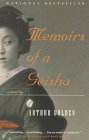
Reading Guide Questions

Please be aware that this discussion guide will contain spoilers!
The questions, discussion topics, and suggested reading list that follow are intended to enhance your group's experience of reading Arthur Golden's
Memoirs of a Geisha. We hope that they will give you a number of interesting ideas and angles from which to approach this enthralling debut novel, which is the fictional true confessions of one of Japan's most celebrated geisha.
The strikingly pretty child of an impoverished fishing family, Chiyo is taken to faraway Kyoto and sold into slavery to a renowned geisha house where she is renamed Sayuri. Initially reluctant, Sayuri must finally invent and cultivate an image of herself as a desirable geisha in order to survive in Gion's cruel hierarchy. Through her eyes, we are given a backstage view of the ancient and secretive geisha district, Gion, and of the lives of the women who learn and practice the rigorous arts of the geisha. Behind its facade of haunting beauty the district turns out to be a viciously competitive place where women vie desperately for men's favor and largess, where a young girl's virginity is auctioned off to the highest bidder, where personal trust is almost nonexistent, and where no woman can afford even to dream about love or happiness. A timeless pocket of the world, Gion cannot remain cut off from the bustle of the modern era forever. When Japan enters the Second World War, Gion's isolation is finally breached and Sayuri must once again reinvent herself and her way of existence.
Memoirs of a Geisha is a treasure of a book, an unparalleled look at a strange and mysterious world which has now almost vanished. It is also, and unforgettably, a dazzling portrait of a singular and most seductive woman who tells her story in a compelling first person voice.
For discussion
- Many people in the West think of geisha simply as prostitutes. After reading Memoirs of a Geisha, do you see the geisha of Gion as prostitutes? What are the similarities, and what are the differences? What is the difference between being a prostitute and being a "kept woman," as Sayuri puts it [p. 291]?
- "The afternoon when I met Mr. Tanaka Ichiro," says Sayuri, "really was the best and the worst of my life" [p. 7]. Is Mr. Tanaka purely motivated by the money he will make from selling Chiyo to Mrs. Nitta, or is he also thinking of Chiyo's future? Is he, as he implies in his letter, her friend?
- In his letter to Chiyo, Mr. Tanaka says "The training of a geisha is an arduous path. However, this humble person is filled with admiration for those who are able to recast their suffering and become great artists" [p. 103]. The word "geisha" in fact derives from the Japanese word for art. In what does the geisha's art consist? How many different types of art does she practice?
- Does Sayuri have a better life as a geisha than one assumes she would have had in her village? How does one define a "better" life? Pumpkin, when offered the opportunity to run away, declines [p. 53]; she feels she will be safer in Gion. Is her decision wise?
- How does Sayuri's status at the Nitta okiya resemble, or differ from, that of a slave? Is she in fact a slave?
- Are Mother and Granny cruel by nature, or has the relentless life of Gion made them what they are? If so, why is Auntie somewhat more human? Does Auntie feel real affection for Sayuri and Pumpkin, or does she see them simply as chattel?
- "We must use whatever methods we can to understand the movement of the universe around us and time our actions so that we are not fighting the currents, but moving with them" [p. 127]. How does this attitude differ from the Western notion of seizing control of one's destiny? Which is the more valid? What are Sayuri's feelings and beliefs about "free will"?
- Do you see Sayuri as victimized by Nobu's attentions, or do you feel pity for Nobu in his hopeless passion for Sayuri? Do you feel that, in finally showing her physical scorn for Nobu, Sayuri betrayed a friend, or that real friendship is impossible between a man and a woman of their respective stations?
- How do Japanese ideas about eroticism and sexuality differ from Western ones? Does the Japanese ideal of femininity differ from ours? Which parts of the female body are fetishized in Japan, which in the West? The geisha's ritual of preparing herself for the teahouse is a very elaborate affair; how essentially does it differ from a Western women's preparation for a date?
- Does the way in which the Kyoto men view geisha differ from the way they might view other women, women whom they might marry? What are the differences? How, in turn, do geisha view men? Is the geisha's view of men significantly different from that of ordinary women?
- Do you find that the relationship between a geisha and her danna is very different from that between a Western man and his mistress? What has led Sayuri to think that "a geisha who expects understanding from her danna is like a mouse expecting sympathy from a snake" [p. 394]?
- As the older Sayuri narrates her story, it almost seems as though she presents Chiyo and Sayuri as two different people. In what ways are Chiyo and Sayuri different? In what ways are they recognizably the same person?
- Pumpkin believes that Sayuri betrayed her when she, rather than Pumpkin, was adopted by the Nitta okiya. Do you believe that Sayuri was entirely blameless in this incident? Might she have helped to make Pumpkin's life easier while they were in the okiya together? Or has Pumpkin's character simply been corrupted by her years with Hatsumomo and the entire cruel system that has exploited her?
- Sayuri senses that she shares an en, a lifelong karmic bond, with Nobu [p. 295]. How might a Western woman express this same idea?
- During Sayuri's life, Japan goes through a series of traumas and unprecedented cultural change: the Great Depression, the War, the American Occupation. How do the inhabitants of Gion view political events in the outside world? How much effect do such events have upon their lives? How aware are they of mainstream Japanese culture and life?
- What personal qualities do Sayuri and Mameha have that make them able to survive and even prosper in spite of the many cruelties they have suffered? Why is Hatsumomo, for example, ultimately unable to survive in Gion?
- Is Sayuri the victim of a cruel and repressive system, a woman who can only survive by submitting to men? Or is she a tough, resourceful person who has not only survived but built a good life for herself with independence and even a certain amount of power?
- Why might Golden have chosen to begin his narrative with a "Translator's Note"? What does this device accomplish for him?
- In Memoirs of a Geisha, Arthur Golden has done a very daring thing: he, an American man, has written in the voice of a Japanese woman. How successfully does he disguise his own voice? While reading the novel, did you feel that you were hearing the genuine voice of a woman?
Suggestions for further reading
Colette, Gigi
Liza Dalby, Geisha
Daniel Defoe, Moll Flanders
Masuji Ibuse, A Geisha Remembers
Harriet Jacobs, Incidents in the Life of a Slave Girl: Written By Herself
Yasunari Kawabata, Snow Country
Samuel Richardson, Pamela
Cecelia Segawa Seigle, Yoshiwara
The Glittering World of the Japanese Courtesan
George Bernard Shaw, Mrs. Warren's Profession
Emile Zola, Nana.
Page numbers refer to the Vintage paperback edition.
Reading group guide and suggested reading list reproduced with the permission of the publisher, Vintage.
Unless otherwise stated, this discussion guide is reprinted with the permission of Vintage.
Any page references refer to a USA edition of the book, usually the trade paperback version, and may vary in other editions.