return to home  
Join   |  Gift   |  Member Login   |  Library Login
BookBrowse Mobile
Follow Us: 
   Reading Guides

Half the Sky by Nicholas D Kristof: Questions, plus a reading group guide, with links to reviews, excerpt, author biography at BookBrowse.com.

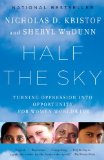
Half the Sky

Half the Sky
Turning Oppression into Opportunity for Women Worldwide
by Nicholas D. Kristof, Sheryl WuDunn
Hardcover: Sep 2009,
320 pages.
Paperback: Jun 2010,
320 pages.

Publication information
Author Information:
Kristof
WuDunn
Critics' Opinion:   
Readers' Rating:  
About BookBrowse Rankings
Share: 
Buy This Book

Reading Guide Questions

 Printer Friendly Guide

Please be aware that this discussion guide may contain spoilers!

About This Guide
The questions and topics that follow are intended to enhance your group's conversation about Nicholas Kristof and Sheryl WuDunn's enlightening and inspiring book, Half the Sky: Turning Oppression into Opportunity for Women Worldwide.

About This Book

The questions and topics that follow are intended to enhance your group's conversation about Nicholas Kristof and Sheryl WuDunn's enlightening and inspiring book, Half the Sky: Turning Oppression into Opportunity for Women Worldwide.


Reader's Guide

  1. "It appears that more girls have been killed in the last fifty years, precisely because they were girls, than men were killed in all the battles of the twentieth century" (p. xvii). Why is the dire state of women in impoverished cultures, as set out by the authors in the introduction, also a great opportunity for them?      
  2. "The modern global slave trade is larger in absolute terms than the Atlantic slave trade in the eighteenth and nineteenth centuries" (p. 11).  Given the scale of the problem, what do Kristof and WuDunn suggest as reasonable efforts towards ending human trafficking?
  3. What do the stories about Srey Momm and Srey Neth indicate about the complexities of the trafficking problem in places like Thailand and Cambodia? Why do Kristof and WuDunn say "it's most productive to focus efforts on prevention and putting brothels out of business" (p. 45)?
  4. What difficulties do "the new abolitionists," like Sunitha Krishnan and Abbas Be, face in trying to shut down the brothel trade? How does Sunitha's story highlight the kind of bravery required to save women from enslavement in brothels?
  5. The judge in the rape and kidnapping case of Woineshet, in Ethiopia, disapproved of the fact that this young girl was insisting on prosecuting her rapist: "He wants to marry you. Why are you refusing?" (p. 65). How is this story emblematic of the much larger problem of "tradition" in countries like Ethiopia?
  6. Kristof and WuDunn argue that "universities should make it a requirement that all graduates spend at least some time in the developing world" (p. 88), and that "time spent in Congo and Cambodia might not be as pleasant as in Paris, but it will be life-changing" (p. 89). Do you agree that young Americans should be required to widen their knowledge by direct experience? How might such a requirement change the lives of young Americans, and their view of poverty and privilege?
  7. How does the story of Prudence Lemokouno illustrate the dangers of pregnancy and delivery in the developing world (pp. 109–13)? Does it seem an obvious and desirable principle that reproductive health should be considered an international human rights issue, as argued by Dr. Allan Rosenfield (p. 122)?  What does the example of Sri Lanka prove about the possibilities of reducing women's mortality rates in childbirth?
  8. Muslim nations are among those in which women are most severely disadvantaged; so the authors directly address the question of whether Islam is misogynistic (p. 150).  What do they conclude?  What are the best ways to address the frustrations of women like Ellaha, who feel trapped in conservative Muslim cultures where women are at the mercy of their male relatives (pp. 156–57)? Is religion part of the reason for the oppression of women? Is it part of the solution?
  9. The authors present a great deal of information about the troubles surrounding the education of girls. Discuss the thorny problems raised in chapter ten, "Investing in Education" (pp. 167–78), and the ways that Ann Cotton has succeeded in addressing many of them with her Camfed project in Zimbabwe (pp. 179–83).
  10. Chapter Eleven, "Microcredit: The Financial Revolution," focuses on the positive changes that are possible when you lend women money to start businesses, or when women have control of the family purse. Is it surprising to learn that when men control family spending, more is spent on beer and prostitutes, and when women are in control more is spent on food and education (pp. 192–93)? Does India's law, assuring that one third of village leaders will be women, suggest that putting more women in positions of political power will make the world a better place for children?
  11. Thomas Clarkson and William Wilberforce worked tirelessly to expose the truths about the cruel and gruesome conditions endured by the slaves in the British slave trade (pp. 235–36). Their work is a model for the political effectiveness of bringing atrocities to the forefront of the public mind and conscience. What realities were brought to light for you, as you read this book? What details or stories would you consider most provocative, disturbing, or inspiring for middle-class readers?
  12. With the stories they recount in this book, Kristof and WuDunn hope to convince readers to help bring about changes that are desperately needed in the developing world. How effective would you predict Half the Sky willbe in its effort to create new activists, donors, and volunteers for the international women's movement (p. 237)?
  13. Kristof and WuDunn make three specific recommendations for immediate action: "A $10 billion effort over five years to educate girls," focusing on Africa but also encouraging Afghanistan and Pakistan to do better; a drive to iodize salt in poor countries, to improve I.Q. points lost to iodine deficiency in utero; and a twelve-year, $1.6 billion campaign to eradicate obstetric fistula and to reduce maternal mortality (pp. 246–47). What do you think about this vision? What has reading the book done to your sense of what needs to be done and what kinds of action might be most effective? Has reading the book inspired you to develop an action strategy or a personal plan to join the movement to address some of these issues? What kinds of actions personally do you think would be the most effective?
  14. Jonathan Haidt has written in The Happiness Hypothesis that "a connection to something larger" can greatly affect our feelings of happiness. As Kristof and WuDunn suggest, "we are neurologically constructed so that we gain huge personal dividends from altruism" (p. 250). Do you feel this to be true? Do you feel, upon finishing this book, that you can have a direct impact on helping to turn women in impoverished parts of the world "into full-fledged human beings" (p. 251)?

Suggested Reading
Kevin Bales, Ending Slavery: How We Free Today's Slaves
Louise Brown, Sex Slaves: The Trafficking of Women in Asia
Dave Eggers, What Is the What?
Muktar Mai, In the Name of Honor: A Memoir
Greg Mortensen, Three Cups of Tea: One Man's Mission to Promote Peace...One School at a Time
Zainab Salbi, The Other Side of War: Women's Stories of Survival and Hope
Lisa Shannon, A Thousand Sisters: My Journey into the Worst Place on Earth to Be a Woman
Peter Singer, The Life You Can Save: Acting Now to End World Poverty
Muhammad Yunus, Banker to the Poor: Micro-Lending and the Battle Against World Poverty


Unless otherwise stated, this discussion guide is reprinted with the permission of Anchor Books. Any page references refer to a USA edition of the book, usually the trade paperback version, and may vary in other editions.

Become a Member
Click Here
Editor's Choice
  •  May 21 
  •  May 20 
  •  May 18 
Helga's Diary
Helga Weiss

Helga's Diary Jacket

The remarkable diary of a young girl who survived the Holocaust—appearing in English for the first time.
Fever
Mary Beth Keane

Fever Jacket

A bold, mesmerizing novel about the woman known as "Typhoid Mary," the first known healthy carrier of typhoid fever in the burgeoning metropolis of early twentieth century New York.
The Woman Upstairs
Claire Messud

The Woman Upstairs Jacket

The riveting confession of a woman awakened, transformed, and betrayed by passion and desire for a world beyond her own.
Click Here
   Most Recent Blog Entries
Movies Based on Books: Summer 2013 (May - August)
Jewish Young Adult Books That Are Not About The Holocaust
Books to Give This Mother's Day
rss  RSS   rss  subscribe
Recent Reader Reviews
Z: A Novel of Zelda Fitzgerald by Therese Fowler
Z, the novel about the life of Zelda Sayre Fitzgerald is at points charming and; like another reviewer, I kept thinking of the movie, "Midnight... read more
Flight Behavior by Barbara Kingsolver
Although heavy on the scientific details, which slowed down the story for me (OK, I admit, I was one of those liberal arts majors who skipped out on... read more
The House at the End of Hope Street by Menna van Praag
Loved this book. Magical, quirky, enchanting I could go on. All books do not have to be literary fiction, sometimes it is just so comforting to read... read more
RSS RSS feed More...  
Most Viewed This Week
1. The Help
Kathryn Stockett
2. The Immortal Life of Henrietta Lacks
Rebecca Skloot
3. A Child Called It
Dave Pelzer
4. Half the Sky
Nicholas D. Kristof, Sheryl WuDunn
5. The Glass Castle
Jeannette Walls
More...
Book Club Recommendations
The Gods of Gotham
by Lyndsay Faye
Paperback (Mar/13)
Forgotten Country
by Catherine Chung
Paperback (Mar/13)
Philida
by André Brink
Paperback (Feb/13)
Gone Girl
by Gillian Flynn
Hardback (Jun/12)
More...
First Impressions
Members read and review books often months before they're published. See what they think in First Impressions!
The Sisterhood
by Helen Bryan
Four Stars            (Apr/13)
The Last Girl
by Jane Casey
Four Stars            (May/13)
Golden Boy
by Abigail Tarttelin
4.5 Stars            (May/13)
The Caretaker
by A .X. Ahmad
Four Stars            (May/13)
More...
  Latest BookBrowse News
British Parliament asks Amazon to clarify why it pays $9 million in income tax on $23 billion of UK sales. (May 20 2013)
Amazon will be called back to give further evidence to members of the British Parliament "to clarify how its activities in the U.K. justify its low corporate... Full Story
rss RSS feed More...
 
BookBrowse Poll
Q: Which of these Summer movies based on books would you like to see? (Info on each movie here)
The Great Gatsby
Epic
Man of Steel
World War Z
The Lone Ranger
The Wolverine
R.I.P.D.
Percy Jackson
Paranoia
The Mortal Instruments
Select Any That Apply
Search: Title or Author
Free Newsletters
The Light Between Oceans

Online Book Club
More about
The Comfort of Lies
Join the discussion!


Win This Book!
On Sal Mal Lane


"Piercingly intelligent and shatter-your-heart profound."

Enter To Win Now!

wordplay
Solve this clue:
"I I M B T Give T T R"

and be entered
to win....
frame top
New Author
Interviews
Menna van Praag
Erica Brown
Helga Weiss
Kate Morton
frame bottom
HOME Book Submissions | Advertising | Library Subscriptions | Reviewing for BookBrowse | Contact Us