Reading Guide Questions

Please be aware that this discussion guide will contain spoilers!
Introduction
One of the
Washington Post's Best Books of 2008.
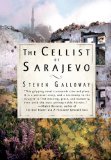
The Cellist of Sarajevo is a gripping portrait of a city under siege,
the small acts of humanity that come to renew it, and from the ashes, the
rising, redemptive grace notes of one musician.
After witnessing a shelling that takes the lives of twenty-two civilians
outside his window, a man decides he will play at the site of the attack for
twenty-two days in tribute, to mark their deaths in a city bombarded
relentlessly by surprise attacks and sniper fire.
Elsewhere in the city, a young man leaves home to gather clean drinking water
for his family—a perilous mission that forces him to weigh the value of
generosity against selfish survivalism.
A third man, older, sets out in search of bread and distraction, and instead
runs into a friend from the past who reminds him of the city he has lost, and
the man he once was.
As each is drawn into the web and center of the mournful adagio, a female
sniper holds the fate of the cellist in her hands. While she protects him with
her life, her own army prepares to challenge the kind of person she has become.
A novel of great intensity and power,
The Cellist of Sarajevo is a
testament to the endurance of the spirit and the subtle ways individuals reclaim
their humanity in a time of war.
Discussion Questions
- What effect does the constant confrontation of war and occupation have
on each narrator? Does suffering, violence and loss ever become normalized
for them? What is it like to live in this kind of anarchy—especially when
symbols of peace and power have been extinguished (the eternal flame from
WWII, the Kosovo Olympic stadium now used as a burial ground)? And what does
it mean to have the color, beauty, and vibrancy of music and flowers (left
behind for the cellist) introduced?
- How has life changed in the city since the arrival of the men on the
hills? What resources, both physical and mental, are the four characters in
the book using to help them survive? What is involved in day-to-day living?
How would you fare under these same conditions—and what would be your
greatest challenges?
- Each chapter in the novel is told through the lens of one of the four
main characters (including the cellist) in the story. How does this strategy
color our reading? How might our experience be different if told in first
person? If it were told in a more journalistic way?
- How do each of the narrators (Arrow, Dragan, Kenan) view their fellow
citizens? How do they each look upon their struggles, choices, and their
attitudes? What makes them not give up on each other? Does Kenan's
classification of the "three types of people" (144) ring true to you?
- Do you think the author intends for the reader to be sympathetic to
Arrow's life and career trajectory? What prevents (or encourages) us from
fully engaging, trusting, relating to her? Do you think war forces everyone
to compromise something in themselves—their attitude, their moral compass?
- What are the goals of "the men on the hill"? What exactly is it they are
trying to destroy? What do they come to represent for the main
characters—and what separates them from Arrow?
- In the beginning of the novel, Dragan is said to avoid his friends and
coworkers because "the destruction of the living is too much for him," Arrow
assumes a new name to distance herself from her role as a sniper, and Kenan
takes refuge in his new ritual of obtaining water for his family. How have
the three used rituals as ways to cope with their fear of what is happening
in the city? At the end of the book, do you feel that their experiences of
the cellist's performances have changed how they deal with the danger around
them? In what way?
- What force does music have upon the war torn state—and what powers does
it have over the lives of the characters? (For Kenan, Arrow, and Dragan? For
the cellist himself?) Do you find yourself relating to the power of the
cellist's performances? Are there parallel moments in your life where you
also experienced such sudden awakening, or realization?
- "Sarajevo was a great city for walking." How does the mapping of the
landscape—the physical and psychic layout of the city—affect the narrative?
How does our intimacy with this map affect our experience of the story?
- In one of his early chapters, Kenan is particularly disturbed by the
interruption and shelled state of the tram's service ("The war will not be
over until the trams run again") and the destruction of the National Library
("the most visible manifestation of a society he was proud of")—representing
for him basic civilization. What signs, services, and signals do you
consider pillars of civilization?
- Why do you think the sniper avoids taking his shot at the
cellist—especially when he has such ample opportunity?
- Why does Dragan take such drastic measures to prevent the dead man's
body from being filmed by the journalist? What does the author suggest
through this as a lesson for the living? What are we to do to prevent the
horror of war from becoming commonplace, something to tune our televisions
out from?
- Were you surprised by Arrow's final act of protest? Do you think she was
ultimately able to reclaim herself, her identity? Do you think she
succeeded?
Unless otherwise stated, this discussion guide is reprinted with the permission of Riverhead Books.
Any page references refer to a USA edition of the book, usually the trade paperback version, and may vary in other editions.
 Book Reviewed by: