return to home  
Join   |  Gift   |  Member Login   |  Library Login
BookBrowse Mobile
Follow Us: 
   Reading Guides

A Free Life by Ha Jin: Questions, plus a reading group guide, with links to reviews, excerpt, author biography at BookBrowse.com.

A Free Life

A Free Life
by Ha Jin
Hardcover: Oct 2007,
624 pages.
Paperback: Jan 2009,
672 pages.

Publication information
Author Information
Critics' Opinion:   
Readers' Rating:  
About BookBrowse Rankings
Share: 
Buy This Book

Reading Guide Questions

 Printer Friendly Guide

Please be aware that this discussion guide may contain spoilers!

About This Book

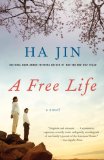
Nan Wu is a Chinese graduate student in political science at Brandeis University when the Tiananmen Square massacre changes everything for him. Because of his activity with a prodemocracy group, it is now impossible for him to return to China to take up the academic career he had been working toward. His wife, Pingping, is already with him in Boston; their six-year-old son, Taotao, who has been living with his grandparents in Jinan, is finally able to join them. Nan has not seen his son for four years, and Taotao doesn't remember his father. Reunited now in exile, they must all begin a new life.

Nan soon decides that political science, the field of study assigned to him by the Chinese government, does not interest him-at heart, he wants to write poetry. He is haunted as well by thoughts of Beina, the woman who broke his heart in China. He knows he doesn't truly love Pingping, but the economic survival of his family takes priority over all his private desires. He quits graduate school, and he and Pingping move to Atlanta, where they buy a small Chinese restaurant in a shopping mall. Slowly Nan develops his cooking skills and the restaurant thrives, but he is troubled by his continuing dissatisfaction with life. His poet friend Dick meanwhile, takes an academic job at Emory, and through him Nan learns what it means to survive as a poet in America—to win grants, to be published by a respectable press, to be invited to speak, and to read from one's work. His daily work at the restaurant keeps him drained and uninspired. But the larger problem is that he must decide whether to write in Chinese or in English—he is caught between two languages, and each expresses a world of alienation for Nan.

In a narrative style that reflects the slow accretion of daily experience with the texture of events both large and small, Ha Jin masterfully and movingly presents the struggle—fraught with difficulty, anxiety, and exhaustion—of an immigrant family building a life in America.


Reader's Guide

  1. From the beginning, the novel presents a structure of very short chapters. Why might Ha Jin have chosen this means of organizing his story, and what is its effect? In what ways does the pace of the novel reflect the rhythms of daily life?
  2. What is likable about Nan's character, and what is less so? Do his continuing infatuation with Beina, his lack of love for Pingping [pp. 23, 57–60], and his emotional distance from his son affect your opinion of him, and if so, how?
  3. The use of language is an important focus of A Free Life. Ha Jin writes Nan's mistakes and mispronunciations into the dialogue when Nan is speaking in English; when characters speak in Chinese their speech appears in italics. What is the effect of the occasional misuse or noncolloquial use of a word or phrase in English, as when Nan says, for instance, that Sam is "bibulous" [p. 260], that a poet is "well endowed" [p. 305], or when he says in a job interview that he and his co-workers "all got laid together" [p. 25]?
  4. The Wus' friendship with Janet and Dave Mitchell involves them in the emotional events of Hailee's adoption from China, as well as the discovery and treatment of her leukemia. At one point Nan is amazed at how emotional Dave becomes when having to choose between two orphan girls; he thinks, "Probably it was their Christian faith that had instilled in them the sense of guilt and enabled them to commiserate with the babies more than they—the Wus—could" [p. 313]. Do you think Christianity is the reason for the Mitchells' sensitivity? Does the episode suggest something about cultural difference or about Nan's own powers of empathy?
  5. Responding to Mr. Liu's statement that China should attack Taiwan to maintain its territorial integrity, Nan says, "For the individual human being, what is a country? It's just an idea that binds people together emotionally. But if the country cannot offer the individual a better life, if the country is detrimental to the individual's existence, doesn't the individual have the right to give up the country, to say no to it?" [p. 320]. Do you agree with this statement? What are the reasons that Nan feels he must say no to China?
  6. When they deposit the $50,000 check and the woman at the bank looks at them strangely, Pingping realizes, "There was no way this woman could imagine the sacrifice and labor this check embodied" [p. 185]. Would you agree that most native-born Americans are no longer capable of the self-sacrifice and unremitting labor that the Wus engage in? What are the effects of a capitalist and consumerist economy on people's values and behavior, as seen through the eyes of Nan and Pingping?
  7. Throughout the story, Nan holds onto the memory of Beina and wants to see her again "in order to preserve her in his memory as a lovely woman beyond his reach, as someone who still possessed his soul, so that the flames of inspiration would blaze in him again" [p. 562]. How do his feelings change after he sees Beina in Illinois [pp. 586-90]?
  8. Nan tells Dick that "zer core of American culture" is "obsessed with two s's ... self and sex" [p. 307]. How does Nan react in episodes related to sex [pp. 31–34, 86–90, 544–46, 595–99]? What is the difference between Nan's self-absorption and the self-obsession he sees in Americans?
  9. When the Wus sell their restaurant to their friends Shubo and Niyan they are shocked to learn that Shubo won't let Pingping work there [pp. 613–15]. What does this incident, as well as Nan's later visit to his parents in China [pp. 557–60] make clear for Nan about the bonds of friendship and family? How does he respond to the celebration of Halloween in their suburban neighborhood [pp. 271–73], and why?
  10. After paying off the mortgage on their house, Nan has a brief period of elation which is followed by a profound sense of disappointment: "The struggle had ended so soon that he felt as though the whole notion of the American dream was shoddy, a hoax. . . . He should feel successful. But somehow the success didn't mean as much to him as it should" [p. 418]. What is the cause of his dismay? How is his distress affected by his conversation with Shubo about the idea that immigrants must sacrifice their own dreams for their children and grandchildren [pp. 420–21]?
  11. Observing the culture of moneymaking on his trip to China, Nan thinks, "Now he wanted all the more to live and die in America. How he missed his home in Georgia" [p. 568]. Throughout the story, Nan has felt almost no nostalgia for his life in China. Is this lack of emotional connection to his native culture partly the reason that Nan is willing to risk writing in English? What had come to define "home" for Nan?
  12. The story's arc brings to Nan's attention only belatedly what the reader perhaps already feels: that Pingping has proven herself from the beginning the stronger and steadier character. She has left her native country to be with a husband she knows does not love her, she accepts his moods and his anger, and she works daily with their son to make sure he succeeds at school. How do Pingping's pregnancy and the loss of the baby girl affect their marriage [p. 469]? How does Nan come to realize Pingping's worth [p. 612]? What does his poem "Belated Love" [pp. 619–20] express about his new knowledge?
  13. How would you describe the prose style of the novel? What are the notable aspects of the narration and what kinds of details does it bring into focus? Do you assume that the narration is mainly from Nan's point of view; is it a more objective third-person narration, or does it shift between the two?
  14. 14. Regarding his poetic vocation, Nan thinks, "The truth was that he had been frightened by the overwhelming odds against writing in English artistically, against claiming his existence in this new land, and against becoming a truly independent man who followed nothing but his own heart. To date he had tried every way to wriggle out of the struggle" [p. 472]. How do the poems at the end of the volume reflect Nan's new independence? What does the "free life" of the title mean for him?
     

Suggested Reading

Monica Ali, Brick Lane; Kiran Desai, The Inheritance of Loss; Andre Dubus III, House of Sand and Fog; Ma Jian, Beijing Coma; Jhumpa Lahiri, The Namesake; Nam Le, The Boat; Rohinton Mistry, Family Matters; Vladimir Nabokov, Pnin and Speak, Memory; V. S. Naipaul, A House for Mr. Biswas; Boris Pasternak, Doctor Zhivago; John Steinbeck, The Grapes of Wrath; Mo Yan, Life and Death Are Wearing Me Out.


About the Author

Ha Jin left his native China in 1985 to attend Brandeis University. He is the author of the internationally bestselling novel Waiting, which won the PEN/Faulkner Award and the National Book Award; War Trash, which won the PEN/Faulkner Award; The Crazed; In the Pond; the story collections The Bridegroom, which won the Asian American Literary Award, Under the Red Flag, which won the Flannery O'Connor Award for Short Fiction, and Ocean of Words, which won the PEN/Hemingway Award; and three books of poetry. He is a professor of English at Boston University and lives in the Boston area.

Ha Jin is available for select readings and lectures. To inquire about a possible appearance, please visit www.knopfspeakersbureau.com or call 212-572-2013.


Unless otherwise stated, this discussion guide is reprinted with the permission of Vintage. Any page references refer to a USA edition of the book, usually the trade paperback version, and may vary in other editions.

Become a Member
Click Here
Editor's Choice
  •  May 20 
  •  May 18 
  •  May 16 
Fever
Mary Beth Keane

Fever Jacket

A bold, mesmerizing novel about the woman known as "Typhoid Mary," the first known healthy carrier of typhoid fever in the burgeoning metropolis of early twentieth century New York.
The Woman Upstairs
Claire Messud

The Woman Upstairs Jacket

The riveting confession of a woman awakened, transformed, and betrayed by passion and desire for a world beyond her own.
How to Create the Perfect Wife
Wendy Moore

How to Create the Perfect Wife Jacket

Stranger than fiction, blending tragedy and farce, How to Create the Perfect Wife is an engrossing tale of the radicalism, and deep contradictions, at the heart of the Enlightenment.
Click Here
   Most Recent Blog Entries
Movies Based on Books: Summer 2013 (May - August)
Jewish Young Adult Books That Are Not About The Holocaust
Books to Give This Mother's Day
rss  RSS   rss  subscribe
Recent Reader Reviews
Z: A Novel of Zelda Fitzgerald by Therese Fowler
Z, the novel about the life of Zelda Sayre Fitzgerald is at points charming and; like another reviewer, I kept thinking of the movie, "Midnight... read more
Flight Behavior by Barbara Kingsolver
Although heavy on the scientific details, which slowed down the story for me (OK, I admit, I was one of those liberal arts majors who skipped out on... read more
The House at the End of Hope Street by Menna van Praag
Loved this book. Magical, quirky, enchanting I could go on. All books do not have to be literary fiction, sometimes it is just so comforting to read... read more
RSS RSS feed More...  
Most Viewed This Week
1. Half the Sky
Nicholas D. Kristof, Sheryl WuDunn
2. Lots of Candles, Plenty of Cake
Anna Quindlen
3. Because of Winn-Dixie
Kate DiCamillo
4. Eagle Strike
Anthony Horowitz
5. K Blows Top
Peter Carlson
More...
Book Club Recommendations
The Gods of Gotham
by Lyndsay Faye
Paperback (Mar/13)
Forgotten Country
by Catherine Chung
Paperback (Mar/13)
Philida
by André Brink
Paperback (Feb/13)
Gone Girl
by Gillian Flynn
Hardback (Jun/12)
More...
First Impressions
Members read and review books often months before they're published. See what they think in First Impressions!
The Sisterhood
by Helen Bryan
Four Stars            (Apr/13)
A Dual Inheritance
by Joanna Hershon
Four Stars            (May/13)
The Laws of Gravity
by Liz Rosenberg
4.5 Stars            (May/13)
More...
  Latest BookBrowse News
British Parliament asks Amazon to clarify why it pays $9 million in income tax on $23 billion of UK sales. (May 20 2013)
Amazon will be called back to give further evidence to members of the British Parliament "to clarify how its activities in the U.K. justify its low corporate... Full Story
rss RSS feed More...
 
BookBrowse Poll
Q: Which of these Summer movies based on books would you like to see? (Info on each movie here)
The Great Gatsby
Epic
Man of Steel
World War Z
The Lone Ranger
The Wolverine
R.I.P.D.
Percy Jackson
Paranoia
The Mortal Instruments
Select Any That Apply
Search: Title or Author
Free Newsletters
Bring Up the Bodies

Online Book Club
More about
Five Days
Join the discussion!


Win This Book!
The Pigeon Pie Mystery


Enter To Win Now!

wordplay
Solve this clue:
"I I M B T Give T T R"

and be entered
to win....
frame top
New Author
Interviews
Menna van Praag
Erica Brown
Helga Weiss
Kate Morton
frame bottom
HOME Book Submissions | Advertising | Library Subscriptions | Reviewing for BookBrowse | Contact Us



