Reading Guide Questions

Please be aware that this discussion guide will contain spoilers!
- The phrase "a thousand splendid suns," from the poem by Saib-e-Tabrizi,
is quoted twice in the novel – once as Laila's family prepares to leave
Kabul, and again when she decides to return there from Pakistan. It is also
echoed in one of the final lines: "Miriam is in Laila's own heart, where she
shines with the bursting radiance of a thousand suns." Discuss the thematic
significance of this phrase.
- Mariam's mother tells her: "Women like us. We endure. It's all we have."
Discuss how this sentiment informs Mariam's life and how it relates to the
larger themes of the novel.
- By the time Laila is rescued from the rubble of her home by Rasheed and
Mariam, Mariam's marriage has become a miserable existence of neglect and
abuse. Yet when she realizes that Rasheed intends to marry Laila, she reacts
with outrage. Given that Laila's presence actually tempers Rasheed's abuse,
why is Mariam so hostile toward her?
- Laila's friendship with Mariam begins when she defends Mariam from a
beating by Rasheed. Why does Laila take this action, despite the contempt
Mariam has consistently shown her?
- Growing up, Laila feels that her mother's love is reserved for her two
brothers. "People," she decides, "shouldn't be allowed to have new children
if they'd already given away all their love to their old ones." How does
this sentiment inform Laila's reaction to becoming pregnant with Rasheed's
child? What lessons from her childhood does Laila apply in raising her own
children?
- At several points in the story, Mariam and Laila pass themselves off as
mother and daughter. What is the symbolic importance of this subterfuge? In
what ways is Mariam's and Laila's relationship with each other informed by
their relationships with their own mothers?
- One of the Taliban judges at Mariam's trial tells her, "God has made us
different, you women and us men. Our brains are different. You are not able
to think like we can. Western doctors and their science have proven this."
What is the irony in this statement? How is irony employed throughout the
novel?
- Laila's father tells her, "You're a very, very bright girl. Truly you
are. You can be anything that you want." Discuss Laila's relationship with
her father. What aspects of his character does she inherit? In what ways is
she different?
- Mariam refuses to see visitors while she is imprisoned, and she calls no
witnesses at her trial. Why does she make these decisions?
- The driver who takes Babi, Laila, and Tariq to the giant stone Buddhas
above the Bamiyan Valley describes the crumbling fortress of Shahr-e-Zohak
as "the story of our country, one invader after another… we're like those
walls up there. Battered, and nothing pretty to look at, but still
standing." Discuss the metaphorical import of this passage as it relates to
Miriam and Laila. In what ways does their story reflect the larger story of
Afghanistan's troubled history?
- Among other things, the Taliban forbid "writing books, watching films,
and painting pictures." Yet despite this edict, the film Titanic
becomes a sensation on the black market. Why would people risk the Taliban's
violent reprisals for a taste of popcorn entertainment? What do the
Taliban's restrictions on such material say about the power of artistic
expression and the threat it poses to repressive political regimes?
- While the first three parts of the novel are written in the past tense,
the final part is written in present tense. What do you think was the
author's intent in making this shift? How does it change the effect of this
final section?
Unless otherwise stated, this discussion guide is reprinted with the permission of Riverhead Books.
Any page references refer to a USA edition of the book, usually the trade paperback version, and may vary in other editions.
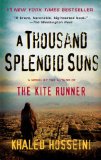
 Book Reviewed by: