The Dead Fathers Club by Matt Haig: Questions, plus a reading group guide, with links to reviews, excerpt, author interview and author biography at BookBrowse.com.
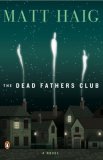
The Dead Fathers Club
by Matt Haig
Hardcover: Feb 2007,
336 pages.
Paperback: Dec 2007,
336 pages.
Please be aware that this discussion guide may contain spoilers!
DISCUSSION QUESTIONS
During the course of his narrative, Philip Noble, commits a series of crimes that grow increasingly serious. Despite his criminal behavior, does he continue to move the sympathies of the reader? By what means does he do so?
Leah confides to Philip that she hates God. By contrast, her father, Mr. Fairview, has turned enthusiastically toward religion after the death of his wife. What commentary does The Dead Fathers Club offer regarding religion, and how does religion influence events and relationships in the novel?
Philip observes, If you speak to yourself people think you are mad but if you write the same things they think you are clever. Discuss examples from life or literature that bear out this observation on the nature of madness and intelligence.
Philip routinely omits standard punctuation and sometimes arranges words on the page to add visual meanings to the verbal significance of his writing. How do these devices influence the experience of reading the novel?
How might Philips mental disturbances be influenced by matters relating to sexuality, for example, his recent circumcision, his attraction toward his mother, and his ambivalent feelings about Leah?
Many of Haigs characters, including Uncle Alan (Claudius), Philips mother (Gertrude), Leah (Ophelia), and Ross and Gary (Rosencrantz and Guildenstern) have clear parallels in Shakespeares Hamlet. Nevertheless, these characters have been reimagined with traits and motivations that distinguish them from their Shakespearean models. Choose a character from The Dead Fathers Club and reread the scenes involving that characters counterpart in Hamlet. How has Haig altered the character? What do you think of these changes?
Philip takes a surprising interest in Roman history, especially in the reign of Nero. How does this interest relate to Philips overall mental state, and how is it woven into the novels plot?
Philip, who occasionally alludes to the wealth of the Fairview family and comments that clever schools did Rugby and thick schools did Football, is aware of the social and intellectual class system that surrounds him. To what extent is Haigs novel shaped by issues of class?
What is the most useful way to understand the spirit that we come to know as Philips fathers ghost? Should he be thought of as a character, as an embodiment of Philips anxieties, as a demonic presence, or as something else? Why does Philip trust him for so long?
Philip grossly misjudges the people around him and, because he tells the story, we view these people only from his misguided perspective. Nevertheless, by some miracle of narration, we are able to see them more or less as they are: as somewhat limited but basically well-meaning human beings. How does Haig manage both to immerse us in Philips point of view and give us an objective understanding of his other characters?
In a famous essay, T. S. Eliot complained that Hamlet was artistically flawed because the heros emotions were in excess of the factual situation in which he found himself. Does Haigs retelling of the story give Philip sufficient motives for his extreme conduct? Do you find Philip believable as a character? Why or why not?
Unless otherwise stated, this discussion guide is reprinted with the permission of Penguin.
Any page references refer to a USA edition of the book, usually the trade paperback version, and may vary in other editions.
A bold, mesmerizing novel about the woman known as "Typhoid Mary," the first known healthy carrier of typhoid fever in the burgeoning metropolis of early twentieth century New York.
Two Lives is a memoir written by international best-selling author, Vikram Seth. In this interesting and engaging book, Seth writes about his great...
read more
Z, the novel about the life of Zelda Sayre Fitzgerald is at points charming and; like another reviewer, I kept thinking of the movie, "Midnight...
read more
Although heavy on the scientific details, which slowed down the story for me (OK, I admit, I was one of those liberal arts majors who skipped out on...
read more
Judge rules unused Borders gift cards to be worthless(May 23 2013) Borders owes nothing to holders of roughly $210.5 million of gift cards that had not been used by the time the bookstore chain shut down, a Manhattan federal...
Full Story