Book Club Discussion Questions
For supplemental discussion material see our Beyond the Book article, and our BookBrowse Review of The Lay of the Land.
Please be aware that this discussion guide will contain spoilers!
The introduction, discussion questions, suggestions for further reading, and
author biography that follow are meant to enliven your group's discussion of
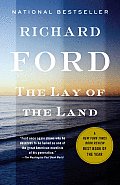
Richard Ford's abundant, funny, sorrowful, and miraculously observed new novel,
The Lay of the Land.
About This Book
In
The Lay of the Land, the author reintroduces readers to Frank Bascombe,
the protagonist of his earlier novels
The Sportswriter and the Pulitzer
Prize–winning
Independence Day. He is a man of mild aspect and strong,
sometimes violent feelings, capable of kindnesses both diligent and spontaneous
but also of flashes of cruelty and contempt. A native Southerner transplanted to
Michigan, the New Jersey suburbs, and lately the beach town of Sea-Clift ("NEW
JERSEY'S BEST-KEPT SECRET"); a one-time novelist turned sportswriter and then
realtor; a survivor of a divorce, the father of a dead son: Frank is living
testimony to the infinite renewability of American life (just as his career
speaks of the infinite renewability of American real estate). But Frank doesn't
want any more renewal. At 55, he's entered the Permanent Period, the "end to
perpetual becoming, to thinking that life schemed wonderful changes for me, even
if it didn't. It portended a blunt break with the past and provided a license to
think of the past only indistinctly (who wouldn't pay plenty for that?)" [p.
54].
But as he prepares for the Thanksgiving weekend of the year 2000 and braces
himself for the aftershocks of an inconclusive presidential election, Frank
worries that his Permanent Period may be coming to an end. His wife Sally has
left him for her first husband, who was supposed to be dead; his first wife,
Ann, has decided that she's in love with him, again or still; his prostate has
sprouted cancer, which is being treated with radioactive BBs, and even his
daughter Clarissa, who faithfully shepherded him through his procedure and
recovery, is switching sexual preference. Add the ill-considered business plans
of his Tibetan business partner, the imminent arrival of his eccentric surviving
son, and a bomb going off at the hospital where he likes to eat lunch, and you
can understand why Frank would rather skip Thanksgiving, why he might rather
skip everything.
The fact that he doesn't—that he shows up for every painful and absurd event of
this dizzyingly eventful novel and reports them all in a voice as confiding,
expansive, and laugh-out-loud funny as any in American fiction—is something to
be grateful for. Happy Thanksgiving.
Reader's Guide
- What do you make of the story that opens the novel: that of the
community college teacher who, before being gunned down by one of her
disgruntled students, was asked if she was ready to meet her maker and
replied "Yes. Yes, I think I am" [p. 3]. Why is Frank so riveted by this
question? How does he think he might answer in similar circumstances? What
does he mean when he says that "It's not a question . . . that suburban life
regularly poses to us. Suburban life, in fact, pretty much does the
opposite" [p. 4]? Is he right? How do the themes of death, self-accounting,
and the terrifying randomness of the American berserker recur throughout
The Lay of the Land?
- What does Bascombe mean by the "Permanent Period?" When does he seem to
have entered it, and what events threaten to evict him from it? How serious
is he when he speaks of its pleasures? In the scheme of this novel, is
permanence the same thing as happiness? As resignation?
- The Lay of the Land is set during Thanksgiving, as The
Sportswriter takes place at Easter and Independence Day over a July 4th
weekend. How does the holiday figure in the novel? How does Frank feel about
it, and how do the other characters appear to be celebrating it? Discuss the
novel's exploration of themes like gratitude, family, and abundance—as well
as the ambiguous meaning of "pilgrim."
📖
Get the full reading guide
Join BookBrowse free to unlock all 15 discussion questions, author background, themes, and more for The Lay of the Land.
Join free — it takes 30 seconds
Already a member? Log in →
- How does the author develop themes of identity and belonging throughout the narrative?
- What role does the setting play in shaping the characters' decisions and relationships?
- Discuss how the ending reframes the events of the story. Were you surprised?
Unless otherwise stated, this discussion guide is reprinted with the permission of Vintage.
Any page references refer to a USA edition of the book, usually the trade paperback version, and may vary in other editions.

 Book Reviewed by: