Reading Guide Questions

Please be aware that this discussion guide will contain spoilers!
About the Book
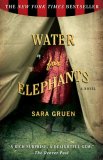
Though he may not speak of them, the memories still dwell inside Jacob
Jankowski's ninety-something-year-old mind. Memories of himself as a young man,
tossed by fate onto a rickety train that was home to the Benzini Brothers Most
Spectacular Show on Earth. Memories of a world filled with freaks and clowns,
with wonder and pain and anger and passion; a world with its own narrow,
irrational rules, its own way of life, and its own way of death. The world of
the circus: to Jacob it was both salvation and a living hell.
Jacob was there because his luck had run out --- orphaned and penniless, he had
no direction until he landed on this locomotive "ship of fools." It was the
early part of the Great Depression, and everyone in this third-rate circus was
lucky to have any job at all. Marlena, the star of the equestrian act, was there
because she fell in love with the wrong man, a handsome circus boss with a wide
mean streak. And Rosie the elephant was there because she was the great gray
hope, the new act that was going to be the salvation of the circus; the only
problem was, Rosie didn't have an act --- in fact, she couldn't even follow
instructions. The bond that grew among this unlikely trio was one of love and
trust, and ultimately, it was their only hope for survival.
Surprising, poignant, and funny,
Water for Elephants is that rare novel with a
story so engrossing, one is reluctant to put it down; with characters so
engaging, they continue to live long after the last page has been turned; with a
world built of wonder, a world so real, one starts to breathe its air.
- To what extent do the chapters concerning the elderly Jacob enhance the
chapters recounting the young Jacob's experiences with the Benzini Brothers
circus? In what ways do the chapters about the young Jacob contribute to a
deeper understanding of the elderly Jacob's life?
- How does the novel's epigraph, the quote from Dr. Seuss's Horton Hatches the
Egg, apply to the novel? What are the roles and importance of faithfulness and
loyalty in Water for Elephants? In what ways does Gruen contrast the antagonisms
and cruelties of circus life with the equally impressive loyalties and instances
of caring?
- Who did you, upon reading the prologue, think murdered August? What effect
did that opening scene of chaos and murder have on your reception of the story
that follows?
- In connection with Jacob's formal dinner with August and Marlena in their
stateroom, Jacob remarks, "August is gracious, charming, and mischievous" (page
93). To what extent is this an adequate characterization of August? How would
you expand upon Jacob's observation? How would you characterize August? Which
situations in the novel reveal his true character?
- August says of Marlena, "Not everyone can work with liberty horses. It's a
God-given talent, a sixth sense, if you will" (page 94). Both August and Jacob
recognize Marlena's skills, her "sixth sense," in working with the horses. In
what ways does that sixth sense attract each man? How do August and Jacob differ
in terms of the importance each places on Marlena's abilities?
- After Jacob puts Silver Star down, August talks with him about the reality
of the circus. "The whole thing's illusion, Jacob," he says, "and there's
nothing wrong with that. It's what people want from us. It's what they expect"
(page 104). How does Gruen contrast the worlds of reality and illusion in the
novel? Is there anything wrong with pandering to people's need for illusion? Why
do we crave the illusions that the circus represents?
- Reflecting on the fact that his platitudes and stories don't hold his
children's interest, the elderly Jacob notes, "My real stories are all out of
date. So what if I can speak firsthand about the Spanish flu, the advent of the
automobile, world wars, cold wars, guerrilla wars, and Sputnik --- that's all
ancient history now. But what else do I have to offer?" (page 110). How might we
learn to appreciate the stories and life lessons of our elders and encourage
people younger than ourselves to appreciate our own?
- Looking at himself in the mirror, the old Jacob tries "to see beyond the
sagging flesh." But he claims, "It's no good. . . . I can't find myself anymore.
When did I stop being me?" (page 111). How would you answer that question for
Jacob or any individual, or for yourself?
- In what ways and to what degree do Uncle Al's maneuvers and practices
regarding the defunct Fox Brothers circus reflect traditional American business
practices? How would you compare his behavior with that of major businessmen and
financiers of today? What alternative actions would you prefer?
- As he lies on his bedroll, after his night with Barbara and Nell, Jacob
cannot empty his mind of troubling visions and he reflects that "the more
distressing the memory, the more persistent its presence" (page 143). How might
the elderly Jacob's memories corroborate or contradict this observation? What
have been your experiences and observations in this regard?
- In his Carnival of the Animals, Ogden Nash wrote, "Elephants are useful
friends." In what ways is Rosie a "useful" friend? What is Rosie's role in the
events that follow her acquisition by Uncle Al?
- After Jacob successfully coaches August in Polish commands for Rosie, he
observes, "It's only when I catch Rosie actually purring under August's loving
ministrations that my conviction starts to crumble. And what I'm left looking at
in its place is a terrible thing" (page 229). What is Jacob left "looking at,"
how does it pertain to August's personality and Jacob's relationship with
August, and what makes it a "terrible thing"?
- How did you react to the redlighting of Walter and Camel, and eight
others, off the trestle? How might we see Uncle Al's cutthroat behavior as "an
indictment of a lifetime spent feigning emotions to make a buck" (in the words
of one reviewer)?
- After the collapse of the Benzini Brothers circus and Uncle Al's having
"done a runner" (page 314), Jacob realizes, "Not only am I unemployed and
homeless, but I also have a pregnant woman, bereaved dog, elephant, and eleven
horses to take care of" (page 317). What expectations did you entertain for
Jacob and Marlena's --- and their menagerie's --- future after they leave the
Benzini Brothers circus? How do the elderly Jacob's memories of Marlena and
their life together confirm or alter those expectations?
- At the end of the novel, Jacob exclaims, "So what if I'm ninety-three? .
. . why the hell shouldn't I run away with the circus?" (page 331). What would
you project to be the elderly Jacob's experiences after he runs away with the
circus the second time? How does his decision reflect what we have learned about
his early years?
- Sara Gruen has said that the "backbone" of her novel "parallels the
biblical story of Jacob," in the book of Genesis. On the first night after his
leaving Cornell, for example, Jacob --- as did his biblical namesake --- lies
"back on the bank, resting my head on a flat stone" (page 23). In what other
ways does Water for Elephants parallel the story of the biblical Jacob? How do
the names of many of the characters reflect names of characters in the biblical
account?
- In the words of one reviewer, Water for Elephants "explores . . . the
pathetic grandeur of the Depression-era circus." In what ways and to what extent
do the words "pathetic grandeur" describe the world that Gruen creates in her
novel?
These book-group discussion questions were prepared by Hal Hager, of Hal
Hager & Associates, Somerville, New Jersey. Reproduced by permission
of Algonquin Books.
Unless otherwise stated, this discussion guide is reprinted with the permission of Algonquin Books.
Any page references refer to a USA edition of the book, usually the trade paperback version, and may vary in other editions.
 Book Reviewed by: