Reading Guide Questions

Please be aware that this discussion guide will contain spoilers!
About the Book
For most of us, the word "coal" conjures up images of puffing smokestacks in a
nineteenth-century industrial city or the dark, dank atmosphere of a coal mine.
Few of us think of coal when we power up our laptop, turn on the television, or
load our iPod. But we should. Few of us fully realize the role that coal plays
in America and around the world.
Coal executives, government officials, and energy companies have long promoted
coal's virtues as a cheap, plentiful, homegrown source of energy. But coal has a
dark side in the toll it takes on our health, our environment, and our
communities.
In the tradition of Rachel Carson and Eric Schlosser, acclaimed journalist Jeff
Goodell travels around the United States to examine the faulty assumptions
underlying coal's dominance and to shatter the myth that cheap coal is the
energy source for the twenty-first century.
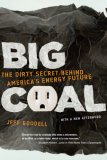
Big Coal is an intelligent, frank
look at how and why coal has maintained a prominent role in the energy
conversation. Through hard-hitting investigative reporting, historical
background, and business analysis, Goodell highlights issues all Americans
should understand about coal, why we need to care, and what needs to change.
Questions for Discussion
We hope the following questions will stimulate discussion as well as provide a
deeper understanding of
Big Coal for every reader.
- In Big Coal, Jeff Goodell discusses the economic, health, and
environmental implications of coal use. Many are invisible to the end user: we
don't typically think about how much raw fuel it takes to supply electricity to
run our computers or microwaves, or how many pollutants enter the atmosphere as
a result, or how many cases of asthma the pollutants may trigger, for instance.
Did you find Goodell's measure of coal's hidden costs alarming? Why or why not?
- In the face of the global oil crisis, coal power has gained prominence as
a supposedly cleaner, more plentiful alternative fuel. But the often-cited
estimate that the United States has 250 years' worth of cheap, accessible coal
available has been revealed to be a gross exaggeration. How was this
misinformation introduced into the energy dialogue, and what factors have
perpetuated it? What other inaccuracies have been uncovered? If this most basic
assumption about our energy reserves is wrong, how must we revise our plans for
energy use in the future?
- Goodell cites some staggering statistics: coal-fired power plants in the
United States are responsible for more than one-third of the emissions of carbon
dioxide, the main greenhouse gas, into the atmosphere each year; in just the
past twenty years, air pollution from coal plants has shortened the lives of
more than half a million Americans. Yet coal presently supplies more than half
the electricity consumed in the United States. Given the detrimental effects of
burning coal, why is this substance in such widespread use? What are some of the
alternatives to coal energy, and how do these sources compare to coal?
- Big Coal lays bare the toll that coal mining exacts on individuals and
communities. It documents the unsafe conditions and practices that persist in
the coal-mining industry even today and that have led to horrific tragedies.
Were you surprised to learn about these modern risks? Is it fair to argue that
the human cost is outweighed by the gain to society?
- Coal mining takes a harsh toll on the land as well. For example,
mountaintop-removal mining has permanently destroyed 1,200 miles of streams,
polluted groundwater and rivers, and demolished some 400,000 acres of forest in
Appalachia alone. What effect will this destruction of the land have on our
general quality of life?
- What kind of statement is made by the struggle against big business
undertaken by an individual like Maria Gunnoe? Would you do the same thing if
you were in her shoes? Why or why not?
- In America today, the coal power industry operates for the most part in
the same antiquated configuration envisioned by Samuel Insull at the dawn of the
electric age: a state-regulated utility system whereby enormous centralized
generating plants supply cheap energy for vast numbers of consumers. What were
the benefits of this plan initially, and what are its drawbacks today? Should
the infrastructure be reorganized? How? What are some of the obstacles to such a
change?
- Goodell writes, "The fact that most Americans no longer fear that
pollution from a coal-fired plant will kill them is both a sign of progress and
a dangerous illusion." Discuss this seeming contradiction.
- How has our history of coal use contributed to global warming?
- One way to lessen the environmental impact of the coal industry is to
reduce carbon emissions, either through greater efficiency in production or
through carbon capture and storage, so that less carbon enters the atmosphere.
What would be the short-term and long-term economic effects of such efforts?
- Coal-fired power plants are the largest emitters of mercury in the United
States. How does the debate over mercury toxicity exemplify the larger problems
inherent in drafting acceptable energy policy? How do the demands of American
industry influence energy policy in this country? What effect does U.S. energy
policy have on the rest of the world?
- What solutions do regulatory measures such as the Kyoto Protocol and the
Environmental Protection Agency's Clear Skies initiative offer? What obstacles
do they face?
- As Goodell points out, China has seen dramatic increases in its energy
consumption in recent years. As the single largest user of coal energy, China's
coal consumption is astounding. What cultural factors have contributed to this
rise in energy demand? How will China's coal use affect greenhouse gas emissions
in the future?
- In his afterword to the paperback edition, Goodell discusses shifts in
the political and economic landscape that may lead to new energy solutions. How
might these new efforts compel the industry to change?
- America seems to be in denial about the far-reaching effects of our
energy use, when in fact, as Goodell puts it, "we risk stirring up more
Hurricane Katrinas just so we can crank up the AC." How does one person's energy
use contribute to the problem? Alternately, how can one person's energy
conservation help alleviate the negative effects?
- Do you think Americans need to change our energy consumption habits? Is
it even possible to do so after decades of energy greed? Have you altered your
own habits since reading the book? Do you feel a need to address energy
inefficiencies in your own life by installing energy-saving appliances in your
home, for instance, or by offsetting your own carbon use?
For Further Reading
The following books may also be of interest to readers of Big Coal.
The End of Oil by Paul Roberts
Fast Food Nation by Eric Schlosser
Silent Spring by Rachel Carson
Water by Marq de Villiers
Unless otherwise stated, this discussion guide is reprinted with the permission of Mariner Books.
Any page references refer to a USA edition of the book, usually the trade paperback version, and may vary in other editions.
 Book Reviewed by: