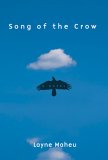
Song of the Crow by Layne Maheu: Questions, plus a reading group guide, with links to reviews, excerpt, author interview and author biography at BookBrowse.com.
Song of the Crow
by Layne Maheu
Hardcover: Jun 2006,
240 pages.
Paperback: May 2007,
244 pages.
Please be aware that this discussion guide may contain spoilers!
Do you remember the creation stories of your religious or
cultural upbringing, or from school? What are they and how do they
compare to Maheus version of things in Song of the Crow?
What other books and stories have you read or movies have you
seen that use animals as characters? To what extent do they seem
like they are anthropomorphized (given human characteristics,
behavior, and language)? What examples have you read wherein
different animals seem to be chosen to represent certain types of
people, or human behavior, such as the pigs in George Orwells
Animal Farm?
Have you read or seen books, stories, or movies that are more
like what Maheu was trying to do with crows? How successful do you
think he was in trying to be as pure as possible to what crows would
do in nature? How good a job did he do, in your opinion, in
imagining what crows might be thinking when they are doing
something, as crows? How appropriate did you think his use of crows
was in telling this particular story? What descriptive and
narrative devices did he use to develop characters for the crows to
distinguish them one from the other?
A bildungsroman is defined as a novel which traces the
spiritual, moral, psychological, or social development and growth of
the main character from (usually) childhood to maturity. How well
does this novel fit this definition, with respect to I Am? Does Maheu succeed in giving the crow all these dimensions of character?
What events or passages from the novel dramatize these qualities?
The very name I Am connotes self consciousness. In what way is I
Am conscious of himself? Is he different from the other crows in
this respect?
What role does fear play in what happens to each of the
characters bird and human in this novel?
Examine each of the human characters in this novel, as you are
able to from the story as told. How would you analyze each of them
in terms of their respective roles within the family dynamic, their
personalities, and views of the world as they know it? How would
you describe their interpersonal relationships? What is apparently
going on in the human world as Noah is building his ark? What rule
or rules do Ham and Nanniah violate on board the Ark. Why does Noah
exile them afterwards?
What kind of sense of time does this novel use? How old is
Noah? How long did it take him to build the ark? How many years
pass in the novel itself? How if at all can you calculate it? If
you had a Judeo-Christian or comparable upbringing, did that help
you understand this element of the story? If you did not, did you
have difficulty following any or all of the events of the novel and
its portrayal of the passage of time and human life span?
Discuss the fantastic elements of the novel. How many can
you identify? If you are a fan of that type of writing, what other
novels, if any, does it remind you of? What makes it different from
your favorites? If you are not a particular fan of that type of
writing, did this novel appeal to you anyway? If so, why?
Think about the ending of the novel. What emotions does it
evoke in you? How does it make you feel? What do you make of what
happens between God Crow, Raven, and I Am? When I Am tells us we
should listen to him, because he might be talking to us, what do you
think he might be saying and why should we pay attention?
Maheu says that he took a traditional myth and developed his
own themes around it. What do you think some of those themes are,
and what evidence do you find for them in the events of the novel or
the way Maheu chooses to tell his story? What do you think the
larger point or points of the novel is/are?
Recommended Reading Fools Crow by James Welch Watership Down by Richard Adams Crow and Weasel by Barry Lopez Desert Notes: Reflections in the Eye of a Raven by Barry Lopez The White Bone by Barbara Gowdy Waterland by Graham Swift Ravens in Winter by Bernd Heinrich The American Crow and the Common Raven by Lawrence Kilham Bird Brains: The Intelligence of Crows, Ravens, Magpies and Jays
by
Candace Savage Hebrew Myths, the Book of Genesis compiled by Robert Graves and Patai
Raphael Out of the Cradle, Endlessly Rocking by Walt Whitman Refusal to Mourn the Death of a Child by Fire, in London by Dylan
Thomas.
Unless otherwise stated, this discussion guide is reprinted with the permission of Unbridled Books.
Any page references refer to a USA edition of the book, usually the trade paperback version, and may vary in other editions.
Fearless, gripping, at once darkly funny and tender, spanning three continents and numerous lives, Americanah is a richly told story set in today's globalized world.
The story of an American family, middle class in middle America, ordinary in every way but one. But that exception is the beating heart of this extraordinary novel.
The most mature work yet from an incomparable storyteller, TransAtlantic is a profound meditation on identity and history in a wide world that grows somehow smaller and more wondrous with...
From the first page, I was drawn in by the lyrical writing of the author and mesmerized as the narrator, eight year old Raami, remembered the years...
read more
Trite but true, all good things must come to an end. I so wanted to keep reading the wonderful prose, the settings that let one think they are part...
read more
A magical book, an enchanted house, a cast of characters who previously lived there but remain on the walls in photographs to be talked to whenever...
read more
Kenn Nesbitt is new Children's Poet Laureate(Jun 12 2013) Kenn Nesbitt has been named the new Children's Poet Laureate: Consultant in Children's Poetry to the Poetry Foundation, which noted that the two-year position...
Full Story