return to home  
Join   |  Gift   |  Member Login   |  Library Login
BookBrowse Mobile
Follow Us: 
   Reading Guides

Arthur & George by Julian Barnes: Questions, plus a reading group guide, with links to reviews, excerpt, author interview and author biography at BookBrowse.com.

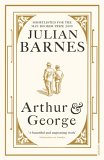
Arthur & George

Arthur & George
by Julian Barnes
Hardcover: Jan 2006,
400 pages.
Paperback: Dec 2006,
512 pages.

Publication information
Author Information
Critics' Opinion:   
Readers' Rating:  
About BookBrowse Rankings
Share: 
Buy This Book

Reading Guide Questions

 Printer Friendly Guide

Please be aware that this discussion guide may contain spoilers!

The discussion questions, topics, and suggested reading that follow are intended to enhance your group's conversation about Arthur & George, Julian Barnes's moving account of the intersection of the lives of Arthur Conan Doyle, world-famous writer of the Sherlock Holmes stories, and George Edalji, a Birmingham solicitor imprisoned for dreadfully gruesome crimes.


About This Book

Julian Barnes brings his unparalleled narrative and investigative skills to the story of two men born in Britain in the late nineteenth century. Arthur, the son of an improvident father and an intelligent, capable Scottish mother, trains as an eye doctor, but becomes instead the famous creator of Sherlock Holmes and Doctor Watson. George Edalji is the son of a Scottish mother and a Church of England vicar who was born a Parsee in Bombay. And here—in his racial difference—lies George's problem.

From his earliest school years he has been jeered at by farm boys and the local police. Highly intelligent, straitlaced and conscientious, George becomes a solicitor and writes a book about railway law of which he is very proud. But minding his own business does him no good: when a series of animal mutilations brings terror to his local village, George is the only person pursued by the police. On trumped-up evidence he is convicted and sentenced to seven years' hard labor. After three years he is released but not cleared of guilt, so he cannot resume his working life. In desperation, he writes to Arthur Conan Doyle, who brings to his aid all of the investigative know-how of Sherlock Holmes.

With Arthur & George, Julian Barnes re-creates the detailed world of the Edwardian past, and with extraordinary empathy and imagination invites readers into the relationship between two men whose paths would never have crossed but for a terrible miscarriage of justice.


Discussion Questions

  1. One of the first things we learn about George is that "For a start, he lacks imagination" (4). George is deeply attached to the facts, while early in life Arthur discovers the "essential connection between narrative and reward" (12). How does this temperamental difference determine their approaches to life? Does Barnes use Arthur and George to explore the very different attractions of truth telling and storytelling?
  2. What qualities does the Mam encourage in Arthur? How does Arthur's upbringing compare with George's? What qualities are encouraged in George by his parents? What does the novel imply about one's parents as a determinant in character development?
  3. To what degree do George's parents try to overlook or deny the social difficulties their mixed marriage has produced for themselves and their children? Are they admirable in their determination to ignore the racial prejudice to which they are subjected?
  4. Critic Peter Kemp has commented on Julian Barnes's interest in fiction that "openly colonises actuality—especially the lives of creative prodigies" (London Times, 26 June 2005). In Arthur & George, the details we read about Arthur's life are largely true. While the story of George Edalji is an obscure chapter of Doyle's life, its details as presented here are also based on the historical record. What is the effect, for the reader, when an author blurs the line between fiction and biography, or fiction and history?
  5. From early on in a life shaped by stories, Arthur has identified with tales of knights: "If life was a chivalric quest, then he had rescued the fair Touie, he had conquered the city, and been rewarded with gold. . . . What did a knight errant do when he came home to a wife and two children in South Norwood?" (60). Is it common to find characters like Arthur in our own day? How have the ideas of masculinity changed between Edwardian times and the present?
  6. George has trouble believing that he was a victim of race prejudice (235). Why is this difficult for him to believe? Is it difficult for him to imagine that others don't see him as he sees himself? Does George's misfortune seem to be juxtaposed ironically with his family's firm belief in the Christian faith?
  7. The small section on pages 79–80, called "George & Arthur" describes an unnamed man approaching a horse in a field on a cold night. What is the effect of this section, coming into the novel when it does, and named as it is?
  8. Inspector Campbell tells Captain Anson that the man who did the mutilations would be someone who was "accustomed to handling animals" (84); this assumption would clearly rule out George. Yet George is pursued as the single suspect. Campbell also notes that Sergeant Upton is neither intelligent nor competent at his job (86). What motivates Campbell as he examines George's clothing and his knife, and proceeds to have George arrested (102–7)?
  9. George's lawyer, Mr. Meek, is amused at George's sense of outrage when he reads the factual errors and outright lies in the newspapers' reports of his case (119–20; 122–23). Why is Mr. Meek not more sympathetic?
  10. George's arrest for committing "the Great Wyrley Outrages" (153) causes a sensation in England just a few years following the sensational killing spree of Jack the Ripper that sold millions of newspapers throughout England. Are the newspapers, and the public appetite for sensational stories, partly responsible for the crime against George Edalji?
  11. How does Barnes convey the feeling of the historical period of which he writes? What details and stylistic effects are noticeable?
  12. England was extremely proud of its legal system; Queen Victoria had expressed her outrage against the injustice in the trumped-up case against Alfred Dreyfus, which had occurred a few years earlier in France. Yet the Edalji case seems to present an even greater outrage against justice, and again because of the race of the accused. Why might the Home Office have refused to pay damages to Edalji?
  13. For nine years, Arthur carries on a chaste love affair with Jean Leckie. Yet he feels miserable after the death of his wife Touie, particularly when he learns from his daughter Mary that Touie assumed that Arthur would remarry (215–17). Why is Arthur thrown into "the great Grimpen Mire" by his freedom to marry Jean (220)? Why does he believe that "if Touie knew, then he was destroyed" (267)? Has he, as he fears, behaved dishonorably to both women? What does the dilemma do to his sense of personal honor?
  14. Why is the real perpetrator of the animal killings never identified? In a Sherlock Holmes story the criminal is always caught and convicted, but Doyle gets no such satisfaction with this real world case. How disturbing is the fact that Edalji is never truly vindicated and never compensated for the injustice he suffered? Does Barnes's fictional enlargement of George Edalji's life act as a kind of compensation?
  15. Arthur & George presents a world that seems less evolved than our own in its assumptions about race and human nature, and justice and evidence, as well as in its examples of human innocence and idealism. Does this world seem so remote in time as to be, in a sense, unbelievable? Or might American readers recognize a similar situation in a story like Harper Lee's To Kill a Mockingbird, or more recent news stories about racial injustice?
  16. The story ends with George's attendance at the memorial service for Arthur. What is most moving about this episode?

Suggested Reading

Andrea Barrett, The Voyage of the Narwhal; Geraldine Brooks, Year of Wonders; Joseph Conrad, Lord Jim; Arthur Conan Doyle, The Complete Sherlock Holmes and Memories and Adventures; E. M. Forster, A Passage to India; John Galsworthy, The Man of Property; Rudyard Kipling, Kim; Rohinton Mistry, Family Matters; Colm Tóibín, The Master; W. G. Sebald, Austerlitz; Daniel Stashower, Teller of Tales: The Life of Arthur Conan Doyle.

Page numbers refer to the USA hardcover edition, and may vary in other editions.


Unless otherwise stated, this discussion guide is reprinted with the permission of Jonathan Cape. Any page references refer to a USA edition of the book, usually the trade paperback version, and may vary in other editions.

Become a Member
Click Here
Editor's Choice
  •  May 18 
  •  May 16 
  •  May 15 
The Woman Upstairs
Claire Messud

The Woman Upstairs Jacket

The riveting confession of a woman awakened, transformed, and betrayed by passion and desire for a world beyond her own.
How to Create the Perfect Wife
Wendy Moore

How to Create the Perfect Wife Jacket

Stranger than fiction, blending tragedy and farce, How to Create the Perfect Wife is an engrossing tale of the radicalism, and deep contradictions, at the heart of the Enlightenment.
Happier Endings
Erica Brown

Happier Endings Jacket

A wise and affirming meditation on living fully and preparing for death, written by a highly regarded spiritual teacher.
Click Here
   Most Recent Blog Entries
Jewish Young Adult Books That Are Not About The Holocaust
Books to Give This Mother's Day
A Short History of Chechnya
rss  RSS   rss  subscribe
Recent Reader Reviews
Flight Behavior by Barbara Kingsolver
Although heavy on the scientific details, which slowed down the story for me (OK, I admit, I was one of those liberal arts majors who skipped out on... read more
The House at the End of Hope Street by Menna van Praag
Loved this book. Magical, quirky, enchanting I could go on. All books do not have to be literary fiction, sometimes it is just so comforting to read... read more
Ordinary Grace by William Kent Krueger
Can an wiser, older narrator view the past with more wisdom than he might have possessed forty years earlier in the summer he was thirteen? Ordinary... read more
RSS RSS feed More...  
Most Viewed This Week
Book Club Recommendations
The Gods of Gotham
by Lyndsay Faye
Paperback (Mar/13)
Forgotten Country
by Catherine Chung
Paperback (Mar/13)
Philida
by André Brink
Paperback (Feb/13)
Gone Girl
by Gillian Flynn
Hardback (Jun/12)
More...
First Impressions
Members read and review books often months before they're published. See what they think in First Impressions!
The Sisterhood
by Helen Bryan
Four Stars            (Apr/13)
A Dual Inheritance
by Joanna Hershon
Four Stars            (May/13)
The Laws of Gravity
by Liz Rosenberg
4.5 Stars            (May/13)
More...
  Latest BookBrowse News
U.S. ebook sales up in 2012, but rate of growth is slowing (May 16 2013)
In 2012, trade book sales (i.e. non academic book sales) rose 6.9%, to $15.049 billion, and e-book sales continued to grow, although the rate of growth... Full Story
rss RSS feed More...
 
BookBrowse Poll
Q: Do you mainly read newly published or older books?
Mainly newer books
Mainly older books
A mix of new and old books
Search: Title or Author
Free Newsletters
Bring Up the Bodies

Online Book Club
More about
Five Days
Join the discussion!


Win This Book!
The Pigeon Pie Mystery


Enter To Win Now!

wordplay
Solve this clue:
"I I M B T Give T T R"

and be entered
to win....
frame top
New Author
Interviews
Menna van Praag
Erica Brown
Helga Weiss
Kate Morton
frame bottom
HOME Book Submissions | Advertising | Library Subscriptions | Reviewing for BookBrowse | Contact Us