Reading Guide Questions

Please be aware that this discussion guide will contain spoilers!
Introduction
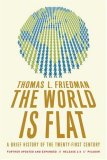
Whether in Bangalore or Beijing, Friedman asks brilliant questions of everyone
he encounters. The truth he distills from their responses brings a new
perspective to the ways in which CEOs and religious radicals, entrepreneurs and
garden-variety consumers, all create ripples that stir the geopolitical tide.
The World Is Flat shows how each of us has an undeniable stake in
globalization.
-
The first chapter in The World Is Flat recalls the
voyage of Columbus, colonization, and industrialization. Are the motivations
behind twenty-first-century globalization much different from the ones
recorded throughout history?
-
Thomas L. Friedman discusses the many occupations that can
now be outsourced or offshored, including his own job as a journalist. Could
your job be done by someone in another country? Could you do your job better
from home, as the JetBlue telephone agents do? Would you feel comfortable
knowing that your taxes had been prepared by an overseas accountant, or your
CAT scan read by an overseas radiologist? (Chapter One).
-
The second chapter outlines "Ten Forces That Flattened the
World," ranging from the fall of the Berlin Wall on November 9, 1989, to the
open-source software movement. In what way did politics influence
entrepreneurship in the 1990s? What psychological impact did November 9 have
on the world, particularly when paired with new means for global
communication?
-
What is your opinion of the open-source movement? Should
there be any limit to the amount of freedom, including "freedom" from the
demand to make a profit, in the technology marketplace? (Chapter Two).
-
What qualities enabled India to take center stage when the
looming Y2K scenario generated unprecedented demand for programmers? What
can other nations learn from India's success in this realm? What are India's
greatest vulnerabilities? (Chapter Two)
-
Discuss the ruthless efficiency demanded by supply-chaining.
In the long run, does it benefit consumers? Do you believe it enhances or
reduces production quality? (Chapter Two)
-
Were you familiar with the concept of "insourcing" prior to
reading The World Is Flat? Does it matter to you whether your
computer is repaired by an employee of Toshiba or of UPS? Should it matter?
(Chapter Two).
-
Friedman calls the tenth flattener "steroids." Are these
crucial to success, or are they luxuries? Will the globe's nonsteroidal
citizens be able to compete without them? (Chapter Two).
-
In what ways has the Triple Convergence affected your
day-to-day life? (Chapter Three).
-
Discuss the "Indiana versus India" anecdote, recounted in
the second section of Chapter Four. Which approach benefits Americans more: offshoring state projects and cutting taxpayer expenditures, or paying
higher wages to maintain job security at home?
-
Chapter Six, "The Untouchables," features the story of
Friedman's childhood friend Bill Greer. What does his story indicate about
flattening in the creative fields? Will illustrators lose out to
Illustrator? What would it take for you to become an untouchable?
-
Chapter Seven, "The Quiet Crisis," outlines three dirty
secrets regarding American dominance: fewer young Americans pursuing careers
in math and science, and the demise of both ambition and brainpower among
American youth. What accounts for this? What would it take to restore
academic rigor and the enthusiasm enjoyed during the "man on the moon" days?
-
Which of the proposals in Chapter Eight, "This Is Not a
Test," would you be able to implement?
-
In Chapter Nine's third section, "I Can Only Get It for You
Retail," Friedman offers a vivid portrait of the "neighborhoods" comprising
various parts of the globe today. How will those neighborhoods look one
hundred years from now? Will America still be a gated community, and Asia "the other side of the tracks"?
-
Friedman contemplates the cultural traits (such as
motivated, educated workers and leaders who don't squander the nation's
treasure) that drive a nation's success. He uses this to illustrate
why Mexico, despite NAFTA, has become the tortoise while China has become
the hare. Does America fit Friedman's cultural profile as a nation poised
for prosperity? (Chapter Nine).
-
Do you work for a company that is implementing any of
Friedman's coping strategies? Which of them would be the most controversial
in your industry? (Chapter Ten).
-
What do you make of the approach taken by Bill Gates's
foundation to combat disease? In your opinion, what are the roots of the
public-health crisis in the Third World? (Chapter Eleven).
-
How did the book's images of India compare to your previous
perceptions of it, from the country-club atmosphere described on the first
page to the tragedy of the untouchables? (Chapters One and Eleven).
-
Compare The World Is Flat and Longitudes and
Attitudes to Friedman's pre-9/11 books, The Lexus and the Olive Tree
and From Beirut to Jerusalem. Has the author's approach to
current affairs changed much since 9/11? Has al-Qaeda achieved any of its
political goals in the fifteen-year span represented by all four books?
-
Do you have faith in Michael Dell's theory of conflict
prevention? What can we do to ensure that the strategic optimists win? And
when they do, what dreams do you have for the world they will create?
(Chapter Twelve).
Further Reading
-
The New Economy: And What It Means for America's Future by
Roger Alcaly;
-
20:21 Vision: Twentieth-Century Lessons for the Twenty-first
Century by Bill Emmott;
-
China, Inc.: How the Rise of the Next Superpower Challenges
America and the World by Ted C. Fishman;
-
The Eagle's Shadow: Why America Fascinates and Infuriates
the World by Mark Hertsgaard;
-
The Red Carpet: Bangalore Stories by Lavanya Sankaran;
-
The Argumentative Indian: Writings on Indian History,
Culture and Identity by Amartya Sen
Unless otherwise stated, this discussion guide is reprinted with the permission of Picador.
Any page references refer to a USA edition of the book, usually the trade paperback version, and may vary in other editions.
 Book Reviewed by: