return to home  
Join   |  Gift   |  Member Login   |  Library Login
BookBrowse Mobile
Follow Us: 
   Reading Guides

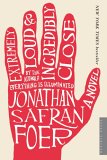
Extremely Loud and Incredibly Close by Jonathan Safran Foer: Questions, plus a reading group guide, with links to reviews, excerpt, author interview and author biography at BookBrowse.com.

Extremely Loud and Incredibly Close

Extremely Loud and Incredibly Close
by Jonathan Safran Foer
Hardcover: Apr 2005,
368 pages.
Paperback: Apr 2006,
368 pages.

Publication information
Author Information
Critics' Opinion:   
Readers' Rating:  
About BookBrowse Rankings
Share: 
Buy This Book

Reading Guide Questions

 Printer Friendly Guide

Please be aware that this discussion guide may contain spoilers!

Introduction

Meet Oskar Schell, an inventor, Francophile, tambourine player, Shakespearean actor, jeweler, pacifist, correspondent with Stephen Hawking and Ringo Starr. He is nine years old. And he is on an urgent, secret search through the five boroughs of New York. His mission is to find the lock that fits a mysterious key belonging to his father, who died in the World Trade Center on 9/11.

An inspired innocent, Oskar is alternately endearing, exasperating, and hilarious as he careens from Central Park to Coney Island to Harlem on his search. Along the way he is always dreaming up inventions to keep those he loves safe from harm. What about a birdseed shirt to let you fly away? What if you could actually hear everyone's heartbeat? His goal is hopeful, but the past speaks a loud warning in stories of those who've lost loved ones before. As Oskar roams New York City, he encounters a motley assortment of people who are all survivors in their own way. He befriends a 103-year-old war reporter, a tour guide who never leaves the Empire State Building, and lovers enraptured or scorned. Ultimately, Oskar ends his journey where it began, at his father's grave. But now he is accompanied by the silent stranger who has been renting the spare room of his grandmother's apartment. They are there to dig up his father's empty coffin.


Discussion Questions

  1. Extremely Loud and Incredibly Close was published in 2005; many reviewers thought of it as the first major 9/11 novel.  What does it mean for a book to be a "9/11 novel"?  Does our sense of what a 9/11 novel is change over time?  How do you think the reading of this book differs now than from when it was first published? Do you think it will be read differently ten or twenty or fifty years from now?
  2. Did reading the book bring back memories of 9/11 for you? Do you remember how you felt in the days and weeks that followed that event? Do you remember what scared you? What you were grateful for?
  3. Similarly, the book could be called a New York novel. In what ways is the book's sense of place integral to the story being told? In what ways is the setting universal?
  4. Nine-year-old Oskar Schell is the central figure of the book.  Did you find him believable? Compelling? Did you empathize with him? Think about Oskar's literary precedents: Salinger's Holden Caulfield or Zooey Glass; Gunter Grass's Oskar of The Tin Drum; even Foer's own character of Alex in Everything is Illuminated.  Do you feel that Foer built on the tradition of the child narrator in Extremely Loud and Incredibly Close? Did he subvert it in any way?
  5. When the book opens, Oskar is describing some of his "inventions."  What do Oskar's inventions have in common? Which of his inventions resonated the most with you?
  6. Oskar writes letters to famous people—Stephen Hawking, Ringo Starr.  Why does he write these letters?  Oskar's letters to celebrities are only a few of the letters in the book.  Who else writes letters?  Do you consider this an epistolary novel? Why or why not?
  7. On p. 99, we see an image of one of Oskar's "business cards," on which he defines himself with over a dozen titles.  On pp. 157–158, we are introduced to his neighbor's card catalog, by which Mr. Black describes everyone he's ever met using one word. Which method of defining a person is more accurate? Which is more revealing? How does Oskar change how he defines himself over the course of the book? What about the other characters' self-definitions?
  8. What is the relationship in the book between writing and memory? How do characters use writing to remember things? How does writing obscure or impair or alter (perceived?) memory? How is writing manipulated—or manipulating?  (Think about the Grandmother writing her life story, and the Grandfather reading it.) What is the relationship between writing and reality?
  9. The two central traumas in the book occur in the lives of Oskar Schell and his grandfather, Thomas Schell.  Does Foer encourage a kind of historical or moral equivalence between the two precipitating events—the attacks on 9/11 and the American bombing of Dresden?  What is the author saying about the individual's role in history?
  10. The book is full of typographical oddities, some playful, some sad.  Some of      the many photographs in the book are part of Oskar's compilation of "Stuff that Happened to Me"—yet most of the images he collects there (like images of a shark attack) didn't happen to him.  What is Oskar's relationship to this material? How did it make you feel, as the reader, to encounter these images while you read the book?
  11. Characters throughout the book conflate the physical and the emotional; many of the characters make material totems of their emotional states—from the ball of his grandmother's yarn that Oskar tugs to indicate that he is okay, to the bracelet that Oskar's grandmother's grandmother said she would measure her wrist twice for, to make sure she could wear this symbol of her love. Why do you feel the characters use physical embodiments of their feelings in this way? In Oskar's imagining of the last moments at the World Trade Center, he says, "I read that it was the paper that kept the towers burning. All of those notepads, and Xeroxes, and printed e-mails, and photographs of kids, and books, and dollar bills in wallets, and documents in files… all of them were fuel" (p.325). What is the author saying about the ways we express ourselves?
  12. The book is filled with liminal areas, borders between opposites. Many of the characters of the book seem to struggle with uniting these opposites (between Yes and No, between Something and Nothing, between Manhattan and the Sixth Borough). What is Foer saying about these efforts to unite opposites? Is it a longing to connect, to make something divided whole? Or is he advocating a rejection of the idea of opposites?
  13. Oskar's narrative is structured by his quest to find the lock that his key will open. What other purpose does the quest provide? What is the result of the quest?
  14. What is the importance of last words? Do they mean more than other words? Think about the last words you've said to someone, or they've said to you. Do they feel more meaningful than other conversations?
  15. What did you make of the novel's closing sequence, with the flip-book images? Did you find them moving? Trivializing? Helpful? Hopeful?

© 2011 Houghton Mifflin Harcourt

Discussion questions written by Erin Edmison.


Unless otherwise stated, this discussion guide is reprinted with the permission of Mariner Books. Any page references refer to a USA edition of the book, usually the trade paperback version, and may vary in other editions.

Become a Member
The Expats by Chris Pavone
Editor's Choice
  •  Jun 17 
  •  Jun 15 
  •  Jun 13 
Americanah
Chimamanda Ngozi Adichie

Americanah Jacket

Fearless, gripping, at once darkly funny and tender, spanning three continents and numerous lives, Americanah is a richly told story set in today's globalized world.
We Are All Completely Beside Ourselves
Karen Joy Fowler

We Are All Completely Beside Ourselves Jacket

The story of an American family, middle class in middle America, ordinary in every way but one. But that exception is the beating heart of this extraordinary novel.
TransAtlantic
Colum McCann

TransAtlantic Jacket

The most mature work yet from an incomparable storyteller, TransAtlantic is a profound meditation on identity and history in a wide world that grows somehow smaller and more wondrous with...
Click Here
   Most Recent Blog Entries
Top Ten Guidelines For How to Behave in a Book Club
Movies Based on Books: Summer 2013 (May - August)
Jewish Themed Young Adult Books, Not About The Holocaust
rss  RSS   rss  subscribe
Recent Reader Reviews
In the Shadow of the Banyan by Vaddey Ratner
From the first page, I was drawn in by the lyrical writing of the author and mesmerized as the narrator, eight year old Raami, remembered the years... read more
TransAtlantic by Colum McCann
Trite but true, all good things must come to an end. I so wanted to keep reading the wonderful prose, the settings that let one think they are part... read more
The House at the End of Hope Street by Menna van Praag
A magical book, an enchanted house, a cast of characters who previously lived there but remain on the walls in photographs to be talked to whenever... read more
RSS RSS feed More...  
Most Viewed This Week
1. Little Princes
Conor Grennan
2. Ava's Man
Rick Bragg
3. Half the Sky
Nicholas D. Kristof, Sheryl WuDunn
4. K Blows Top
Peter Carlson
5. The Special Prisoner
Jim Lehrer
More...
Book Club Recommendations
A Monster Calls
by Siobhan Dowd, Patrick Ness
Paperback (Mar/13)
The End of the Point
by Elizabeth Graver
Paperback (Feb/14)
Out of The Easy
by Ruta Sepetys
Paperback (Feb/14)
Maggot Moon
by Sally Gardner
Hardback (Feb/13)
More...
First Impressions
Members read and review books often months before they're published. See what they think in First Impressions!
Crime of Privilege
by Walter Walker
Four Stars            (Jun/13)
Children of the Jacaranda Tree
by Sahar Delijani
4.5 Stars            (Jun/13)
Her Last Breath
by Linda Castillo
4.5 Stars            (Jun/13)
More...
  Latest BookBrowse News
Kenn Nesbitt is new Children's Poet Laureate (Jun 12 2013)
Kenn Nesbitt has been named the new Children's Poet Laureate: Consultant in Children's Poetry to the Poetry Foundation, which noted that the two-year position... Full Story
rss RSS feed More...
 
BookBrowse Poll
Q: Which of these Summer movies based on books would you like to see? (Info on each movie here)
The Great Gatsby
Epic
Man of Steel
World War Z
The Lone Ranger
The Wolverine
R.I.P.D.
Percy Jackson
Paranoia
The Mortal Instruments
Select Any That Apply
Search: Title or Author
Free Newsletters

Online Book Club
More about
The Execution of Noa P. Singleton
Join the discussion!


Win This Book!
The Execution of Noa P. Singleton


"An intense and gripping novel of betrayal & guilt."
- Ayelet Waldman


Enter To Win Now!

wordplay
Solve this clue:
"I G I O Ear A O T O"

and be entered
to win....
frame top
New Author
Interviews
Carol Rifka Brunt
Kent Wascom
Jennifer McVeigh
Elizabeth Becker
frame bottom
HOME Book Submissions | Advertising | Library Subscriptions | Reviewing for BookBrowse | Contact Us