return to home  
Join   |  Gift   |  Member Login   |  Library Login
BookBrowse Mobile
Follow Us: 
   Reading Guides

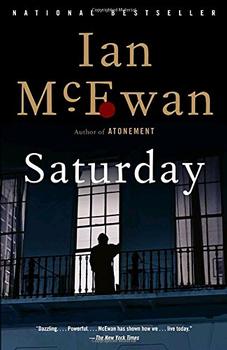
Saturday by Ian McEwan: Questions, plus a reading group guide, with links to reviews, excerpt, author interview and author biography at BookBrowse.com.

Saturday

Saturday
by Ian McEwan
Hardcover: Mar 2005,
304 pages.
Paperback: Apr 2006,
304 pages.

Publication information
Author Information
Critics' Opinion:   
Readers' Rating:  
About BookBrowse Rankings
Share: 
Buy This Book

Reading Guide Questions

 Printer Friendly Guide

Please be aware that this discussion guide may contain spoilers!

Ian McEwan's fiction never fails to make us think a little differently–about humanity, and storytelling, and the beliefs that comprise our myth and memory. In Saturday, he has created a storyline that brings to bear the full weight of these facets in the contemporary world.

With intense precision, McEwan draws us into the life of London neurosurgeon Henry Perowne. Taking place over a single day, Saturday follows Henry as he copes with everyday quandaries: insomnia, aging, the quest for a moment of leisure in the midst of so many obligations. But this particular day ripples with unexpected fears. Before the sun is up, he sees fire glowing from an airplane as it lumbers above the Thames. Newscasters deliver conflicting accounts of the incident. Later, as Henry drives to a game of squash, anti-war protestors clog the streets. And then his car scrapes against another, a fender-bender that should have had only minor consequences. Yet, as much as Henry tries to enjoy an ordinary day, this is not meant to be a day of minor consequences. With every tender encounter–stolen moments with his wife, tea with his fragile mother, marvelous discussions with his grown children–he is looking over his shoulder. As he should be. For this is the day his fears will become realized, and he will have to choose the best means of defense.

This guide is designed to enhance your reading of Saturday. We hope the following questions and topics will enrich your experience of this provocative novel. For more about this book, including an excerpt, go to www.saturday-book.com. For more information on the author, visit www.IanMcEwan.com. To explore other great titles for reading groups, visit us at www.NanATalese.com.


  1. Saturday's epigraph comes from Nobel Prize winner Saul Bellow, whose novel Herzog features an academic facing the shortcomings of his life. The novel was published in 1964; how might the history of the early Sixties have influenced Bellow's perspective? Forty years later, how does Ian McEwan's protagonist embody current events?

  2. At the end of Saturday's first paragraph, as Henry wakes too early, McEwan writes, "And he's entirely himself, he is certain of it, and he knows that sleep is behind him: to know the difference between it and waking, to know the boundaries, is the essence of sanity." To what else does Henry awaken as the novel progresses? In the book and in the world, who remains asleep (and unaware of their slumber)?

  3. When Henry hears about the cargo plane's safe landing, McEwan observes, "Schrödinger's cat was alive after all." How does Schrödinger's thought-experiment, allowing two outcomes to co-exist during a period of uncertainty, apply to Henry's daily life? How does it express the nature of human thought during times of anxiety?

  4. Was the collision between Henry's car and Baxter's an accident? What visual cues (the type of car Henry associates with criminals, the "scarecrow" clothes that make him look like something other than a doctor) stoke the fire? What class conflicts are projected as the men argue? What determines who has more power in that situation?

  5. Discuss the irony of the novel's title. Henry intended to spend the day relaxing; does the modern world allow for any true respite from worry?

  6. In your opinion, what accounts for the bliss between Henry and his wife? When he met her, did her vulnerability (through illness) feed their attraction, or was it merely a means for them to find one another? What accounts for Henry's uneasy relationship with his father-in-law?

  7. In researching Saturday, Ian McEwan spent months observing brain surgery. What parallels exist between a writer's craft and a surgeon's? What is the effect of McEwan's decision to cast Henry in the specialty of neurosurgery (as opposed to thoracic or orthopedic surgery, for example)? How does Henry's ease with medical terminology, but discomfort with the vocabulary of literature, influence your reading experience?

  8. Jay Strauss moved to the U.K. in part because of his enthusiasm for socialized medicine. How would you describe the healthcare system presented in the novel?

  9. Do you think Jay personifies most or few Americans? Is he more competitive than Henry?

  10. As Henry watches his mother's dementia worsen, he labels the physiological reasons for her decline. Does his familiarity with science ease or aggravate the sadness of losing her?

  11. One of Henry's last errands in the novel is to listen to attend a performance by Theo's band. What does blues music, along with its American flavor, mean to Theo? Does Henry experience this art differently from the way he hears Daisy's work?

  12. Why was Baxter's invasion of Henry's house essential to this novel? In what way can this scene be explored as a metaphor for politics, war, even global economics? Why was it also necessary for Henry's security system to be proven ineffective that night?

  13. Using an anthology or website, read Matthew Arnold's nineteenth-century masterwork "Dover Beach" in its entirety. What caused it to resonate with Baxter's memories? Can you think of any contemporary poems in free verse that would have served Daisy's purpose so well?

  14. What saves Henry's family from Baxter and his cohorts: Poetry? Pregnancy? Bravery? Intelligence? Luck? Divine intervention? Baxter's illness? How would you have reacted in a similar situation?

  15. As Henry returns to the hospital that night, he realizes this is where he feels most comfortable–even more so than when he's in the world of alleged leisure. Earlier in the novel, McEwan describes how orderly Henry's mother was; Henry wishes he had just once invited her to the operating theater. Is this sense of order and belonging innate to Henry's profession, or is it something Henry has ascribed to it? In what locale do you personally feel you're at the top of your game? Is this the same locale that puts you at ease?

  16. Why is Henry willing to perform surgery on Baxter? What keeps Henry from craving the revenge Rosalind anticipated? Would you be able to drop the charges, as Henry hopes to do? How do you respond to McEwan's questions: "Is this forgiveness? . . . Or is [Henry] the one seeking forgiveness?"

  17. Can Henry's surgery on Baxter be called revenge? Is his probing of Baxter's brain a violation? Or, is Henry's magnanimous act a victory of enlightened liberalism over Baxter's primal power politics?

  18. During Henry's reunion with Daisy, they waver between words of affection and a rapid-fire ideological debate about Iraq. How would such a debate have unfolded in your household?

  19. Four generations are presented in Saturday, including Daisy's child. What does each generation bestow, or hope to bestow, upon the next? What spurred such an exceptional level of accomplishment among the members of the Perowne family?

  20. Discuss the element of storytelling itself in Saturday. Do the stories disseminated within this novel–by the broadcasters, the protesters, the lawless, the keepers of family legacy–all describe the same reality? Who or what has the power to influence what we believe? What literary devices did Ian McEwan use to evoke realism in this novel?

  21. Examining the works of Ian McEwan as a continuum, how does Saturday enrich the portrait of life he has been crafting throughout his career?


Unless otherwise stated, this discussion guide is reprinted with the permission of Anchor Books. Any page references refer to a USA edition of the book, usually the trade paperback version, and may vary in other editions.

Become a Member
Golden Boy
Editor's Choice
  •  May 23 
  •  May 21 
  •  May 20 
And the Mountains Echoed
Khaled Hosseini

And the Mountains Echoed Jacket

Khaled Hosseini has written a new novel about how we love, how we take care of one another, and how the choices we make resonate through generations
Helga's Diary
Helga Weiss

Helga's Diary Jacket

The remarkable diary of a young girl who survived the Holocaust—appearing in English for the first time.
Fever
Mary Beth Keane

Fever Jacket

A bold, mesmerizing novel about the woman known as "Typhoid Mary," the first known healthy carrier of typhoid fever in the burgeoning metropolis of early twentieth century New York.
Click Here
   Most Recent Blog Entries
Movies Based on Books: Summer 2013 (May - August)
Jewish Young Adult Books That Are Not About The Holocaust
Books to Give This Mother's Day
rss  RSS   rss  subscribe
Recent Reader Reviews
Two Lives by Vikram Seth
Two Lives is a memoir written by international best-selling author, Vikram Seth. In this interesting and engaging book, Seth writes about his great... read more
Z: A Novel of Zelda Fitzgerald by Therese Fowler
Z, the novel about the life of Zelda Sayre Fitzgerald is at points charming and; like another reviewer, I kept thinking of the movie, "Midnight... read more
Flight Behavior by Barbara Kingsolver
Although heavy on the scientific details, which slowed down the story for me (OK, I admit, I was one of those liberal arts majors who skipped out on... read more
RSS RSS feed More...  
Most Viewed This Week
1. Sold
Patricia McCormick
2. Unbroken
Laura Hillenbrand
3. And the Mountains Echoed
Khaled Hosseini
4. A Child Called It
Dave Pelzer
5. Tethered
Amy Mackinnon
More...
Book Club Recommendations
Why Be Happy When You Could Be Normal?
by Jeanette Winterson
Paperback (Mar/13)
Eleanor & Park
by Rainbow Rowell
Hardback (Feb/13)
The House Girl
by Tara Conklin
Paperback (Oct/13)
The Painted Girls
by Cathy Marie Buchanan
Hardback (Jan/13)
More...
First Impressions
Members read and review books often months before they're published. See what they think in First Impressions!
The Sisterhood
by Helen Bryan
Four Stars            (Apr/13)
Golden Boy
by Abigail Tarttelin
4.5 Stars            (May/13)
The Last Girl
by Jane Casey
Four Stars            (May/13)
The Caretaker
by A .X. Ahmad
Four Stars            (May/13)
More...
  Latest BookBrowse News
Judge rules unused Borders gift cards to be worthless (May 23 2013)
Borders owes nothing to holders of roughly $210.5 million of gift cards that had not been used by the time the bookstore chain shut down, a Manhattan federal... Full Story
rss RSS feed More...
 
BookBrowse Poll
Q: Which of these Summer movies based on books would you like to see? (Info on each movie here)
The Great Gatsby
Epic
Man of Steel
World War Z
The Lone Ranger
The Wolverine
R.I.P.D.
Percy Jackson
Paranoia
The Mortal Instruments
Select Any That Apply
Search: Title or Author
Free Newsletters
The Light Between Oceans

Online Book Club
More about
Five Days
Join the discussion!


Win This Book!
On Sal Mal Lane


"Piercingly intelligent and shatter-your-heart profound."

Enter To Win Now!

wordplay
Solve this clue:
"I Y N P O T Solution, Y P O T P"

and be entered
to win....
frame top
New Author
Interviews
Menna van Praag
Erica Brown
Helga Weiss
Kate Morton
frame bottom
HOME Book Submissions | Advertising | Library Subscriptions | Reviewing for BookBrowse | Contact Us