Book Club Discussion Questions
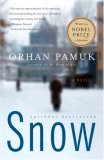
For supplemental discussion material see our Beyond the Book article, and our BookBrowse Review of Snow.
Please be aware that this discussion guide will contain spoilers!
ABOUT THIS BOOK
After twelve years of political exile in Germany, the Turkish poet Ka returns
to his native Istanbul for his mother’s funeral. There he is asked by a friend
at a newspaper to travel to the remote Anatolian town of Kars to report on the
municipal elections, as well as on a disturbing series of suicides by women who
have been forbidden by the secular government to wear their head scarves at
school. He arrives in Kars in the midst of a snowstorm that lasts for three
days, cutting the town off from the greater world, and is quickly drawn into an
intricate set of circumstances. He meets his beautiful friend Ipek, who has
recently separated from her husband, and quickly falls in love with her. He
witnesses an assassination, finds himself discussing the possible existence of
God with an idealistic student from the Islamic high school, is taken to a
meeting with a reputed Islamic terrorist and, after four years without writing a
single poem, is visited with a series of poems that arrive fully formed in his
mind. While the reason for the women’s suicides remains a mystery, Ka is caught
up in a theatrically staged military coup intended to punish the political
Islamists whose power is on the rise in Kars.
Balancing empathy and wit, irony and pathos,
Snow illuminates the
profound difficulties and contradictions of life in lands like Turkey, where
western-style democracy and Islamic fundamentalism are dangerously at odds.
Snow is a riveting and important work by one of contemporary fiction’s most
brilliant practitioners.
Reader's Guide
- Almost immediately after the novel opens, the narrator speaks in first
person directly to the reader and concludes his interjection of Ka’s
“biographical details” with the statement: “I don’t wish to deceive you. I’m
an old friend of Ka’s, and I begin this story knowing everything that will
happen to him during his time in Kars” [p. 5]. Later, during his report of
Ka’s conversation with Necip, the narrator says of Necip, “With a
childishness that amazed Ka, he opened his large green eyes, one of which
would be shattered in fifty-one minutes” [p. 134]. With these direct
statements of the narrator’s foreknowledge, what happens to the fictional
conventions of plot and suspense? How does learning that the narrator’s name
is Orhan, and that he’s written something called The Black Book [p.
425], affect the reader’s reception of the story?
- Ka’s mood at the beginning of the story is dreamlike and nostalgic: “As
slowly and silently as the snow in a dream, the traveler fell into a
long-desired, long-awaited reverie; cleansed by memories of innocence and
childhood, he succumbed to optimism and dared to believe himself at home in
this world” [p. 4]. Does Ka remain in this state of optimism and seeming
innocence throughout his stay in Kars? As an exile, he is moved by a sense
of returning home; does he make a mistake by believing himself at home
enough to become involved in the affairs of Kars?
- While Ka and Ipek are having coffee in the New Life Pastry Shop, they
witness the murder of the director of the Institute of Education. Discuss
the conversation between the Institute director and the young man who has
been sent to assassinate him [pp. 38–48]. What are the elements that make
the scene so effective?
- How does the author develop themes of identity and belonging throughout the narrative?
- What role does the setting play in shaping the characters' decisions and relationships?
- Discuss how the ending reframes the events of the story. Were you surprised?
Unless otherwise stated, this discussion guide is reprinted with the permission of Vintage.
Any page references refer to a USA edition of the book, usually the trade paperback version, and may vary in other editions.