Reading Guide Questions

Please be aware that this discussion guide will contain spoilers!
About This Book
In his bestselling books
Into Thin Air and
Into the Wild, Jon
Krakauer explored the extreme ambitions of men who tested themselves against
Mount Everest and the Alaskan wilderness. In
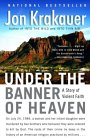
Under the Banner of Heaven,
he turns to a different kind of extremism: religious fanaticism and the violence
it spawns.
In the prologue to
Under the Banner of Heaven, Krakauer asks of the
brutal murders committed by Ron and Dan Lafferty: "How could an apparently sane,
avowedly pious man kill a blameless woman and her baby so viciously, without the
barest flicker of emotion? Whence did he derive the moral justification? What
filled him with such certitude? Any attempt to answer such questions must plumb
those sectors of the heart and head that prompt most of us to believe in God—and
compel an impassioned few, predictably, to carry that irrational belief to its
logical end" [p. XXI]. It is these questions about the specifics of Dan and Ron
Lafferty's motives and beliefs and the larger phenomena of religious faith
such as God's will and fundamentalist violence that make
Under the Banner
of Heaven so illuminating and so disturbing.
Krakauer draws a clear distinction between law-abiding mainstream Mormons and
fanatical Mormon fundamentalists. However, as he alternates between the history
of Mormonism in the nineteenth century and contemporary cases such as the
Lafferty murders and the kidnapping of Elizabeth Smart, Krakauer reveals a
religion steeped in violence almost since its inception. Murderous clashes
between Mormons and gentiles in Missouri and Illinois nearly led to civil war in
the 1840s. After Joseph Smith was killed, the Mormons were forced to settle in
the Utah Territory. At that time, Brigham Young petitioned Washington to
establish a Mormon nation so that he could unite the church's spiritual and
political ambitions and preserve the outlawed practice of polygamy. Federal
troops dissuaded Young, but the conflict at the heart of the turmoil remained:
the Mormon belief in the supremacy of God's law over the secular laws imposed
by a "corrupt" government. This faith in the divine revelation of the will of
God, which put Joseph Smith and the early Mormon church at odds with earthly
authorities, would later inspire fundamentalists like Dan and Ron Lafferty to
commit what they felt to be justified murders.
Indeed, the willingness to break secular laws in order to fulfill God's
will is the central problem
Under the Banner of Heaven explores with such
insight and thoroughness. And it is this belief that allows us to relate Mormon
fundamentalists to their Islamic counterparts around the world: the
fundamentalist's passionate, irrational, and unalterable belief in the
righteousness of his cause, even when that cause demands the most horrific
violence.
Reading Guide
- In his prologue, Jon Krakauer writes that the aim of his book is to "cast
some light on Lafferty and his ilk," which he concedes is a daunting but
useful task for what it may tell us "about the roots of brutality, perhaps,
but even more for what might be learned about the nature of faith" [p.
XXIII]. What does the book reveal about fanatics such as Ron and Dan
Lafferty? What does it reveal about brutality and faith and the connections
between them?
- Why does Krakauer move back and forth between Mormon history and
contemporary events? What are the connections between the beliefs and
practices of Joseph Smith and his followers in the nineteenth century and
the behavior of people like Dan and Ron Lafferty, Brian David Mitchell, and
others in the twentieth?
- Prosecutor David Leavitt argued that "People in the state of Utah simply
do not understand, and have not understood for fifty years, the devastating
effect that the practice of polygamy has on young girls in our society" [p.
24]. How does polygamy affect young girls? Is it, as Leavitt claims,
pedophilia plain and simple?
- Joseph Smith claimed that the doctrine of polygamy was divinely inspired.
What earthly reasons might also explain Smith's attraction to having
plural wives?
- When Krakauer asks Dan Lafferty if he has considered the parallels between
himself and Osama bin Laden, Dan asserts that bin Laden is a "child of the
Devil" and that the hijackers were "following a false prophet," whereas he
is following a true prophet [p. 321]. No doubt, bin Laden would say much the
same of Lafferty. How are Dan Lafferty and Osama bin Laden alike? In what
ways are all religious fundamentalists alike?
- Krakauer asks: "if Ron Lafferty were deemed mentally ill because he obeyed
the voice of God, isn't everyone who believes in God and seeks guidance
through prayer mentally ill as well?" [p. 297] Given the nature of, and
motive for, the murders of Brenda Lafferty and her child, should Ron
Lafferty be considered mentally ill? If so, should all others who "talk to
God" or receive revelations—a central tenant of Mormonism—also be
considered mentally ill? What would the legal ramifications be of such a
shift in thought?
- Krakauer begins part III with a quote from Bertrand Russell, who asserts
that "every single bit of progress in humane feeling, every improvement in
the criminal law, every step toward the diminution of war, every step toward
better treatment of the colored races, or every mitigation of slavery, every
moral progress that there has been in the world, has been consistently
opposed by the organized churches of the world" [p. 191]. Is this a fair and
accurate statement? What historical examples support it? What improvements
in humane feeling and social justice has the Mormon church opposed?
- How are mainstream and fundamentalist Mormons likely to react to Krakauer's
book?
- Much of Under the Banner of Heaven explores the tensions between
freedom of religion and governmental authority. How should these tensions be
resolved? How can the state allow religious freedom to those who place
obedience to God's will above obedience to secular laws?
- Joseph Smith called himself "a second Mohammed," and Krakauer quotes
George Arbaugh who suggests that Mormonism's "aggressive theocratic
claims, political aspirations, and use of force, make it akin to Islam" [p.
102]. What other similarities exist between the Mormon and Islamic faiths?
- How should Joseph Smith be understood: as a delusional narcissist, a con
man, or "an authentic religious genius" [p. 55], as Harold Bloom claims?
- Krakauer suggests that much of John Wesley Powell's book, The
Exploration of the Colorado River and Its Canyons, particularly his
account of his dealings with the Shivwit Indians, should be regarded with a "healthy
dose of skepticism," and that it embellishes and omits important facts [p.
245]. Is Krakauer himself a trustworthy guide to the events he describes in Under
the Banner of Heaven? Are his writing and his judgments fair and
reasonable? What makes them so?
- What patterns emerge from looking at Mormon history? What do events like
the Mountain Meadow massacre and the violence between Mormons and gentiles
in Missouri and Illinois suggest about the nature of Mormonism? Have Mormons
been more often the perpetrators or the victims of violence?
- At the very end of the book, former Mormon fundamentalist DeLoy Bateman
says that while the Mormon fundamentalists who live within Colorado City may
be happier than those who live outside it, he believes that "some things in
life are more important than being happy. Like being free to think for
yourself" [p. 334]. Why does Krakauer end the book this way? In what ways
are Mormons not free to think for themselves? Is such freedom more important
than happiness?
Suggested Reading
Will Bagley, Blood of the Prophets: Brigham Young and the Massacre at
Mountain Meadows;
Fawn Brodie, No Man Knows My History: The Life of
Joseph Smith;
Sally Denton, American Massacre: The Tragedy at Mountain
Meadows, September, 1857;
Judith Freeman, Red Water;
Philip Jenkins, Mystics
and Messiahs: Cults and New Religions in American History;
John D. Lee, Mormonism
Unveiled: Or Life and Confession of John D. Lee and Brigham Young;
Bernard
Lewis, What Went Wrong?: The Clash Between Islam and Modernity in the Middle
East;
Dorothy Allred Solomon, Predators, Prey, and Other Kinfolk: Growing
Up in Polygamy.
Reading guide reproduced with the permission of the publisher, Anchor
Books. All rights reserved.
Unless otherwise stated, this discussion guide is reprinted with the permission of Anchor Books.
Any page references refer to a USA edition of the book, usually the trade paperback version, and may vary in other editions.