Reading Guide Questions

Please be aware that this discussion guide will contain spoilers!
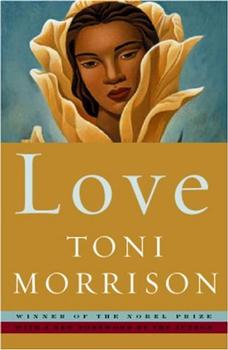
Love tells the story of Bill Cosey and the women who love him, fight over
him, make him miserable, and finally drive him to his grave. As the
novel begins, Mr. Cosey has long-since died under suspicious
circumstances, but his memory and his presence live on inspiring a deep
and lasting hatred between his granddaughter Christine and his widow
Heed. As youngsters, Christine and Heed were best friends until the day
Mr. Cosey decided he would take Heed, at the tender age of eleven, for
his wife. From that moment, bitterness and envy drove the friends apart,
and now they live together in an enmity so deep and so rancorous that it
seems only the death of one or both will free them from it. Mr. Cosey's
will—a handwritten note scrawled on a menu in 1965—is in dispute, as is
the ownership of the house Heed claims to own and in which Christine is
allowed to live. The struggle to verify or nullify that note drives the
women to new depths, and when a street-smart young woman named Junior
arrives to help Heed write a family history, Christine rightly senses a
deception, and their dispute takes on a deadly urgency.
But
Love is about much more than a disputed will and divided
affections. It is about love itself, in all its glorious and ruinous
incarnations, from compassion to lust, and it is about family, history,
race, gender, and all the ways these forces shape and often distort an
individual's life.
Love is also about what to make of a man like
Bill Cosey, a man who created a resort where black people were treated
with respect and could debate "death in the cities, murder in
Mississippi, and what they planned to do about it," a man who took
families off the plantation and gave them jobs, but also a man who
married an eleven-year-old child and then fell in love with a prostitute
named Celestial. He is a rich, complex character, hard to understand,
hard to condemn, hard to condone.
Written with the grace, insight, and power that have characterized her
work from
The Bluest Eye to
Beloved and
Paradise,
Love is a brilliant cautionary tale in the inimitable voice of
one of the world's literary masters.
Discussion Questions- Why has
Toni Morrison chosen Love as the title for her novel? In what
ways is the book about love? What kinds of love affect and afflict its
characters? What does the novel, taken as a whole, suggest about the
nature of love?
- The main narrative of Love is framed by and
interspersed with L's italicized reflections. Why does Morrison use this
framing device? How does it affect the way the book is read? Is L's
interpretation of events the most reliable one? From what vantage point
does she speak?
- L claims she needs "something better" than an "old folks' tale to
draw on. . . . Like a story that shows how brazen women can take a good
man down" [p. 10]. Is that what Love is mainly about? Is Cosey
brought down by brazen women? Why would L think so?
- Throughout the novel, Romen struggles to find his real self. When
he refuses to join his friends in gang-raping a woman at a party, he
does not understand at first why his heart bursts for "a wounded
creature" and wonders, "What made him do it? Or rather, who? . . . But
he knew who it was. It was the real Romen who had sabotaged the newly
chiseled one" [p. 49]. Where else in the novel is Romen torn between
lust and compassion? Which finally wins out in him?
- L says that Mr. Cosey in the way he ran his hotel
"wanted a
playground for folk who felt the way he did, who studied ways to
contradict history" [p. 103]. How does Mr. Cosey "contradict history"?
What history, specifically, does he contradict? What makes his hotel so
attractive to blacks in the 1930s, 40s, and 50s? Why does his hotel
ultimately fail?
- Junior tells Heed that she'd "swallow lye before I'd live with my
folks." Heed recognizes the feeling, "We're both out here, alone. With
fire ants for family" [p. 127]. Why is family, in the novel, so often a
source of misery?
- When the Administrator at the Correctional institute pressures
Junior for a sexual favor, she pushes him off the balcony. What are the
short-and long-term consequences of this act for Junior? Why is she
treated like a criminal for protecting herself?
- How does the burgeoning civil rights movement affect the
characters in the novel? What role does it play in May's madness and in
the decline of Mr. Cosey's hotel?
- Sandler thinks to himself that everyone forgave Cosey everything.
"Even to the point of blaming a child for a grown man's interest in her.
What was she supposed to do? Run away? Where? Was there someplace Cosey
or Wilbur Johnson couldn't reach"? [p. 147]. In what ways are Heed and
the other women in the novel trapped not only by racism but by the power
men wield over them? Which seems to be the more oppressive force?
- What destroys the friendship between Heed and Christine and turns
them into the bitterest of enemies? What enables them to reconcile at
the end of the novel?
- Why is Mr. Cosey so drawn to the prostitute Celestial? Why would
he want to leave everything to her?
- In the novel's climactic scene, Christine tells Heed,
"It's like
we started out being sold, got free of it, then sold ourselves to the
highest bidder." Heed responds, "Who you mean 'we'? Black people? Women?
You mean me and you?" [p. 185]. Who does she mean? Is it true that
blacks, or women, or Christine and Heed, have been sold and then freed,
only to resell themselves?
- Near the end of the novel, L says of Cosey, "You could call him a
good bad man, or a bad good man. Depends on what you hold dear—the what
or the why. I tend to mix them" [p. 200]. What kind of man is Cosey
finally? What are his good and bad traits? Has he brought more happiness
or suffering into the world? How disturbing is it that he marries an
eleven-year-old girl?
- What does Love, as a whole, suggest about the relationship
between history, family, race, and gender? How are the individuals in
the novel affected by these larger forces? What does the novel reveal
about the particular historical moment in which it is set?
Recommended Reading
James
Baldwin, Go Tell It On the Mountain; Ralph Ellison, Invisible
Man; Jonathan Franzen, The Corrections; Robert Morgan, Gap
Creek; Zadie Smith, White Teeth; Zora Neale Hurston, Their Eyes Were Watching God; Alice Walker,
The Color Purple;
Richard Wright, Black Boy.
Unless otherwise stated, this discussion guide is reprinted with the permission of Hyperion.
Any page references refer to a USA edition of the book, usually the trade paperback version, and may vary in other editions.